
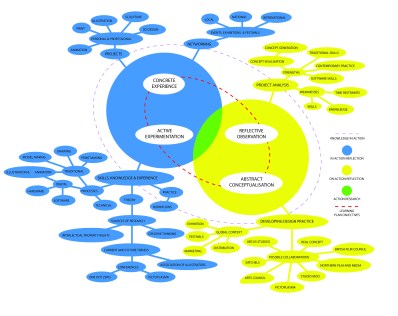
As a class, we were asked to produce a reflective cycle based on ourselves and our working process, to the right is an example we were given which was created by my tutor David Hails. I have created my own as you will see when you scroll down, and I’m going to try to explain it in a way that would make sense, but the particular wording still confuses me so bear with me.
Following the example, to make it my own, I imagined the circles as two eggs so wanted to try convert the diagram into that imagery. So in my piece, in place of the two circles, I have made eggs (I tried to differentiate the two slightly, one yolk being pink and the other being more red) and coloured the centre where the two overlap as that indicates to a specific section within the diagram. The pan that holds them is significant of the outer circle, then the inner circle that connects the eggs is formed from pepper and salt.
Starting with the red egg, it represents ‘on action-reflection’, which is the more research-based side of my working process. This egg includes two factors, ‘reflective observation’ which is self-reflection, assessing my strengths, weaknesses, threats and opportunities. You then move onto the next factor ‘abstract conceptualisation’ which is almost like an action plan. Looking at your weaknesses or threats based on the last factor, you make a plan of how you can improve on them, what you can do to better your process/craft.
Moving onto the pink egg, which represents ‘in action-reflection’ meaning the more practical side of the working process, it also has two factors, the one following the last being ‘active experimentation’ which I believe is the execution of the points you had made within your action plan. The last factor following that one is ‘concrete experience’ which I believe is the experience from work you create, ie what skills you’ve gained, whether its with commercial work or personal, traditional or digital etc. Your experience then follows back on to the reflective observations, reassessing your strengths and weaknesses so onwards the cycle goes.
The inner circle of this diagram otherwise shown as the salt and pepper, represents ‘learning plan objectives’ and I believe this shows how the cycle of the elements within the eggs works within a project setting, for instance, when you get a brief you may do a SWOT analysis first, noting what you want to work on, then you will create an action plan and set your targets, then you will do the practical work, achieving the goals you set, and afterwards you will have the experience from working on the project, and will be able to start all over again, giving yourself SWOT analysis of the work or project you’ve just completed.
The outer circle, or the pan, represents ‘knowledge in action’, which I believe just encapsulates all of these elements and the cycle as a whole, as it is a process which you learn to do automatically whilst working and I personally believe its how you grow as an artist, as you learn to be critical but then you learn to improve and then you gain more experience and more knowledge which will better your strengths onwards in the cycle. I believe that an artist should never stop learning or trying to improve, they can be amazing at what they do, but that shouldn’t mean that they should just stop trying out new skills or techniques or expanding their genre of work/themes as they could become more informed on certain topics, which would then allow their work to reach new audiences and so on. With this theory in mind, the reflective cycle would never stop.


Within the diagram, I have added my own information stemming from the steps within the eggs. Hopefully, with my explanation, the diagram is more understandable, as I know from an outsiders perspective it may just look like a lot of information.
Reflective Observation: In this section, I have just listed some of my current strengths, weaknesses, threats and opportunities.
As of strengths, I feel my work is very open, I don’t necessarily have a set style or colour palette and I have been told that I have quite an editorial eye, possibly within the way I layout my designs or how I have thought about the composition and set out my work within my portfolio and book. So I feel these qualities are good in terms of employability with potential agencies and clients.
My weaknesses and threats seem to link a bit as I believe my biggest threat and weakness is myself at times. I’m not a big fan of change so it often holds me back from moving onwards (on a bit of a tangent, I’ve been in education for all of my life so I’m so scared of when it comes to finishing this course because when I say I’m leaving the comforts of college, I’m really leaving the comforts, I have to find work myself, I will have to apply to agencies, I will most likely need to create more work for them, its just having that incentive to do so. I don’t want to leave college with a degree and just do nothing with it, I do want it to have had a purpose) I have linked some of the threats to my opportunities as they could prevent one another, for instance one of my opportunities is that I could go down to London and have my portfolio checked by the AOI, I however have a fear of travelling as I don’t really travel, the only times that I have is when I’ve had other people with me who were more in charge of things like travel bookings, hotel booking, how to get about etc, (I have planned a couple of trips this summer with my partner, so hopefully I may overcome these fears) I’m basically scared of becoming an adult, but I know I need to overcome that and fast, as I don’t want to be living with my mam forever. I guess I will grow and learn more with experience, so I guess I’ve just got to jump straight in head first, I just fear that I’ll lose the motivation to keep growing and I’ll find myself in an endless job I don’t enjoy.
With my opportunities, as I mentioned, visiting the AOI to get my portfolio checked would be a great opportunity as they would give me advice on what direction my portfolio should go, they could suggest me agencies or find me, clients,, so although I’d have to pay for the membership, it would definitely be worth the money in my eyes. Most of the opportunities I thought of included travelling, whether it was for illustration fairs like the one in London, London Illustration Fair, which runs in winter but applications open in summertime. If I were to apply for this, I would like to go to one of their events first just to see what I’d be getting myself into, but I believe it would be a good networking opportunity. I would also like to go to some American conventions at some point as well, not to sell but I would like to see and purchase art from some of my favourite artists firsthand, one convention in particular that I am most interested in is DesignerCon. I’m not sure if it changes destination each year, but for 2019 it is being held in Anaheim, California in November time. Again I see this being a good networking experience, but it is where I aspire to be, creating my own work and products and selling them in conventions or fairs as well as online.
Active Conceptualisation: Networking links onto the next step within the egg, my action plan, as I do plan to visit more fairs and conventions in the future, I want to get more involved in the illustration community whether it be in person or on social media. I feel artists are the most aware of the algorithms on social media, especially on Instagram, so I really respect the artists I follow supporting one another, whether its sharing their favourite artists or pieces, like some I follow, have a ‘feature Friday’ on their Instagram stories, but you can also show support by just commenting or liking a post. You could also become more involved in the community through challenges, there’s one coming up called Mermay where you would draw mermaids for the month of May, or there’s Inktober which I participated in last year, or there is #DrawThisInYourStyle challenges. I do believe the art community is very open, it’s just a case of becoming more active, posting more, communicating more and becoming apart of that community which I do aspire to do.
The rest of my points for this step relate to knowledge and growth, learning new skills, whether it is with new software like using procreate, or whether it is developing my knowledge with current programs I use. I do feel I know the basics of illustrator, but I could always learn more, who knows, maybe some of the things I do now could be a lot easier if I learnt another way to do it? I do want to gain more experience with traditional mediums though, a lot of the artists I follow use gouache or have recently started to, so I would like to try out the medium for myself. I know it is quite pricey so I have held back from purchasing it before, but I have been recently working with a gouache brush in photoshop, but I obviously don’t believe it gives you the full experience as I believe it is supposed to dry lighter and you build it up? So I would like to experiment and experience the true qualities of gouache for myself.
Active Experimentation: As I mentioned before, this group is based on the more practical side of the cycle, it is the doing part of your action plan. So, in my own process, I usually research for inspiration, whether it is from artists, social media, or blogs and companies like pictoplasma. The sources I use I feel are regularly updated so it is easier to keep on track with trends within the industry, whether its specific colour palettes, patterns, a method of working etc. I believe last year risograph was a big trend and I did see a few riso prints in Berlin for Pictoplasma. This year, I believe I was noticing a trend of the comic halftone effect coming back after the release of Spider-man: Into the Spider-verse, but have not really seen much of it since. I have still tried to incorporate it into my illustrations though, for example in the diagrams the effect has been used as shading to the egg yolks.
In my projects, especially personal ones, I do try to develop my skills, whether it’s working within new areas of illustration, for instance, more editorial as I have tried to do with my Orangutan illustration, or learning new digital techniques, or experimenting with more traditional mediums like pencil as I have done in my recent Wizard of Oz project, mixing the traditional linework and textures with digital colouring.
As I had mentioned in my action plan, I do want to become more active on social media so this would mean posting more often, whether its final pieces, initial sketches or W.I.P’S. I only tend to post finished pieces and don’t really show my audience the process so it may give unrealistic expectations, or just make it seem like there’s no human behind the account, so if I were to post more, giving updates of how a piece is developing, it may make my audience feel closer to me, more connected and possibly more relatable if they could see that I do make mistakes during the process. By building an audience it does give me a higher chance of potential customers. As I have a little following I do overthink when making or ordering products, especially when recently looking into making enamel pins, as the minimum amount to buy is 50 pieces but if you buy more it would make the selling amount per pin cheaper, but I doubt I could even sell 50, so I feel like I would end up under profit and with product still left over. I am going to try to make the pins through college using the laser cutter, but if one day I do have a bigger following, I would feel better about putting more money into my products, especially if I could make a pre-order system so that I would know all of the product would definitely sell and I’d be making money back.
Concrete Experience: Although I feel I gain more skill when working on personal projects, I definitely gain more experience when working on commercial projects. Whether its creating commission based work, working one to one with a client, working on live briefs and competitions, I enjoy these projects more as it’s not just me creating my own brief that I can be as lenient or as harsh with as possible, I’m actually working with a brief or a client, creating concepts and pieces that I would never have imagined creating. I feel with personal briefs the work is what I want to create, but with commercial projects, they open me up to new content, working with new subjects or new styles, forming work that may be new to the work already in my portfolio but could potentially show a client the areas/themes/styles I can work with. If I was left to my own devices, I would just draw women and flowers all day, whereas with my commercial projects I have been able to work with a range of themes and audiences. In this year alone I have created 3 book covers, a set of illustrations and an editorial piece based on deforestation and the loss of habitats for Orangutans, and these were all from live briefs.
Relating back to current trends, I feel I also gain experience when researching as I take in the knowledge from looking at recent artwork, whether it in a magazine like Juxtapoz or just on social media, I keep note if there are any particular trends that I can spot then I feel I start adding these to my own work, whether subliminally or not, using the comic halftone pattern as a reference again, I don’t believe I would have started incorporating it into my own work unless I had seen other artists using it and noting how they apply the pattern to their designs. Another way that research helps is with themes, especially when creating a more thought-provoking piece, as you could use social, economic or environmental themes, using current stories that are potentially affecting a lot of people or the world, themes that you feel strongly about but maybe need more information so that you can best communicate your views.
Networking is also a good method of gaining experience, whether it’s going to local events/exhibitions, or travelling further, like to Pictoplasma in Berlin or New York as an example. I feel it may be a good place to meet others with the same interests, potentially in the same position as you, so in a way, it would allow you to find new artists but also sell yourself/work to them in an indirect sense.
In this section, I had included A Canny Collective, a local exhibition which I was a guest artist for, and although I did not necessarily network much, (as I was mostly selling work) I did gain a lot of experience from doing this, making the work, setting it up, then even selling on the night. I have never sold one to one before, but I have imagined potentially having a stall one day (inspired by my Aunty who use to have a stall at different markets but now actually owns her own shop in Stanley, ‘Purple Dragon’ if you’re ever in the area) so having the experience of selling my own work, as well as others, I feel will be very useful in the future, possibly in our final show, as I believe we will be having a stall there on the night too.
List of Illustrations
Hails, D. (2012) Reflective Cycle.
All other images are my own unless stated otherwise.
Reading List
Designercon.com. (2019). DesignerCon – November 22nd-24th 2019. [online] Available at: https://www.designercon.com/ [Accessed 30 Apr. 2019].
The London Illustration Fair. (2019). Home — The London Illustration Fair. [online] Available at: http://www.thelondonillustrationfair.co.uk/home-1 [Accessed 30 Apr. 2019].
 Melon.R
One thought on “Reflective Cycle”