(End of Year Evaluation) Reflective Practice Presentation – Part 2

In part one of this post I had reflected on my performance in my reflective practice presentation, it wasn’t really the best experience, but you can click here if you would like to read more about it. In this post, I will be going through each of my slides along with the script I made, but I have added more detail as I am able to go into more depth on my blog, but in the presentation, I did have a time limit so the initial script was more brief. If you have read my previous post then you will know how well the script and time limit worked for me.

Slide1

1

For this final year I had set myself goals that I wanted to achieve.

I created two learning plans for both semesters, the reason for this is that with semester one I had more of a plan than I did with semester 2, for instance I knew which competitions I would be doing and had a better idea of when they would be released.

Starting with learning plan one. I wanted more experience and confidence with traditional mediums, as I have tended to work more digitally in the past.

Another goal was to work with more narrative based projects, creating book covers or illustrating stories, as this is an area my portfolio that was lacking, and I wanted to expand.

If you would like to read more about my learning plan for semester one, you can click here.


Slide2

2

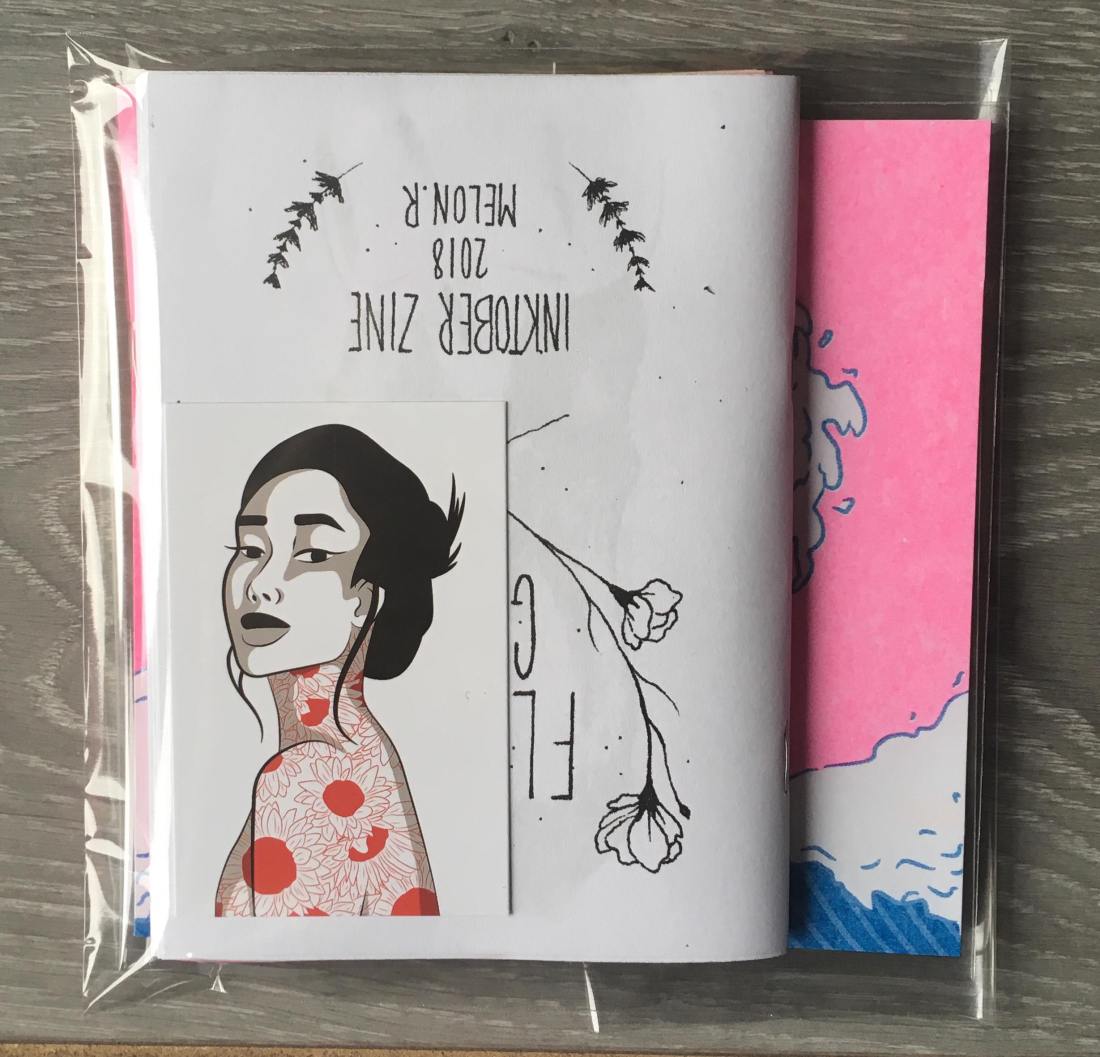
In the first project, Inktober, I had created an inked illustration every day for the month of October.

I used fine liners for the line work and then with a brush and water, I bled the ink which allowed me to create tone and shadows within my characters.

I chose to illustrate flower girls as this was imagery I was confident with, and a theme which I believed would last me the full month.

Other than viewing previous art for Inktober, there was not a lot of research needed for this project, but I had used reference images of women and flowers to help inform my designs.

By the end of this project I did feel a lot more confident with the medium. There were a few times where the ink may have bled or faces/features may have been drawn wrong, but I was able to fix these errors digitally and I was able to create a zine of the 31 illustrations which I have sold since. If you would like to purchase a zine you can have a look at my store at: www.melon-r.com/shop-1
 

Slide3

3

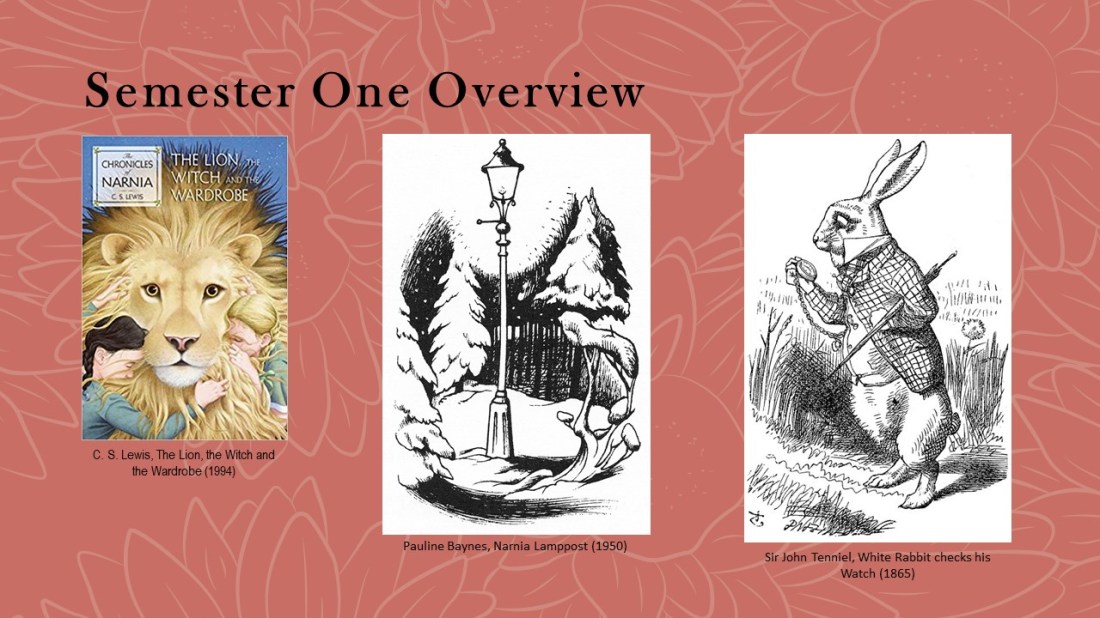
Moving onto the next project: the Lion, the Witch and the Wardrobe, I wanted to experiment with multiple printing techniques to give me more experience for potential output methods that I could use in the future. I also wanted to work with more narrative, following the goals set within my learning plan.

For research, I quoted directly from the book so that I could create accurate depictions of the story, rather than creating illustrations from the imagery I already knew. Initially, I was inspired by Sir John Tenniel and his intricate line work but had later found Pauline Baynes, who was the original illustrator of the Lion, the Witch and the Wardrobe, had worked in a similar style, but she had incorporated colour into her designs which I did not want to do with my own design so I felt my designs would still be different from illustrations already created for the story.
 

Slide4

4

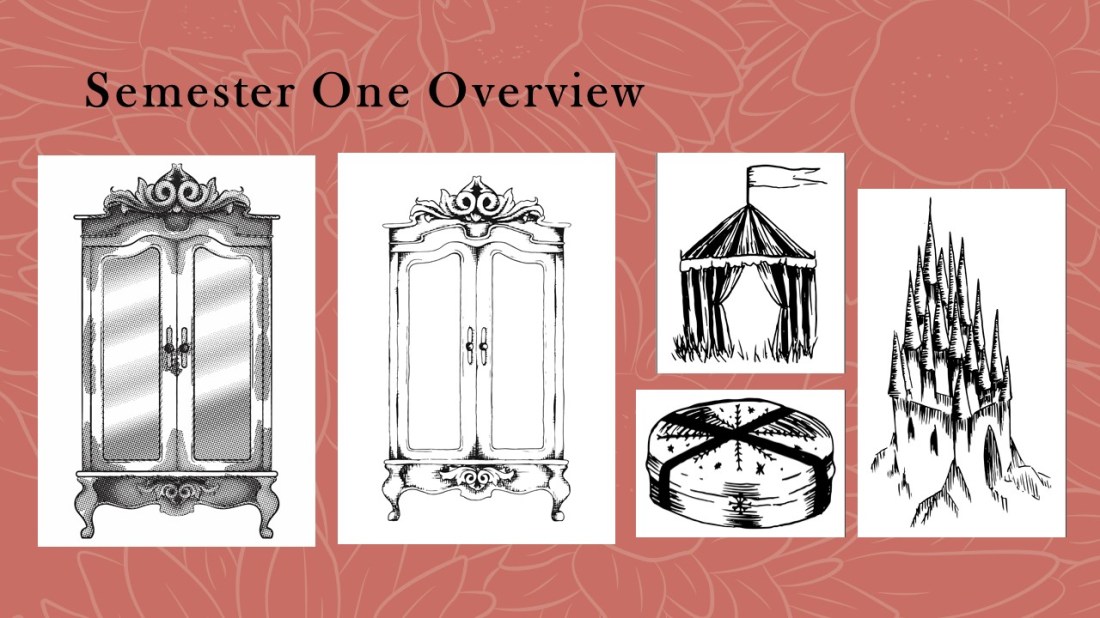
When I first started this project, I felt I had started strong, using the wardrobe imagery to test out each of the printing methods, I.e. screen-printing, etching, using a laser cut plate and lino printing.

With the inclusion of more projects, however, I do feel I lost momentum and felt like I rushed the pieces to the right in the last couple of weeks/days.

Given more time I would’ve refined the last pieces by creating them in illustrator, drawing the line work by hand then using the laser cut method to print them, as I had felt this was the best and cleanest methods from my wardrobe print tests. I believe the addition of illustrator would have made the pieces more proportional, fixing the errors within the symmetry and potentially making the linework straighter and cleaner.
 

Slide5

5

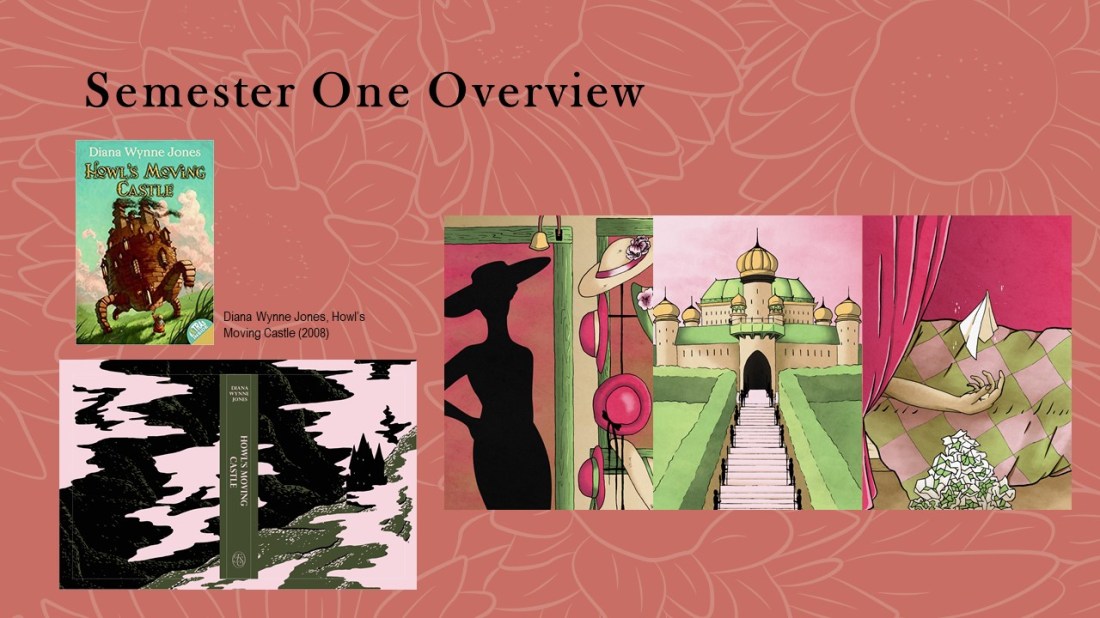
My next project was the House of Illustrations Book Illustration Competition. I had to create a set of 3 illustrations and a book cover for howls moving castle. Again this was narrative based brief, so it fit within the goals of my first learning plan. The only research that I had done for this project was just reading the book so that I again, could create an accurate depiction of the story, as opposed to working with content I may have already seen, for instance with Studio Ghibli’s adaptation of the book. (If you want to know my opinion of the original book and the movie adaptation, also listing the differences between the two, you can read about that here.)

Not researching other artists and styles may have been my downfall during this project as I did struggle when creating the pieces as I didn’t have a strong concept of the styles I wanted to use. I did, however, enjoy my choice of colour palette, as it is easy on the eyes and translates the themes of the book well, showing the magical essence without it being too being direct. The palace piece is my favourite, as I love the symmetry and perspective and it is how I had envisioned the king’s palace within the book. I have been able to translate my thoughts onto the page.
 

Slide6

6

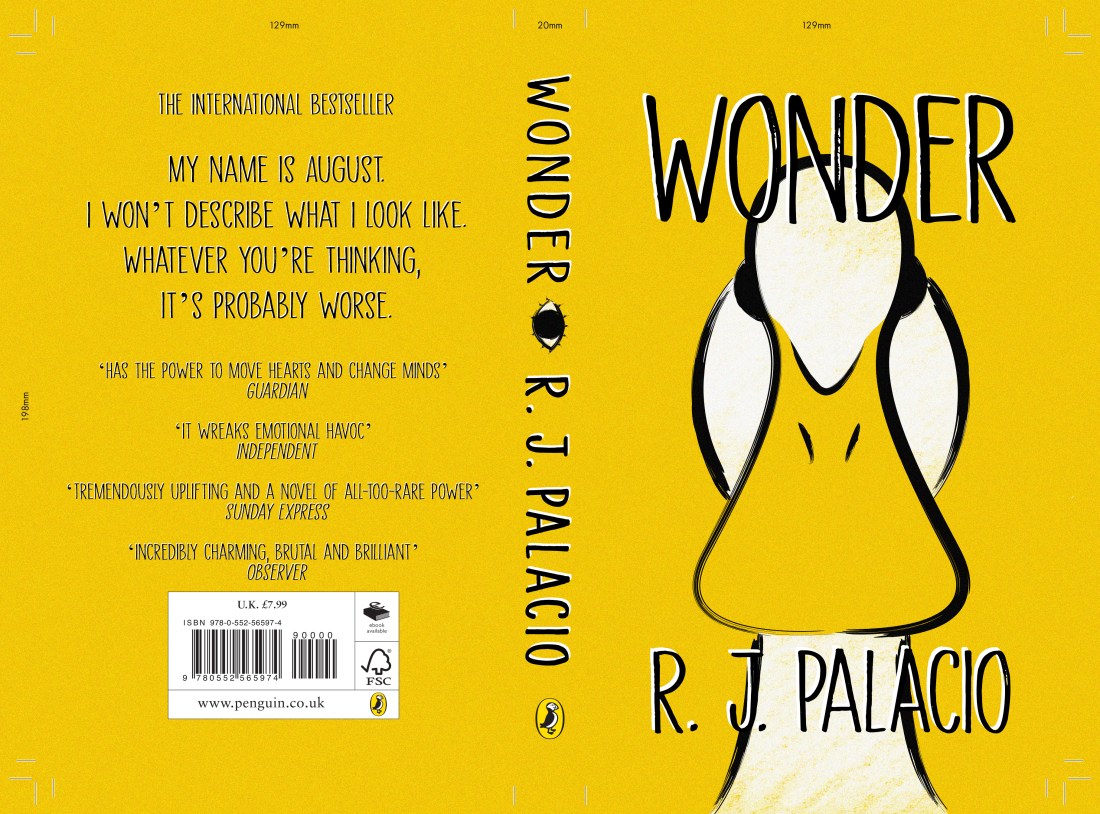
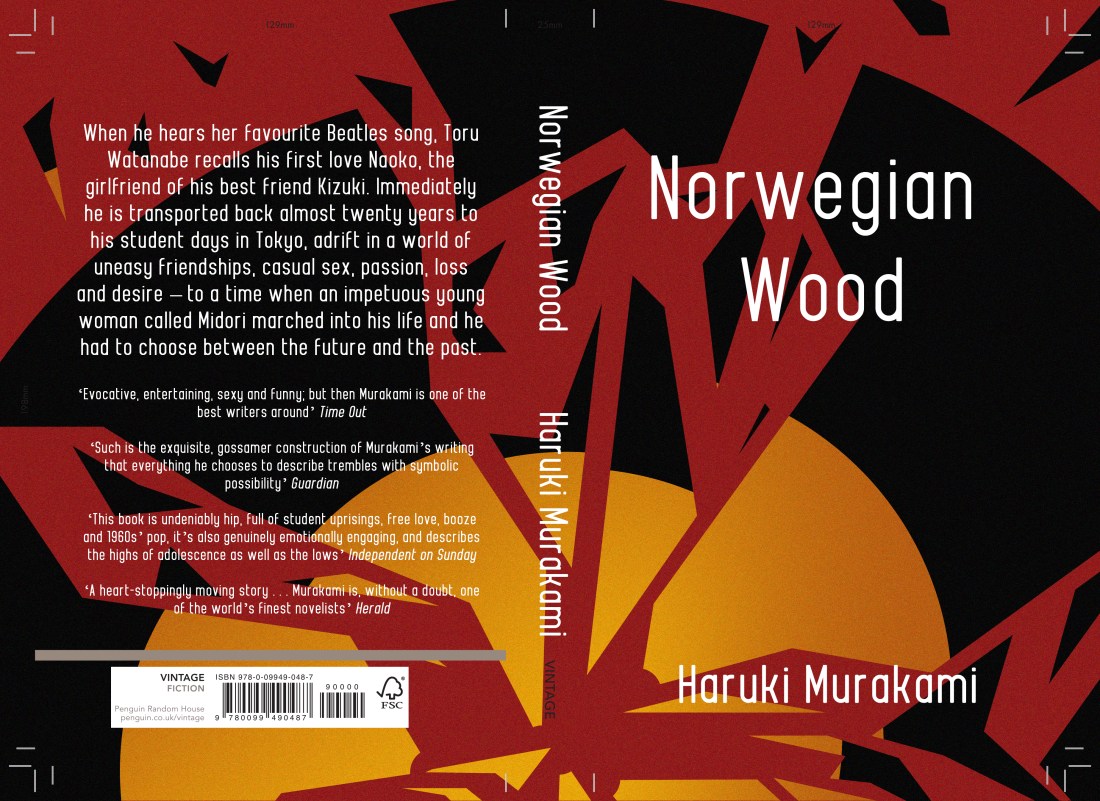
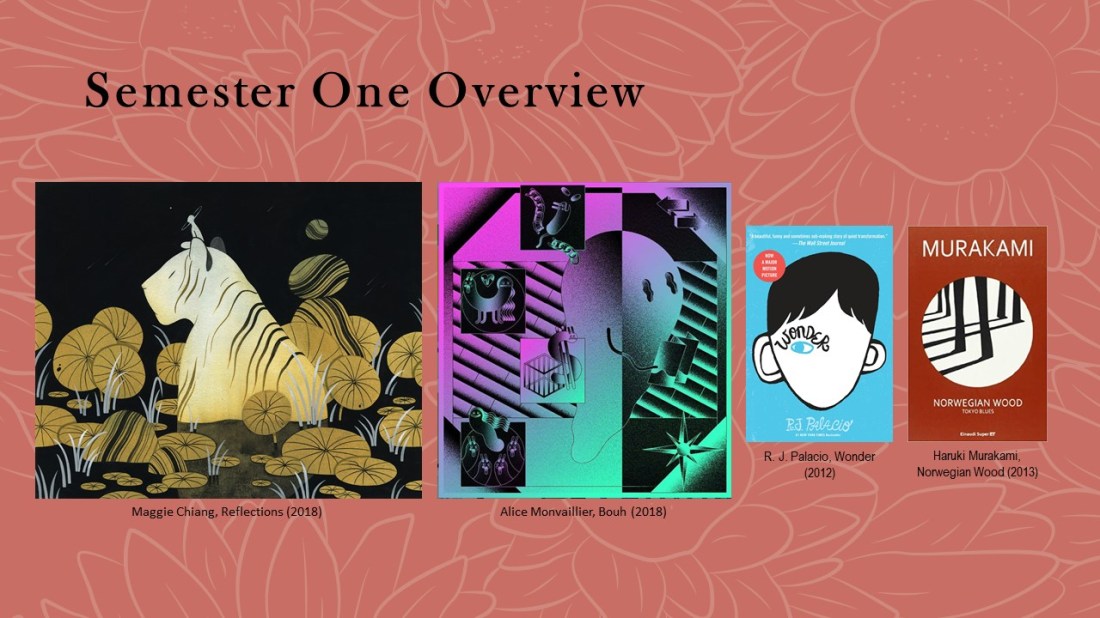
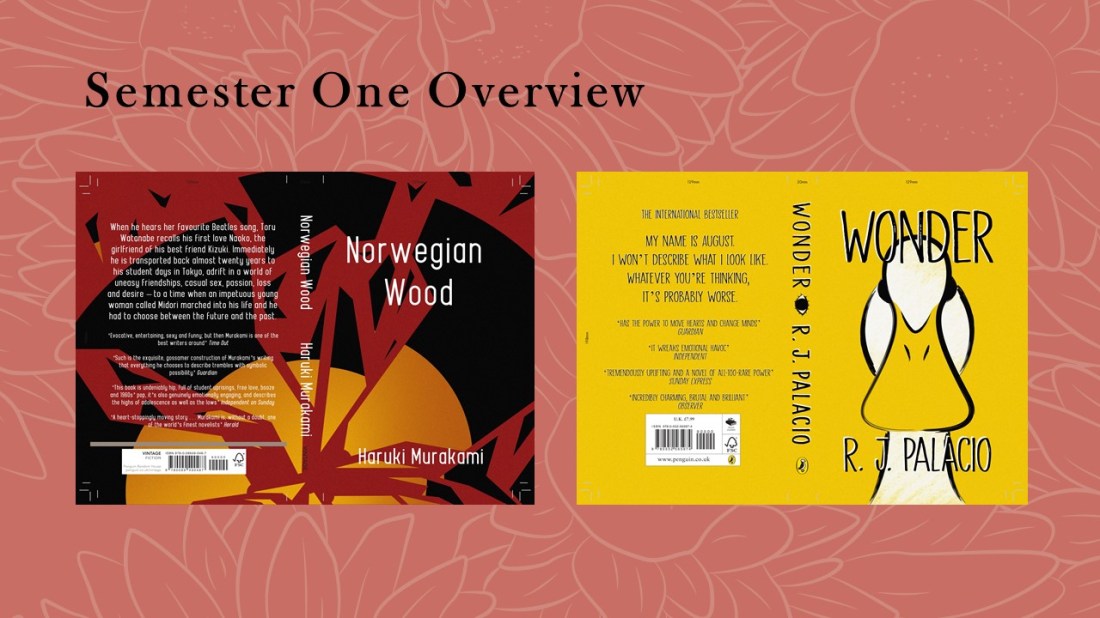
For the next project which was also a competition, this time for the Penguin Student Design Awards, I created 2 book covers for 2 separate categories; the adult’s fiction which was Norwegian Wood and the children’s book was Wonder.

For research I looked at entries from previous years, looking for common trends that I could potentially apply to my own work. I had noticed that a lot of the covers were minimal, and some had a noise effect applied, this had led me to think of artists such as Maggie Chiang and Alice Monvaillier as I believed their styles would work well among the other entries, so would be a good source of inspiration for myself during this project.

Again, I had read both of the books as research.  This allowed me to get a better understanding of the stories so that I could know the type of content I would be creating for the covers, especially considering both books have completely different themes and audiences.
 

Slide7

7

These are the two covers I created. I did complete them within a short amount of time, but I don’t feel as if they look rushed and I feel like these are a lot different from my usual style, as they are minimalistic within the colour pallets and imagery, which are styles/palettes that I have tried to dip into but have not fully achieved until these two creations.

I had struggled a lot with the text and titles, being able to make them readable against the illustrations. In the future, I will consider the type a lot further in advance so that I can work my illustrations around the text, instead of just trying to work the text around the images as I had in this project.
 

Slide8

8

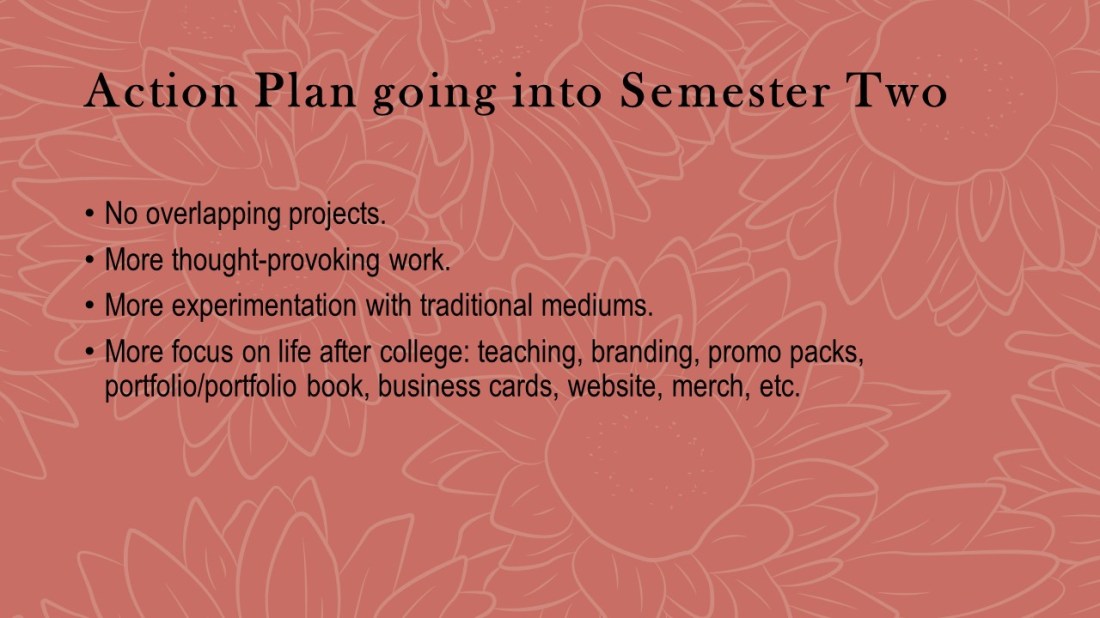
My weaknesses from the first semester were definitely to do with my time keeping and having too many projects in general which ended up overlapping, causing me confusion and stress.

From the first learning plan, I did achieve the goals I had set, working more traditionally and creating more narrative based pieces, so in the next learning plan my goal was to still try working more traditionally, this time using pencils, but I also wanted to create more thought-provoking pieces, that could potentially lean more towards the area of editorial.

I also wanted to use the last semester to focus on my branding, this would mean making a website, business cards, promo packs, merch etc. So that I had a base that I could grow from once I’ve finished the course.

From this point onwards, I vowed to not overlap any more projects, focusing on just one at a time. With the time plan I created for semester two, I was going to work more loosely with it, not having anything set in stone as at that time I still didn’t know when the competitions would be announced.
 

Slide9

9

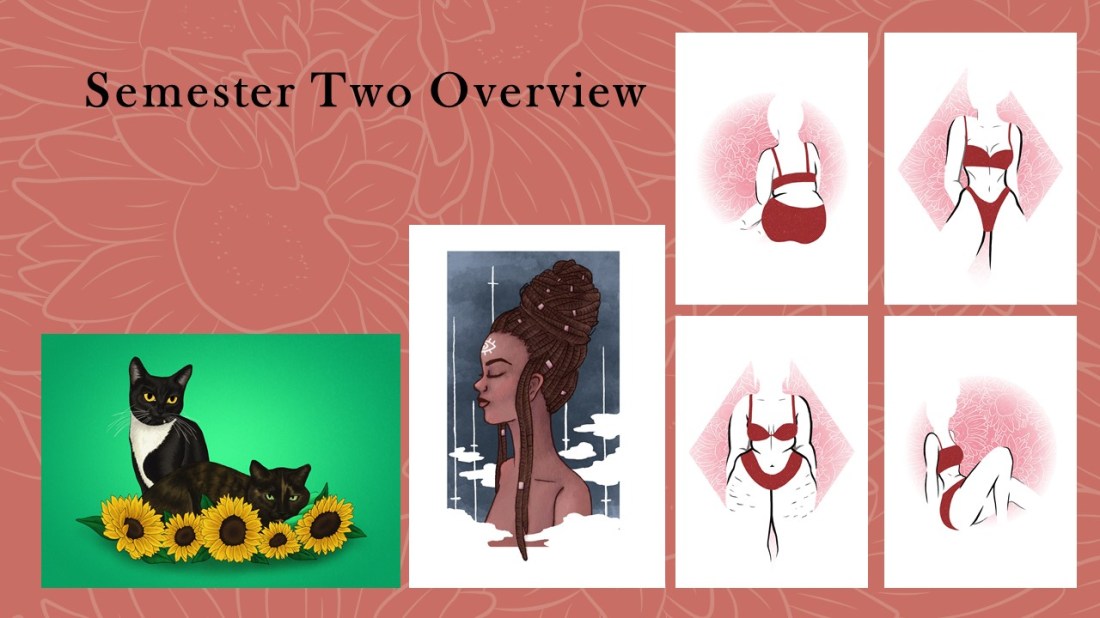
These are unplanned side projects which I ended up spending more time on than I necessarily had.

The first on the left was a commission piece for my friend.

The second was a ‘draw this in your style’ challenge in which I had to recreate an artist’s drawing in my own style, the piece here being a recreation of Chelsea Gracei’s work.

Then the final pieces on the right were a collection I created for ‘A Canny Collective’ which was a local exhibition that I was asked to be a guest artist for.

Although I had spent longer on these pieces than I should have, I do feel like I gained a lot of experience from them, especially with the exhibition pieces, as there was a whole process of creating the pieces and setting them up within the space, but I also worked on the stall on the opening night, so I was able to gain more experience of selling my own and others work one to one, which is something I do believe I will do again in the future. All of these pieces will also go towards my portfolio, hopefully allowing me to show more range of style, techniques and skill within it.
 

Slide10

10

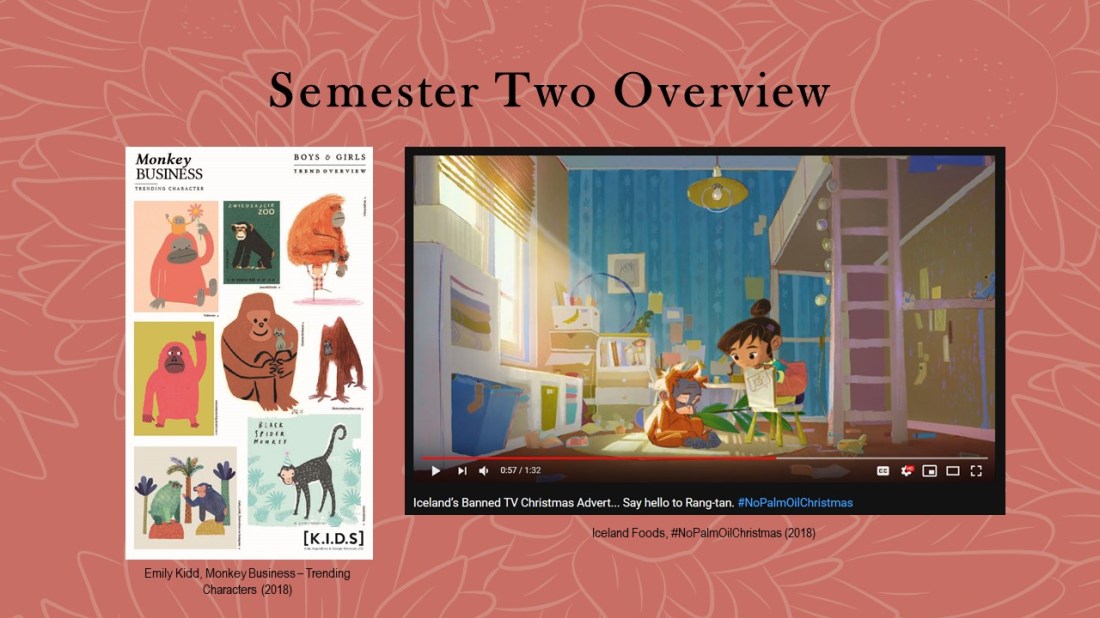
My goal with this specific project was to create a more thought-provoking illustration, which links back to the goals I set in my second learning plan.

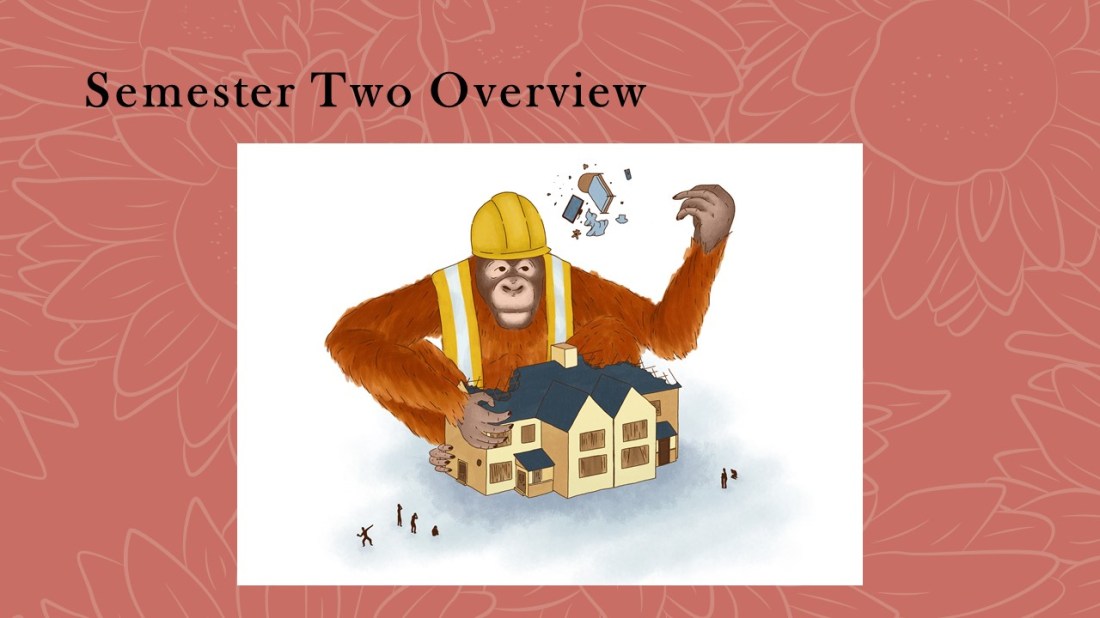
For the Northern Illustration Awards, a competition by the AOI, the brief was ‘monkey.’ When searching Pinterest for inspiration I came across the image on the left, and in the corner saw an orangutan which had been created in a looser style which helped suggest the animal’s fur. I wanted to work in a similar style to create my own monkey, but I did want to use a stronger theme. Thinking of Orangutans, it had reminded me of the banned Iceland advert, in which it discusses the destruction of rainforests (the orangutan’s habitats) for palm oil.
 

Slide11

11

Within this piece, I wanted to show a role reversal between humans and the orangutans, they being the ones that are destroying our homes with such carelessness instead.

I enjoyed working on this piece as it was more experimental and I was able to work more loosely. I was able to play around with different brushes, (in the end, I had used a gouache brush for the fur and a ‘scratchy pen’ for the linework, both from Kyle T. Webster brush packs) and these, in turn, allowed me to build up my own impression of fur, which helped give a sense of realism but the style was still loose and quite painterly for digital art.

I designed this piece to fit within a white page, so it is more minimal in that sense, but this factor could potentially make it more editorial as I could imagine it fitting within a magazine as an illustration for an article.

With this illustration, I had recorded the process and created my first ever YouTube video which was a speed paint of this piece. I do want to carry on uploading more speed paint process videos, potentially giving more information in the form of a voice-over, but one day I do want to live stream as well as/opposed to recording, as I believe I would prefer to talk live to an audience, having an active conversation as I go, rather than feeling like I am talking to myself in a voice over.


Slide12

12

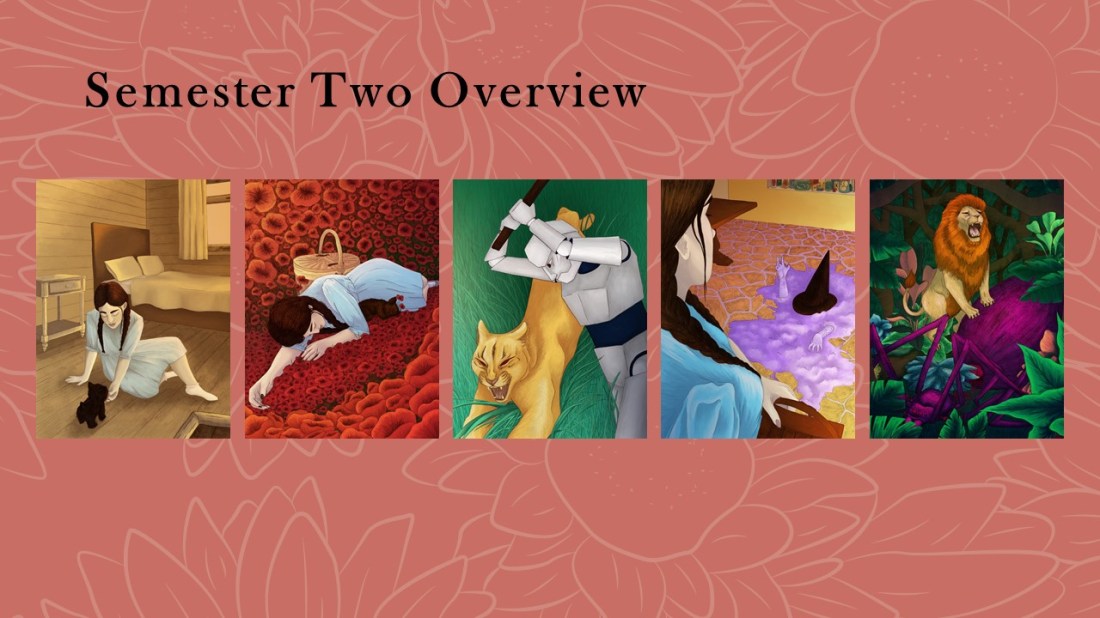
The next project was the Wizard of Oz, my goal with this project was to work more traditionally using pencil and then colouring the pieces digitally as I believed it would give me a better choice in colour palette. With this project, I did want to work with a more fun and vibrant colour palette than I may have used before, as I wanted my pieces to suit the colour themes suggested within the story, such as ‘Emerald City’ and the ‘yellow brick road’.

The idea for the mediums and techniques were initially inspired by Tina Nass, but as my project developed and I moved to a more realistic style within the project, I tended to take more inspiration from an artist named Chantal Hores as she still works with the same mediums and techniques as Tina Nass, however her style is more realistic, especially with her characters.

Again, my research had come directly from the book, finding quotes that would allow me to create an accurate depictions as possible, but in this project I did find it more useful as the movie adaptations were not completely true to the descriptions within the book, for instance, the famous ruby red slippers were actually silver in the story.
 

Slide13

13

These pieces have come a long way from the start, as I had originally sketched them out in a layout that looked flat and boring, I later repositioned and redrew the pieces using my own reference photos, as well as reference images online (more so for the animals) which allowed me to create more organic and dynamic viewpoints within my illustrations.

I’m extremely proud of the outcomes as there is a strong narrative throughout, one that I wouldn’t have thought that I would have been able to achieve at the beginning of the year. I love the colours as they are vibrant and express the themes of Oz. I did try to stay away from the known imagery when working on these pieces, and I do believe I’ve created my own unique interpretations of the story.

I loved the style of work and mediums that I had used and I hope to use them again more often in the future. If I find myself in a spot again where I feel my composition or layout of a piece is a bit boring, I will try to take my own reference images again, exploring different viewpoints and angles etc, so that I can potentially create more dynamic illustrations which are less boring and flat in the future.
 

Slide15

14

Branding has a lot of components within it, for instance I needed to create business cards, a website, a portfolio, creative CV and products and all of these would go into a promo pack which would be sent off to potential clients and or agencies.

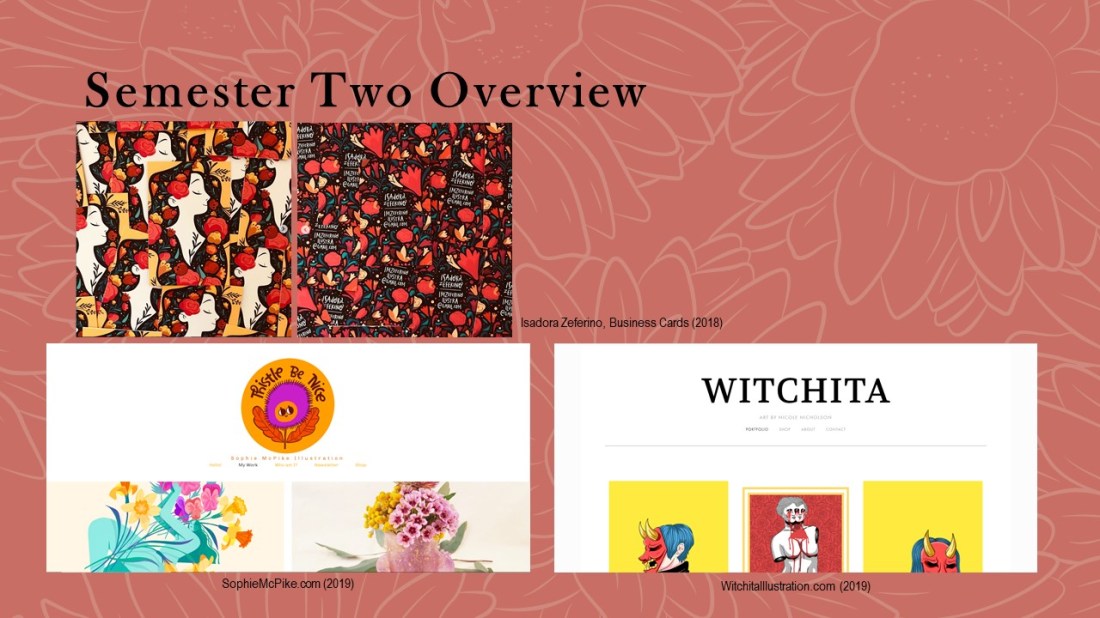
As far as research goes, I initially started the process of creating my business cards within semester one, so that they could be sent off with my zines. I was inspired by an artist named Isadora Zererino as on her cards she has an illustration on the front and her information on the back, they are also portrait, which is something that I hadn’t seen very often and this is how I wanted my own to be laid out.

When creating websites, I was researching as I was going, looking at how other artists laid their work out, what their buttons were, how they ordered them, and how they described themselves in their about pages etc. For this, I had used Sophie McPike and Nicole Nicholson’s (who is a student in my class and made her site first) websites as inspiration. I also took information from a talk we had with someone from AOI who had explained that a client will make their impression of you within the first couple of seconds of looking at your website, so it’s good to have 6-9 pieces on display on the front page.
 

Slide14

15

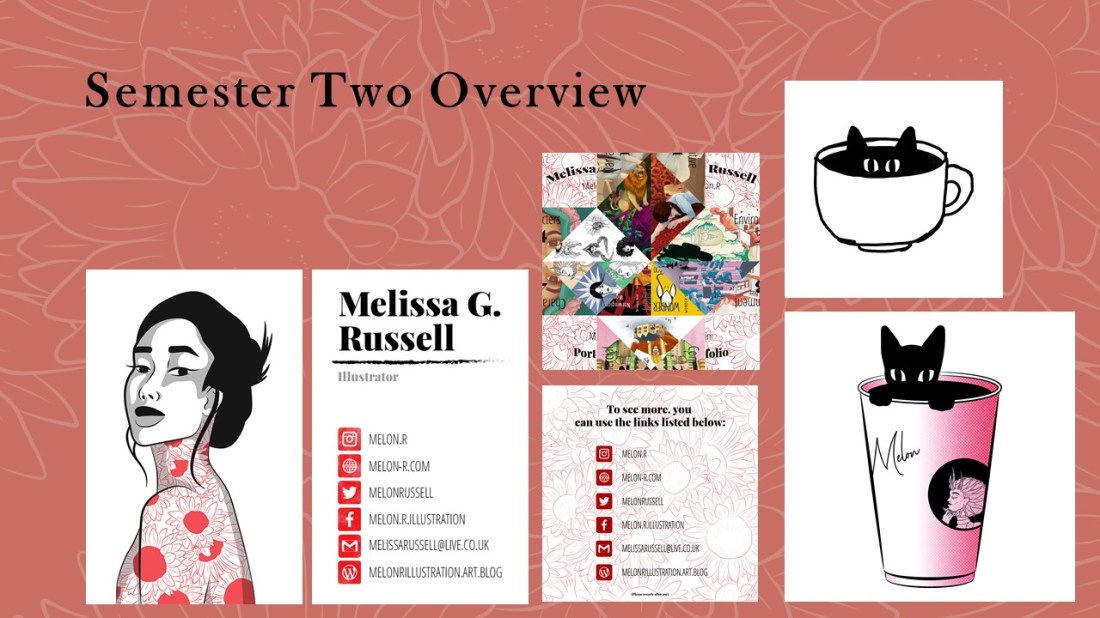
On this slide, to the left, I have shown my current business card with my website included which wasn’t present in semester one.

A mini-portfolio, which is actually a paper fortune teller. I felt this would be an interesting piece for someone to receive in my promo pack as it is a unique way for them to view mini clips of my work. On the back, I did provide links so that the receiver would be able to look at my portfolio more in depth, seeing the pieces that I have cropped down for this mini-portfolio in more detail.

The two pieces on the right side are merchandise ideas. On the top is a sketch of a potential pin. I want to create these in wood using the laser cutter in the workshop as ordering enamel pins is not in my budget or audience range at this moment in time. Maybe in the future, if I do build more of an audience, I could have a pre-order or made-to-buy system which would allow me to make a profit and would ensure that none would go to waste.

The second image on the right is going to be a sticker, potentially a little print.
 

Slide16

16

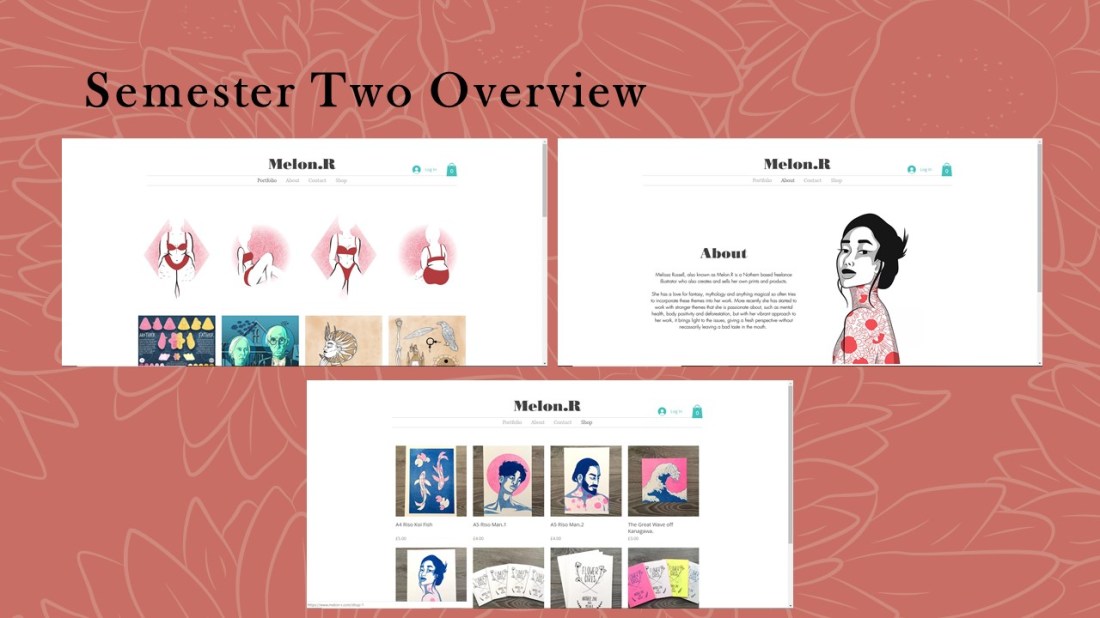
These are pages from my website. I still have work that needs to be added to the portfolio but I will want them to fit within a layout that is organised by colour or theme, which I believe will make the website more aesthetically pleasing to the eye, so I can potentially catch a client’s attention within the first couple of seconds, as the member of AOI had suggested. The website also has a shop which I do plan to work from in the future.
 

Slide17

17

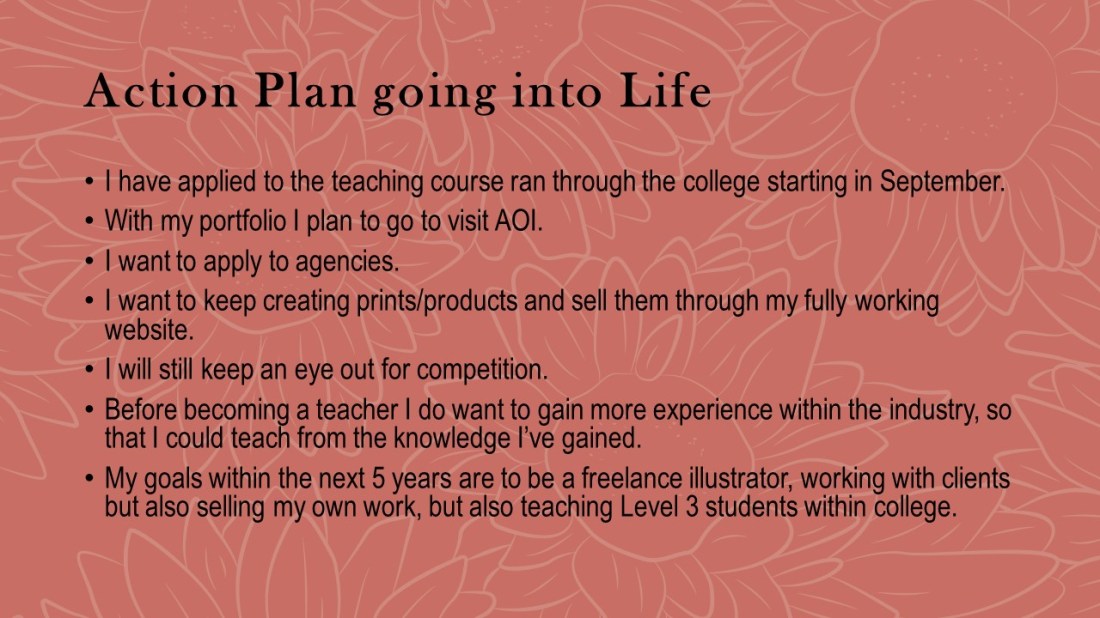
Going into the future, I have applied for a teaching course within the college that will start in September. Before teaching properly, I do wish to have more experience in the industry so that I can teach from my knowledge and experience that I may have gained.

With my portfolio, I plan to visit the AOI to get a review and more information about which direction it should go, if I need to take anything out, if I need to add anything more and so on.

I will also be applying to agencies hoping to get more freelance based work.

I will be continuing to create products and selling them through my website.

I will still try to keep an eye out for competitions.

I will also continue creating YouTube videos, ones that are more in-depth with voiceovers added. I also want to live stream more, having a more relaxed experience, potentially talking one to one with my audience as I create my work.

Overall my goal for the next 5 years is to be a freelance illustrator, working with clients and potentially have an agent. I will also be creating and selling my own work on the side, as well as hopefully teaching level 3 students within a college.
 

Slide18

18

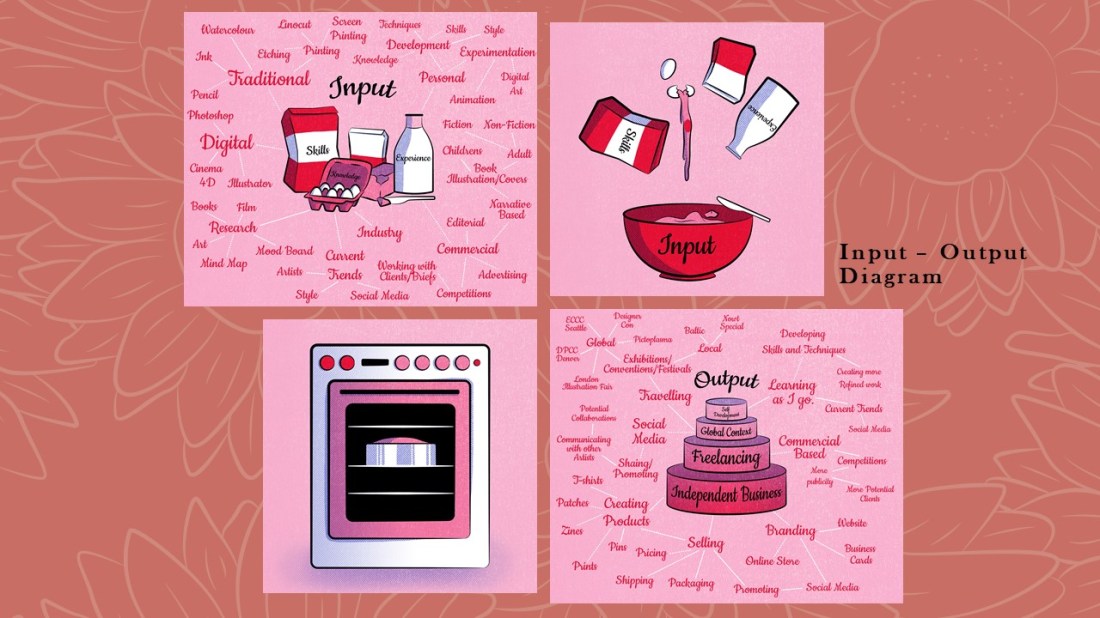
Following on with more self-reflection, I created a couple of diagrams within the space of the year that are up on my blog. This one is an input and output diagram, it describes the skills, knowledge and experience that goes into my work and what is output from it, being anything to do with business, freelance work, self-development and live briefs.

If you would like to read more about my Input-Output diagram, click here.
Slide19

19

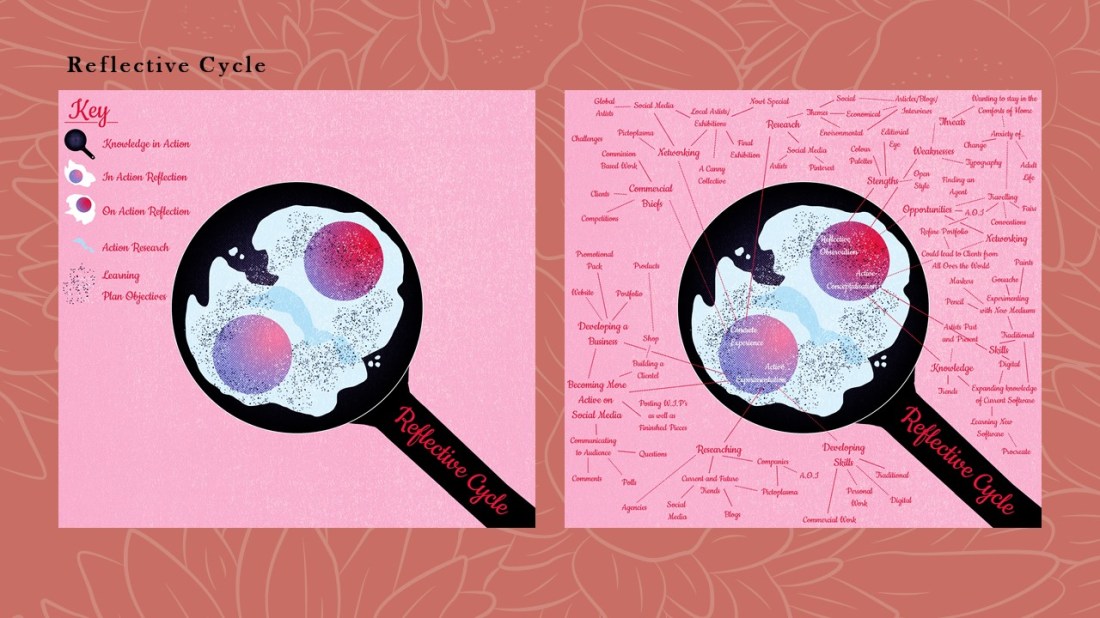
This next diagram is my reflective cycle, it shows my process of planning a project, the research that goes into it, my action plan, the actual practical work and the experience from said practical work. This then carries on and the cycle starts again.

The explanations of both of these diagrams are on my blog, as I wanted to have an easier explanation for someone who may not understand these types of reflective practices, but may want to understand my process of working, thinking etc.

If you would like to read more about my Reflective Cycle, click here.
 

Slide20

20:

This is my bibliography. Thanks for your time do you have any questions?

Although this was more directed at my presentation if you do have any questions feel free to comment and I will try to answer as best as I can!


List of Illustrations

These are all jpeg images of the slides from my Reflective Practice Presentation. Within the slides, I have cited the images that were not mine, so if an image does not have a caption, it is my own work.
Figure 1.Amazon (1994). The Lion, the Witch and the Wardrobe: C. S. Lewis. [image] Available at: https://www.amazon.com/Lion-Witch-Wardrobe-Chronicles-Narnia/dp/0064404994/ref=sr_1_1?crid=1ZYCJ0GH8FLC2&keywords=the+lion+the+witch+and+the+wardrobe&qid=1556748222&s=books&sprefix=the+lion+%2Cstripbooks-intl-ship%2C236&sr=1-1 [Accessed 1 May 2019].
Figure 2.Baynes, P. (1950). Narnia Lamppost. [image] Available at: https://www.paulinebaynes.com/?what=artifacts&image_id=532&cat=69 [Accessed 1 May 2019].
Figure 3.Tenniel, J. (1865). White Rabbit checks his Watch. [image] Available at: https://medium.com/alice-s-adventures-in-wonderland/sir-john-tenniel-s-classic-illustrations-of-alice-in-wonderland-2c3bbdca3a77 [Accessed 1 May 2019].
Figure 4.Amazon (2008). Howls Moving Castle: Diana Wynne Jones. [image] Available at: https://www.amazon.com/Howls-Moving-Castle-Diana-Wynne/dp/0061478784/ref=sr_1_1?crid=1U66801S7NAFP&keywords=howls+moving+castle&qid=1556747151&s=books&sprefix=howls%2Cstripbooks-intl-ship%2C219&sr=1-1 [Accessed 1 May 2019].
Figure 5.Chiang, M. (2018). Reflections. [image] Available at: http://www.hellomaggiec.com/2018/3vwq57poq1ezpl0a78wkarcwx3qiae [Accessed 1 May 2019].
Figure 6.Monvaillier, A. (2018). Bouh. [image] Available at: https://www.instagram.com/p/BhdoARQD1jA/ [Accessed 1 May 2019].
Figure 7.Amazon (2012). Wonder: R. J. Palacio. [image] Available at: https://www.amazon.com/Wonder-R-J-Palacio/dp/0375869026 [Accessed 1 May 2019].
Figure 8.Amazon (2013). Norwegian Wood: Haruki Murakami. [image] Available at: https://www.amazon.com/Norwegian-Wood-Tokyo-Blues-Italian/dp/8806216465/ref=sr_1_12?crid=IINWGD0DLUSW&keywords=norwegian+wood&qid=1556746704&s=books&sprefix=norwe%2Cstripbooks-intl-ship%2C259&sr=1-12 [Accessed 1 May 2019].
Figure 9.Kidd, E. (2018). Monkey Business – Trending Characters. [Blog] Emily Kiddy. Available at: http://frame.bloglovin.com/?post=6540277057&blog=3758402&group=0&frame=1&frame_type=none&avpp=true&context=&context_ids=&feed_order=&click=0&user=0 [Accessed 1 May 2019].
Figure 10.Iceland Foods (2018). Iceland’s Banned TV Christmas Advert… Say hello to Rang-tan. #NoPalmOilChristmas. Available at: https://www.youtube.com/watch?v=JdpspllWI2o [Accessed 1 May 2019].
Figure 11.Nass, T. (2017). [image] Available at: https://www.instagram.com/p/BcFQm-hHS6I/ [Accessed 2 May 2019].
Figure 12.Nass, T. (2017). [image] Available at: https://www.instagram.com/p/BcFQm-hHS6I/ [Accessed 2 May 2019].
Figure 13.Horeis, C. (2019). [image] Available at: https://www.instagram.com/p/BuG3ws5F53Y/ [Accessed 2 May 2019].
Figure 14.Horeis, C. (2019). [image] Available at: https://www.instagram.com/p/BuG3ws5F53Y/ [Accessed 2 May 2019].
Figure 15.Amazon (2015). The Wizard of Oz: L. Frank Baum. [image] Available at: https://www.amazon.co.uk/Wizard-Oz-L-Frank-Baum/dp/1604335424/ref=sr_1_14?keywords=wizard+of+oz+book&qid=1557071553&s=gateway&sr=8-14 [Accessed 2 May 2019].
Figure 16.Zeferino, I. (2019). Business Cards. [image] Available at: https://www.instagram.com/p/BqSkrJllskE/ [Accessed 2 May 2019].
Figure 17.Zeferino, I. (2019). Business Cards. [image] Available at: https://www.instagram.com/p/BqSkrJllskE/ [Accessed 2 May 2019].
Figure 18.McPike, S. (2019). Work — Thistle Be Nice. [online] Thistle Be Nice. Available at: http://www.sophiemcpike.com/mywork [Accessed 2 May 2019].
Figure 19.Nicholson, N. (2019). WITCHITA. [online] Witchita Illustration. Available at: https://witchitaillustrations.com/ [Accessed 2 May 2019].

Guest Artist at A Canny Collectives Exhibition

This was an amazing opportunity I was offered, to be a guest artist with a group named ‘A canny Collective’, who are running an exhibition showcasing their work within a gallery space, all pieces of which have the theme of Valentines, as they planned for it to run on the same week, starting on Monday the 11th.

The group themselves had planned everything out, viewed the space, cleared it out, fixed it up a bit, thought about how they were going to advertise it, made posters/flyers and stuck them up and handed them out around town and within the college, made social media pages and posts, and they just planned out everything that you could think of, that they wanted to have done for the opening night and the gallery space in general.

If you want to read more about their process or experience, you can read about it by clicking:

  • here for Katie Marshals experience
  • here for Phil Hughes
  • here for Nicole Nicholsons
  • and here for Adam Rowlinsons

In a couple of weeks running up to the exhibition, the group had gone to see the place and had tried to plan out where their own work would be set up. They had then realised how much open space they would still have, so had decided to recruit guest artists to fill the extra areas. This had meant that me and another artist called Igor Tavares, would showcase our work at the event, Igor actually live painted on the opening night so there was a next level of entertainment in a sense. 

So with the theme of Valentines, I wanted to focus on self-love in the form of body positivity. Although I feel strong in the message of body positivity, everyone having confidence within their own figures, there was an ulterior motive with these designs, as I wanted to use this project as to better my skills with anatomy, but as I had a shorter timeframe to work with, I decided to illustrate in more of a minimal style.

Using reference imagery and following a tutorial/guide from a video by an artist named Chelsea Gracei (which I had discussed in a previous post, click here to read) from my base sketch, I had formed simple lines to suggest the individual bodies, showing the curves or muscle tones of the specific character. These would then contrast well against the white silhouette of the figure, which was composed against a floral pattern in a circular or diamond shape which would best fit the specific figure.

I do like these illustrations as I feel they are strong, very feminine and I believe they are empowering as they celebrate women of all different figures. I enjoyed working on these pieces as they are more minimal than my usual work, and I feel they are strong, focusing solely on each specific body shape. I did not give these figures any facial features, as I wanted the audience to potentially relate themselves to a certain figure, whereas I believe by giving them faces they would have been less interpretable  I was proud that I was able to create these pieces within a short amount of time as this opportunity, to have my work exhibited within a local exhibition, was too good of an offer to pass up and I’m so appreciative of the group for giving me this chance.

In the future, I would like to expand on this mini project, creating even more body types, potentially drawing more men, as people of all genders, ages etc, do struggle with body positivity, so I would like to make my work all-inclusive, representing people of all different body shapes, no matter what gender, age, ethnicity, etc.

The opening night was good, I was happy to be working on the stall, selling my own work as well as the other artists. I am more of an introvert, so I enjoyed taking a backseat with all of the social interaction. It would have been a good chance to network with other people, but I had enjoyed gaining the experience of selling work one to one with the customers, as it is something I would be interested in doing again in the future, setting a stall up within a market, or even selling at a convention. By working on the stall, I was still able to interact with the people at the event, especially when they would ask if I was ‘Mel, the artist behind the figures’ (I believe they got my name from the zine catalogue that the group had made, so I was taken aback at first like ‘waiiit, HOW DO YOU KNOW MY NAME?) so I feel I did still gain some of the networking side of the experience, but maybe in a less forward sense, meaning that I was not making an effort to go out and socialise but my social interactions ended up happening more naturally.

In conclusion, I do feel I gained a lot of experience from taking part in this exhibition, whether it was working to a shorter time frame, working with themes I do feel strongly about and showing a positive light on all body shapes and sizes, printing and helping set up the space or selling one to one on the stall. I loved being a part of this exhibition and I am so grateful to the Canny Collective group for giving me this opportunity.

If you would like to follow the group, I have shown one of their posts below, but if you would like to follow the artists individually, you can click here for Katie Marshall, here for Nicole Nicholson, here for Phil Hughes and here for Adam Rowlinsons. They are amazing illustrators, so I do recommend giving them a look.


Reading List

Hughes, P. (2019). Week 22: Ready to Rumble. [Blog] Vonfrankenstank. Available at: https://philhughesillustrator.wordpress.com/2019/04/19/week-22-ready-to-rumble/ [Accessed 20 Apr. 2019].

Marshall, K. (2019). A Canny Exhibition: How it went. [Blog] Nostic Art. Available at: https://nosticart.wordpress.com/2019/02/20/a-canny-exhibition-how-it-went/ [Accessed 28 Feb. 2019].

Nicholson, N. (2019). The Team Behind A Canny Collective. [Blog] Witchita Art. Available at: https://witchitaarts.wordpress.com/2019/01/24/update-a-canny-collective/ [Accessed 28 Feb. 2019].

Rowlinson, A. (2019). Valentine’s Exhibition – Set Up. [Blog] AHROW Art. Available at: https://ahrowart.wordpress.com/2019/02/04/valentines-exhibition-set-up/ [Accessed 28 Feb. 2019].

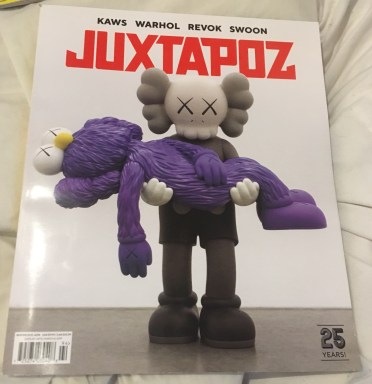
Juxtapoz – Issue 208, Winter 2019 Review

As a class, we were asked to find a copy of Hi-Fructose, an art based magazine which my tutor has recently found interest in, and review it, seeing whether it would be a potential source of information, inspiration and so on within the future. I did look for a copy within WHSmith and the Travelling Man in Newcastle but was not able to find it in either, I did look online but I had found that the shipping of the magazine would cost more than the actual piece.

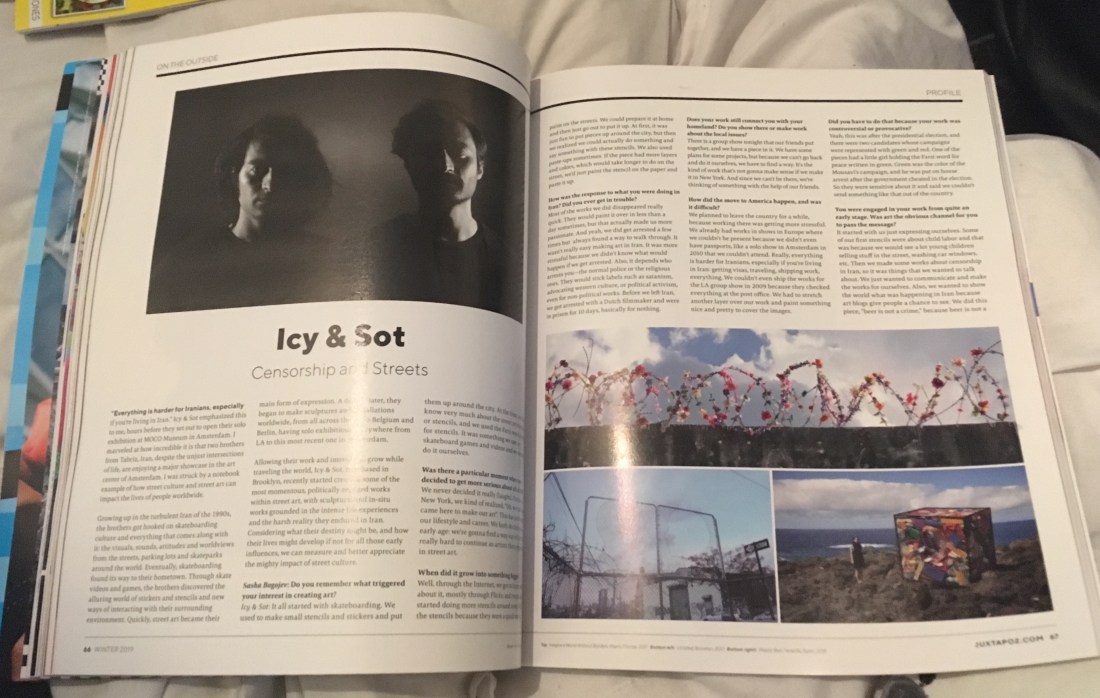
So, I thought instead of Hi-Fructose, I would go back to WHSmith and purchase the newest copy of Juxtapoz, another art based magazine which my tutor has in the past spoken highly of. I have reviewed another issue in the past, and I did not really think too highly of it, but I feel that was more based on the artists involved, as they weren’t necessarily my cup of tea, but I did find artists called Icy and Sot in an advertisement for their exhibition, and I have since followed them on social media from reading the magazine, as they would create pieces with deeper meanings, connecting to worldly issues, either with politics, the economy or the environment.

60731832_677305476037410_834042920435712000_n

So, from this good discovery, I decided to give Juxtapoz another chance, and the copy that I had picked up was, in fact, a 25 years celebratory issue and had come with a booklet called ‘Vans Vision Walks Volume #2’ which the company had made in collaboration with the brand Vans and consists of a lot of urban styled photography taken by multiple artists.

When reading through the magazine, I actually found an interview with Icy and Sot, called ‘Censorship and the Streets’ and is found in a category called ‘On the Outside’ in the contents page if you want to purchase the issue and read more about the artists for yourself.

60606636_603430260144634_5463869794094678016_n

If you would like to read my previous review of Juxtapoz: issue 202 back in 2017, click here.

So, what is the magazine?

Juxtapoz is an art based magazine which has run for 25 years now, (since 1994), and includes interviews with hundreds of artists over the year, of different backgrounds and multiple styles, some of which I shall be discussing within this blog post. The magazine also includes advertisements for many clothing companies, breweries, hairdressers and so on, but they will also include advertisements for art exhibitions, which is how I had initially discovered Icy and Sot. I do however believe all of these advertisements are American based, which makes sense because so is the company, but its a bit annoying when you would be interested in going to the exhibition but it turns out it is in Denver or Arizona or so on.

As the magazine has a variety of artwork it includes, such as street art, sculptural work, photography, paintings or illustrations, etc, the magazine can appeal to a wide audience of artists or art enthusiasts.  The magazine has the ability to inspire people, bring new artists to light, or highlight older more well-known artists with a fresh perspective. So overall, it is a way to keep up to date with current styles and trends within the industry, but in more areas than one, looking at contemporary art as a whole, as opposed to just specifically looking into illustration, street art, fine art and so on.


What does it contain?

It’s featured artists in this specific issue are Andy Warhol, one of the key icons and artists of the pop art movement within the ’60s. Kaws, whose work I have come to notice more regularly within pop culture, especially with his identifiable character, who I believe I had seen set up at a birthday party for Travis Scott, arranged by his girlfriend Kylie Jenner. There is also a featured artist named Swoon, who works with mixed media, creating huge installations, stop-motion animations and so on, and there is an artist named Jason Revok, who I believe is a street artist and I would say that he primarily works with patterns and a lot of colour. Another few notable mentions are James Jarvis, Louise Bonnet, Haroshi and Muzae Sesay.


The artists

There was not a lot of work that I had found appealed to me, or would inspire my work in the future. That is not to say that the work within the magazine was not good, some of it can be amazing to the right audience and reader, but personally, for me, it was not my cup of tea.

Mando Marie

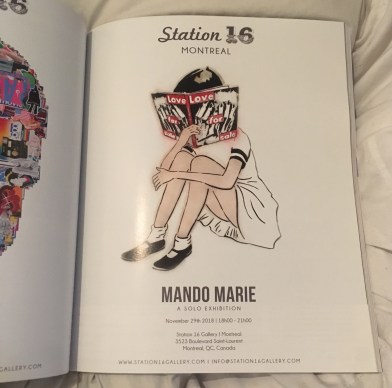
Like how I discovered the artists Icy and Sot, I had also discovered another artist through the advertised exhibitions within the Juxtapoz magazine, this one being of the work by Mando Marie.

I believe she is a street artist, working with a lot of stencils and a flat and minimal colour palette, but what had drawn me to her work was the style, as her figures have a vintage illustration style to them, possibly 50’s as they remind me of the illustrations within Enid Blyton’s book of the magic faraway tree, by Dorothy M. Wheeler.  As I had read this book when I was younger, there is a sense of familiarity with Marie’s style which I do enjoy.

60573855_305052477093879_2781199265001635840_n

I do like the simplicity of the designs and do wish that I was able to see the work first hand, as I do believe I would make the effort to go if it were more local, but as it was in Canada, I do think the travel would be a little of a stretch. If I were to take inspiration from this artist, it would be within her technique, as I would like to create larger scaled work someday, ones that I have not worked on digitally, so I believe using stencils would be the way forward, but I would need to gain more experience with spray paint, as I have not used the medium before and would like to create clean designs.

If you would like to see more from this artist, her Instagram is @seeyouthroughit (as shown below) and she also has a Tumblr site at www.seeyouthroughit.com.

View this post on Instagram

@station16gallery #seeyouthroughit #mandomarie

A post shared by Mando Marie (@seeyouthroughit) on

Swoon

Swoon is one of the featured artists within the magazine, and she is described to be a therapeutic artist, referring to her work “as a balm” (Farr, 2019) as to heal the audience or recipients of her art.

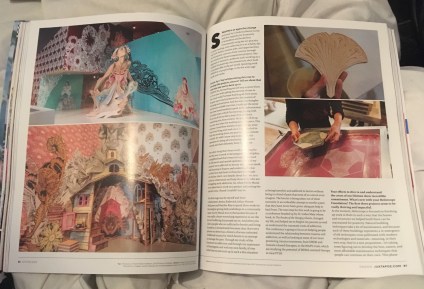
She is a mixed media artist, working with materials from paper to large scale linoleum block printing, with room installations to street art. What had drawn me to her work was the piece called ‘The Canyon’ which was a huge room installation piece of a woman which seemed to be rising out of the ground through waves, and her dress seemed to be made from the imagery of sea creatures. There is a sense of collage to her work and I enjoy how the character is in greyscale, almost having a hand-drawn effect to her, but how the flat pastel colours of the fluid elements or animals included compliment the grey tones and make the design look very soft and appealing to the eye. I also feel the colour palettes make her work more feminine, but the papercut style complements the tones well.

61090264_370473957145844_2302764544159645696_n

Like with the previous artist, I would like to work at a larger scale with my work in the future, but looking at Swoons work, she does encourage me to try new mediums. I relate to this artist with her content as I do enjoy drawing women myself, so it is nice to see where else and what more I could do with that type of imagery.

If you would like to know more about this artist, her Instagram is @swoonhq, (as shown below) and she also has a website at www.heliotropefoundation.org, which is a non-profit organisation that the artist runs along with a team, to help communities that have been affected by natural disasters.

View this post on Instagram

Q&A ~ @amyeisenhoweromholt: “Do you ever feel insecure?” Me: YES. All the time. There’s a part of me which is determined to see myself as less than, to feel like an outsider, stepped on and left behind, and it takes very little to instigate that part. No matter where you’re at in your career you’re always dealing with rejections, even amidst success. Last year I did the largest show of my career and I was pretty proud of it. It was a really meaningful experience and got a lot of wonderful response from individuals. In the larger press and art world press though, it was basically ignored which got me feeling a little insecure. Then an online article came out which brought up an important criticism about the undiscussed role of white privilege in my community based work. It was a necessary subject to broach, one I had been working out how best to discuss when along comes a writer who wades in without comprehending whole show, or even doing the most minimal fact checking. They claimed that post disaster rebuilding projects which have taken the dedicated work of 8 years were the caprice of a few weeks and represented some kind of shallow voluntourism. Many people read the piece and believed its analysis without much question about its accuracy. I was surprised at the extent to which I felt shaken by this. Because the piece held a seed of important truth – there are some glaring, and often undiscussed privileges in my position as a white woman from the United States participating in projects within cultures that are not my own – it opened the door for the rest of the piece, which was largely just un-fact-checked internet bullying, to seep into my consciousness when I might have otherwise ignored it. (I challenged the piece which is down for fact checking). But all of these other insecurities got pulled up. “Maybe I won’t get past the hurdle of entrenched sexism in the art world, maybe my naivety around issues of privilege makes my work more destructive than constructive, maybe I’m at that age where women’s contributions get cast aside.” And on and on, reminding me that there’s no relationship between success and inner security, and self worth is my own to find.

A post shared by Swoon Studio (@swoonhq) on

Overall Opinion

Although I was able to discover these two amazing artists, I still do not hold a high opinion of Juxtapoz, at least for myself and my own preferences of artwork. I do feel this magazine could be a good source of inspiration and current knowledge of the industry for some people, especially if you are more interested in more modern/contemporary work, but as of yet, I have not found an issue of Juxtapoz that I was really excited about or would highly recommend. That’s not to say that there isn’t one out there that could fit my interests more, but with the two that I have read, issue’s number 202 and 208, neither really feel up my alley, so I do not feel encouraged as to purchase them again.


Bibliography 

Bogojev, S. (2019). Icy and Sot – Censorship on the Streets. Juxtapoz, (208), pp.66 – 68.

Farr, K. (2019). Swoon – The Catalyst. Juxtapoz, (208), pp.86 – 93.

Farr, K. (2019). Swoon – The Catalyst. Juxtapoz, (208), p.87.

Heliotrope foundation. (2016). [online] Available at: http://www.heliotropefoundation.org/ [Accessed 21 Feb. 2019].

Russell, M. (2017). Juxtapoz Review 18th November 2017,. [Blog] Melissa Russell’s Blog. Available at: https://melissagrussell.blogspot.com/2017/11/juxtapoz-review-18th-november-2017.html [Accessed 21 Feb. 2019].

List of Figures.

Figure 1 – Juxtapoz. (2019) Winter 2019, (208).

Figure 2 – Bogojev, S. (2019). Icy and Sot – Censorship on the Streets. Juxtapoz, (208), pp.66 – 67.

Figure 3 – Marie, M. (2018). Instagram. [image] Available at: https://www.instagram.com/p/BrIsUPLluFS/ [Accessed 21 Feb. 2019].

Figure 4 – Farr, K. (2019). Swoon – The Catalyst. Juxtapoz, (208), pp.86 – 87.

Figure 5 – Station 16 (2019). Mando Marie. Juxtapoz, (208), p.55.

Figure 6 – Swoon (2018). Instagram. [image] Available at: https://www.instagram.com/p/BmL9QQTDDr6/ [Accessed 21 Feb. 2019].

Imagine FX – Issue 171 March 2019 Review

60674939_2256770794414411_7863332619230904320_n

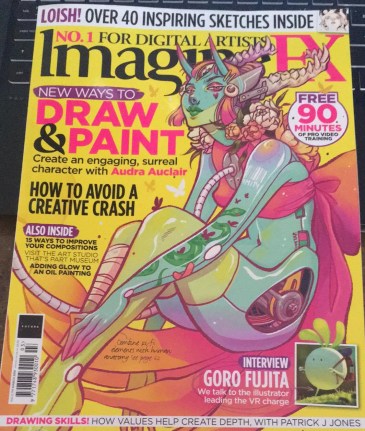
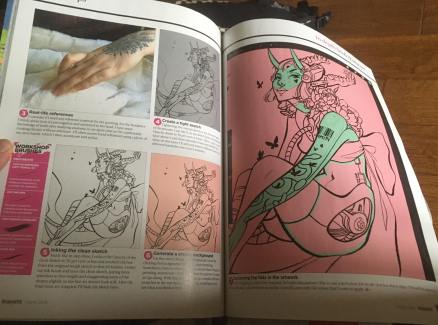
I initially set out to purchase this magazine as an artist named Audra Auclair, who’s work I admire so much and have followed for years now, had her art on the cover and I believed it would contain an interview with the artist inside, however, after purchasing the magazine, I had found the artist had discussed more of her process, showing more of a step by step guide as to how she creates her work.

I had also found that the magazine included another artist that I follow called Loish, or otherwise known as Lois Van Baarle, who has shown and discussed her sketches which I recognise to be from the recent inktober challenge which I myself had taken part in.

So, what is the magazine?

ImagineFX is a digital art based magazine which includes interviews, process guides, reviews and so on, which help look into the current trends within digital art, but also help the reader to potentially discover new artists, learn new techniques and find out more information about the products that are newly released which could help artists throughout their process.

60817839_1196694837177357_5569202252121374720_n

The magazine has been running since 2006, so I would say it is a more new age magazine, focusing on the new technologies and movements within the digital arts industry. I would say the art featured does cater more to the fantasy/sci-fi realm of work, so the audience who this may be directed to is potentially game or concept designers, but I would recommend this magazine to any artist working digitally or wanting to try it out.

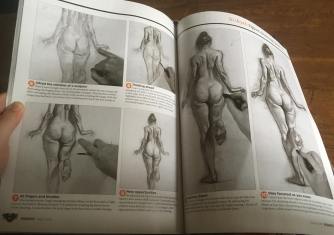
Although the majority of the magazine is digital oriented, there is a good section that is traditionally based, for instance, there is a workshop on figure drawing within this specific issue, discussing how to work with tonal value in order to create a 3D figure.


What does it contain?

This magazine’s featured artists are Audra Auclair, who works both traditionally and digitally, but creates beautiful and strong female characters, which in this case she has combined with sci-fi elements to form a whole new being. This issue also features Loish who I had mentioned previously, who typically works mostly digital, but in this case, has shown her sketches and inked work which she had created for inktober.  The final artist that is featured is Goro Fujita, who I had not heard about previously, who works with virtual reality creating his own world, but he has a more painterly style as opposed to realistic which is what I am used to when I think of VR, but I feel his work would appeal to younger audiences, as I feel they would give the child a sense of being inside of a real-life children’s book.

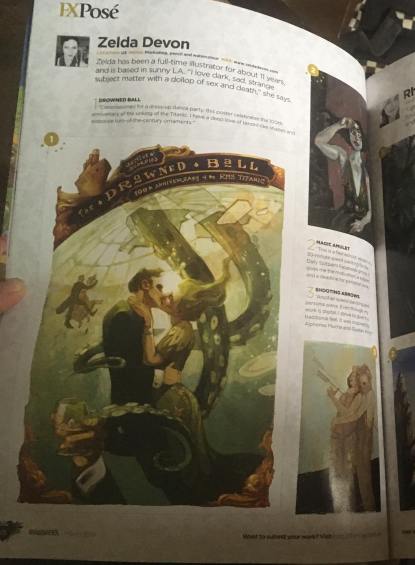
Other than the featured artists, the magazine also has an ‘FX Posé’ and ‘fresh paint’ section in which they showcase new artists, showing their work and a little information about themselves. I do like the addition of this to the magazine because it allows the artist to get their name out there, if they have been working on their craft for a while but may have not gotten recognition or enough publicity with their work, having it shown within this magazine, which is directed at the right type of audience of other artists who work in the same genre, or clients who are potentially looking for new artists, is good publicity for those artists. If you are an artist yourself and feel your work is of standard, you can also apply to be featured within this section, by tagging the magazine on Twitter or Instagram which will help in getting your work noticed. So, with a little more development in my own work, this is something that I will think about in future illustrations, especially for once I have left college as I want to keep the ball rolling with my work and progression, I don’t just want to stop and not have an idea of where to go once I’ve left the comforts of education.


The Illustrators

Audra Auclair 

This is an artist that I have been following on social media for at least 5 years, I am in love with her work and style, and have purchased three of her prints and one of her books in the past. She is one of my favourite artists and she works at a level that I aspire to be at. I have learnt so much from her over the years as I have used her work as inspiration in countless projects, and I would say that she is one of the reasons in why I love drawing women, how my skills have progressed with drawing them over the years and how I still aspire to grow, now more so with anatomy.

60901206_317225819181863_2313378666773479424_n

Auclair’s style is a mixture of semi-realistic female characters, with surrealistic twists, including elements of fantasy/sci-fi and in the cover for the magazine, she has created a female figure with cyborg elements, such as head equipment, the body is formed of separate panels, but in the figures hip, you can see all of the mechanics within the character. I feel there is always a lot of thought that goes into this artists work, but Audra Auclair does have a good understanding of anatomy which she has developed over the years, so it does allow her to create these intricate and in-depth characters.

This artist is not afraid to work with colour and she often uses it to help in communicating a message or tone throughout her work. A common colour she uses is pink, but I believe she does have a good sense of colour theory, so she has a good sense of which colours would work well in a specific piece and how to best apply them within her pieces as to highlight key elements or communicate a specific message.

Audra Auclair has come to work a lot more traditionally over the years, using gouache, oil paints, watercolour, pencils, ink, posca markers etc, but in this magazine, she discusses her process when working digitally, I believe whilst working in Procreate on an Ipad, and she talks the reader through her design, almost teaching them from step to step. One day, maybe in one of my upcoming projects, I would like to follow her workshop to create my own work. I do not have Procreate, but I do feel this guide could also be applied to any software, or I know that I could work in a similar fashion to her through photoshop, so I would like to try to do so in the future, to see if I could potentially learn even more from her.

If you would like to follow the process yourself, I would highly recommend purchasing the magazine. If you would like to see more of the artists work, I have shown an Instagram post of hers below, but you can find her at AudraAuclairor she does have a website at www.audraauclair.com

Zelda Devon

Moving on to the next artist which I had not known so much about, and who I had found through the magazines FX Pose section, her name is Zelda Devon and she is a fulltime illustrator, who creates beautiful narrative based illustrations, which I feel have quite a vintage style to them, as they remind me of old carnival posters, with slightly burnt out tones, maybe thinking along the lines of Bioshock: Infinite, as I believe the game is set in the future with advanced technology, but still has western settings, architecture and posters/art.

60647735_363541864271933_7904158826000023552_n

I love this artists style as it is more painterly and loose, so her characters do show a sense of movement within the frame. I feel her colouring method and mark making techniques are expressive and I feel she does have a good idea of colour theory so her work does flow nicely and it is appealing to the eye.

I believe I have worked with similar techniques to this artist in my own work, but I have not been able to get my own to a high standard that I have come to expect within my work. So, with this artist as inspiration, I would like to experiment with these methods further, as I have now seen that this artist has been able to use these techniques and methods to a professional standard, so I do have more confidence that I may be able to do so as well with more practice and development.

Again, I have shown an Instagram post from the artist below, but if you would like to see more of her work, you can find her at ZeldaDevon.Art and she also has a website at zeldadevon.com

View this post on Instagram

Steampunk Mama

A post shared by Zelda Devon (@zeldadevon.art) on


Overall Opinion

In comparison to other art based magazines that I have read in the past, such as Juxtapoz, I do feel this one suits my own personal interests and work more and I was surprised that it is more informative, in the sense that it does have workshops that you can follow along with (if you have the programs/materials) and can learn from in the long run. So as well as having interviews with current well-established artists that you can take inspiration from, the magazine also introduces you to new artists, ones you may not have heard of before but will potentially take more inspiration from in the future.

Once I feel I have improved my work and skill enough, I do feel I will come back to this magazine and potentially try to get my work noticed by them on social media, as having your work within the magazine would be such an amazing opportunity as you would be getting more publicity from artists with similar interests and/or work processes, and you could potentially get noticed by more clients. I feel if you were to get into the magazine, it could be the first stepping stone of many, one day potentially managing to get in Audra Auclair’s spot, designing a cover and discussing my own process of its creation to the readers.

If you are an artist, working traditionally or digitally, or if you have an interest in fantasy or Sci-Fi themes, I would definitely recommend ImagineFx, as I do feel it has the power to inspire and inform their readers, and I do feel you can also learn a new technique or two from it, whether digital or traditional.


Bibliography 

Auclair, A. (2019). [online] Available at: https://www.audraauclair.com/ [Accessed 29 Jan. 2019].
ImagineFX. (2019) March, (117).
Auclair, A. (2019). Render a Surreal Sci-Fi Character. ImagineFX, (171), pp.62-67.
Carter, D. (2019). Create surreal characters with ImagineFX. [Blog] ImagineFX. Available at: https://www.creativebloq.com/news/create-surreal-characters-with-imaginefx [Accessed 29 Jan. 2019].
Devon, Z. (2019). [online] Available at: http://zeldadevon.com/ [Accessed 29 Jan. 2019].

List of Figures.

Figure 1 – ImagineFX. (2019) March, (117).
Figure 2 – Jones, P. (2019). Create Depth Using Value. ImagineFX, (171), pp.86-87.
Figure 3 – Auclair, A. (2019). Render a Surreal Sci-Fi Character. ImagineFX, (171), pp.64-65.
Figure 4 – Auclair, A. (2018). Instagram. [image] Available at: https://www.instagram.com/p/Bq5UW2Cl6Vq/ [Accessed 29 Jan. 2019].
Figure 5 – ImagineFX. (2019) March, (117), pp.18.
Figure 6 – Devon, Z. (2019). Instagram. [image] Available at: https://www.instagram.com/p/BtPlVVuBAJw/ [Accessed 31 Jan. 2019].

3 Historical Illustrators I Recently Discovered

As a class, we have been asked to find and research some historical artists who we could potentially take inspiration from in our own work, and will also allow us to expand our knowledge of the industry from a historical view, looking at the trends which may have been present then and how they may have changed over time,  and looking at the techniques/mediums/themes which were used and how I could learn from these artists and apply that knowledge to my own designs.

Over the years, throughout my coursework, I have continuously mentioned artists such as Aubrey Beardsley and Authur Rackham, as I love their work and I feel they have had a big influence on my own over the years. However, for this task, I did want to branch out and find new historical artists who I could learn more from, and who could potentially influence my work more.

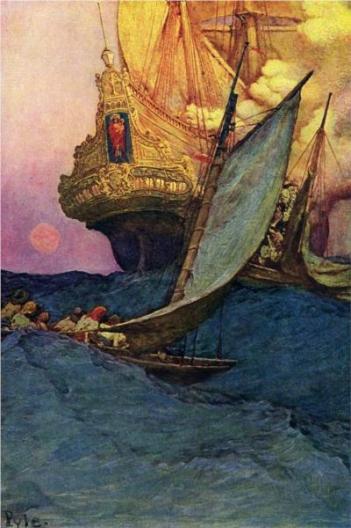
Howard Pyle 

an-attack-on-a-galleon.jpg!Large
Fig.1. Howard Pyle, An Attack on a Galleon (1905)

He was an American illustrator who worked within the late 1800s to early 1900s. He had written his own children’s books which he illustrated himself as well as many other books and later started painting murals. It is said that the idea of how pirates dress nowadays initially originated from his work, as he wanted to create more flamboyant characters which were inspired by gypsies. I believe his depiction is a more romanticised version of a pirate as it is said if their clothing were as Pyle had illustrated, it would have been impractical.

Style

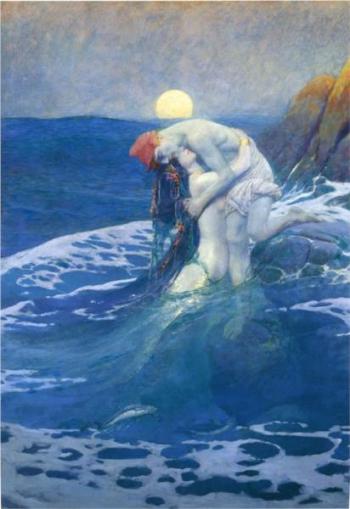
Within these two pieces specifically, I loved colour palettes and the softness to the pieces and when I think of romanticism this is what my mind goes to.

I believe there is a lot of emotion present within the artists work, for instance, in figure 1 the movement within the waves suggests the piece is a more action based narrative, whereas in figure 2, the sea is calm, it’s gentle, fitting the themes within the piece. I feel with the colour palettes used that it keeps a lightness to his paintings, but still communicates the story well.

the-mermaid-1910.jpg!Large
Fig.2. Howard Pyle, The Mermaid (1910)

Technique

Howard Pyle was primarily a painter, and I believe both of these pieces are oil paintings. I have never worked with the medium myself so I wouldn’t know how easy or hard it would be to make the soft blends in which he creates within his work. I, however, can’t deny that there is a lot of skill within his paintings, being able to use a lot of colour, creating movement, motion, showing realism and being able to create it so delicately while still conveying the emotions within the piece. His work is just so undeniably beautiful, and although he has more work that shows a lot more action, these two are my favourite of his work and were the attraction pieces that made me want to research him more and include him within this blog post.

My opinion

As I am soon to be working on quite a colourful project, The Wizard of Oz, I do want to take some inspiration from Pyle as I love the brightness of the colours and softness within the piece. It gives a dreamlike quality to his work, and that may be something I wish to translate within my own work when working on that project.

I have mentioned in previous projects that I would like to try using more traditional mediums, such as gouache or maybe even oil paints like Pyle someday, but as I do mostly work digital and have recently been working more blended tones as opposed to working in a cel-shaded style, I would like to start playing around with more brushes or settings, for instance with the opacity and flow, to see if I could potentially create a painting like these examples, using digital techniques.

My main take away from this artist is how he shows realism within his work, creating softness and dreamlike qualities with his colour palettes and painting methods. I am going to try take that information and apply it to my own work in the future.


Maxfield Parrish

2.jpg!Large
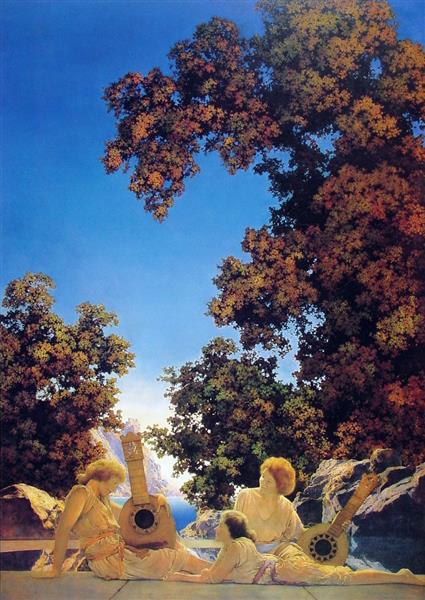
Fig.3. Maxfield Parrish, Interlude (1922)

Following the work of Pyle, I also chose this artist because of his colour palette, but I also love that he worked with more mythological themes. Parrish was an American illustrator who worked in the early 1900s. He was one of the most popular artists of the Golden Age of Illustration, as well as Arthur Rackham and Howard Pyle, but was also apart of three other art movements, regionalism, symbolism and romanticism. These 3 movements I feel are very present within his work, in some pieces his composition reminds me of collage as he will have a beautiful scenic background, then position elements on top of it like characters or items, which can somewhat seem out of place but they do work. Like in figure 3 I feel the women look separate from the design but it’s not necessarily a bad thing, as the piece overall is so beautiful and the separation of the characters helps my eyes focus on them. I believe he did this with his colour palette as the warmer tones contrast against the cooler tones, but in between the two are the trees which have multiple tones of black, greens, reds and yellows so it complements both groups and makes the piece so attractive to the eye.

Style

I would say his style is definitely in the realm of realism, but there is a sense of magic to his work as there are dreamlike qualities to his pieces. In comparison to Howard Pyle, when I use the term ‘dream-like’, for Pyle I mean soft and airy, almost like a cloud, whereas with Parrish’s work, I feel it is less soft but has the whimsical nature of a dream.

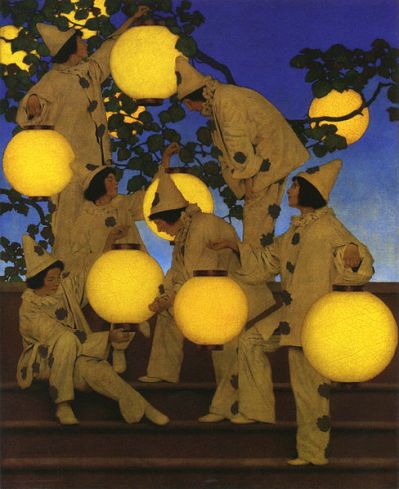
What highlights these themes well was the artist’s knowledge of colour theory, as he would often use complementary colours, as seen in figure 4 which I believe adds more vibrancy and an overall sense of light and fun to his work. The bright colours within his work really help in attracting the audience’s eyes, but the artist knew when to stop, what other colours would need to be added as to not overpower the illustration. Referring back to figure 4 he has used a bright yellow against a deep blue which does help draw in the attention, but in between those colours he used quite neutral tones which helped in breaking up the tones, almost giving your eyes some breathing space.

the-lantern-bearers-1908
Fig.4. Maxfield Parrish, The Lanter Bearers (1908)

Technique 

I believe like Pyle, he used oil paints on canvas too, but whereas I feel Pyles work is soft and quite blended, I feel Parrish worked more realistically, as the people within the paintings could pass as photos, at least within figure 4, in figure 3 the women are quite godly, almost reminding me of Greek mythology, especially the way the characters are dress and how the sun is glowing down on them.

As I had mentioned before, I have not used this medium before so I do believe I would understand it until I did have more experience with it, or possibly watch a video/tutorial, as I know paints are different, for instance, I believe gouache dries lighter than it is laid down so it is a more buildable paint, but I think oil paints take longer to dry so you would have to work wet? I could be very wrong so I would definitely watch a video or do more research into it before trying myself especially as it is a pricey medium and I wouldn’t want it to go to waste. And that goes for both oil paints and gouache!

I would like to try creating digital paintings like this at some point, possibly within the new semester, but one day I would like to try out painting traditionally, and I would aspire to be at the level of Maxfield Parrish or Howard Pyle someday.

My opinion

Like with Pyle, as this Parrish uses beautiful and vibrant colour palettes, I would like to take inspiration from him for my Wizard of Oz project as I do want it to be a very colourful project. So this will mean thinking along the lines of Parrish, what colours may complement each other and attract the audiences attention and will I need to add more neutral tones to give the piece more breathing space.

I do enjoy working more realistically, but after discovering the work of Maxfield Parrish I will now try to find ways to make my work more vibrant and fun as I do really love the whimsical themes with his work.


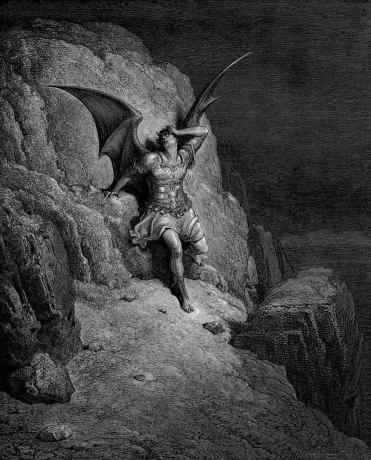
Gustave Doré

This is a French illustrator who had worked within the mid-1800s and created finely detailed wood-engraved illustrations for books such as Inferno of Dante (1861), the large folio Bible (1866) and so on.

plate13
Fig.5. Gustave Doré, Paradise Lost (1866)

Style

Due to the methods he used, his work was primarily monotone, commonly printed with black ink and one of the first things I had noticed, was how incredibly detailed his illustrations are. At a distance, you could think that he had used pencils or graphite to create his work, however, when looking closer you notice all of the intricate lines which form up the tones but also give shape to the scenery or characters, for instance, if you look at the wings or the characters leg in figure 5 to the right, you can see the artist does not use a straight-lined crosshatching method but instead he curves the lines, which does help in creating shape and depth within the image as it does not look flat.

Doré worked within the period of realism and romanticism art movements, and I feel these are both very present in his work, what drew me to his work however was the religious and mythological themes, as he was able to bring the stories to life and as he does work in realism the characters are believable, which is already an amazing skill, but I assume his work would be even more mindblowing in his time, as it was before CGI and any of that technology, so the mythological beasts I see commonly on tv today, I don’t believe people of 1800s would ever have imagined, if it weren’t for artists like Doré.

Technique

Gustave_Doré_-_The_Holy_Bible_-_Judith_XIV_-_Judith_showing_the_head_of_Holofernes_-_original-detail
Fig.6. Gustave Doré, Judas Showing the head of Holofernes (1880)

The artist engraved his illustrations into the wood which would then be printed onto paper. I assume he worked at a large scale due to the tiny and intricate details, (I mean just look at all the tiny dots and lines withing figure 6!) but this may be due to the way I know artists work today, as they will work at a larger scale to get all the details then they will reprint at a smaller size and the details are a lot finer. This method may not have been doable at those times, so if I imagine that his plates would have been printed directly into books, then he would have been working at a smaller scale than I would ever have imagined and it’s unbelievable. I could be wrong as I am not fully aware of his process, I just have brief knowledge of how the technique is created nowadays, but either way you can’t dispute that his work was very detailed and he definitely knew how to work with light sources as he wasn’t afraid to work with too much black and he was able to add the right amount of light, so that he was able to achieve depth within his work, creating the realism within his illustrations.  

My opinion 

This would have been a great artist to take inspiration from during my Lion, the Witch and the Wardrobe project, as I was working in monotone, experimenting with different printing methods and using a somewhat similar lining method to build up depth. Like I had mentioned however, I had been working in more of a straight-lined crosshatching style, whereas Doré was working with more curved lines which gave more shape to his design, and helped in making it look more realistic. I do not believe I would have had the time to work as intricate as he had, but by using a more curved line I believe I could have shown more shape in my own work, and it may have helped in making my work look less flat.

I have recently started to work more realistically in my own work, especially with portraits, so in the future, I may try to create a character in his style, but I may do so by working at a larger scale first then scaling down as to achieve the finer details, as I believe my hand would be too unsteady to create as clean of a piece as his.


Bibliography 

Adropofart.com. (2019). Gustave Doré: Information, biography and art – see exhibitions and museums where their work is curated | adropofart.com. [online] Available at: http://adropofart.com/Artist/173/gustave-dore [Accessed 16 Jan. 2019].
Artbible.info. (2019). Artist: Gustave Doré. [online] Available at: https://www.artbible.info/art/biography/gustave-dore [Accessed 16 Jan. 2019].
Encyclopedia Britannica. (2019). Howard Pyle | American writer and illustrator. [online] Available at: https://www.britannica.com/biography/Howard-Pyle [Accessed 16 Jan. 2019].
Glover, T. (2015). Printmaking Artist Gustave Dore. [online] Ipoxstudios.com. Available at: https://ipoxstudios.com/printmaking-artist-gustave-dore/ [Accessed 16 Jan. 2019].
Gurney, J. (2015). Pyle as a Picture Maker – Illustration History. [online] Illustrationhistory.org. Available at: https://www.illustrationhistory.org/essays/pyle-as-a-picture-maker [Accessed 16 Jan. 2019].
Illustrationhistory.org. (2018). Maxfield Parrish – Illustration History. [online] Available at: https://www.illustrationhistory.org/artists/maxfield-parrish [Accessed 16 Jan. 2019].
Milton, J. (2014). Paradise Lost. [ebook] South Australia: The University of Adelaide, p.Book IV. Available at: https://ebooks.adelaide.edu.au/m/milton/john/paradise/complete.html [Accessed 16 Jan. 2019].
National Museum of American Illustration. (2019). HOWARD PYLE – National Museum of American Illustration. [online] Available at: https://americanillustration.org/project/howard-pyle/ [Accessed 16 Jan. 2019].
Newworldencyclopedia.org. (2019). Howard Pyle – New World Encyclopedia. [online] Available at: http://www.newworldencyclopedia.org/entry/Howard_Pyle [Accessed 16 Jan. 2019].
Rafoxsociety.com. (2012). What was the Golden Age of Illustration? | The R. A. Fox Society. [online] Available at: http://www.rafoxsociety.com/what-was-the-golden-age-of-illustration/ [Accessed 16 Jan. 2019].
The Editors of Encyclopaedia Britannica. (2019). Gustave Doré | French illustrator. [online] Encyclopedia Britannica. Available at: https://www.britannica.com/biography/Gustave-Dore [Accessed 16 Jan. 2019].

List of Illustrations
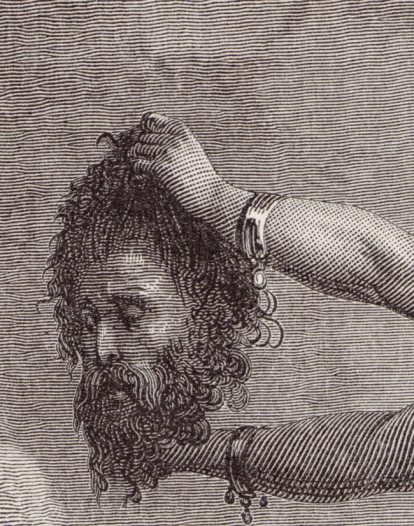
Figure 1 – Pyle, H. (1905). An Attack on a Galleon. [online] http://www.wikiart.org. Available at: https://www.wikiart.org/en/howard-pyle/an-attack-on-a-galleon [Accessed 16 Jan. 2019].
Figure 2 – Pyle, H. (1910). The Mermaid. [online] http://www.wikiart.org. Available at: https://www.wikiart.org/en/howard-pyle/the-mermaid-1910 [Accessed 16 Jan. 2019].
Figure 3 – Parrish, M. (1922). Interlude. [online] http://www.wikiart.org. Available at: https://www.wikiart.org/en/maxfield-parrish/interlude-1922 [Accessed 16 Jan. 2019].
Figure 4 – Parrish, M. (1908). The Lantern Bearers. [online] http://www.wikiart.org. Available at: https://www.wikiart.org/en/maxfield-parrish/the-lantern-bearers-1908 [Accessed 16 Jan. 2019].
Figure 5 – Dore, G. (1866). Paradise Lost. [ebook] South Australia: The University of Adelaide, p.Book IV. Available at: https://ebooks.adelaide.edu.au/m/milton/john/paradise/complete.html [Accessed 16 Jan. 2019].
Figure 6 – Dore, G. (1880). Judith showing the head of Holofernes. [online] Ipoxstudios.com. Available at: https://ipoxstudios.com/printmaking-artist-gustave-dore/ [Accessed 16 Jan. 2019].

‘Twas the week before Christmas…

If you have read my previous post, you will know how stressed I was trying to achieve my deadline for one of my projects, it wasn’t my real deadline, but it was the one I had set myself for that specific project. So, with this week, as it is probably the last week I can do work before getting lost in festivities, and having to clear my workspace away so that, to my mother’s delight, the dining table would be free again for the week between Christmas and New Years. Yes, I work at the dining table as my room is currently under construction and has been for a while, so I don’t really have elsewhere to work. So with these factors, I wanted to put all hands on deck to create 2 covers for the Penguin competition. This included sketching ideas, creating thumbnails for potential covers, then designing them digitally and refining them further.

I have surprised myself during this week, as I have managed to create 3 possible designs for the story Wonder by R. J. Palacio, technically 2 with the 3rd being a combination of both concepts, and I have created 2 possible designs for Norwegian Wood by Haruki Murakami.  I did start the process with 4 concepts for each book but have narrowed down my options when it came to creating them digitally. This was due to either time or lack of enthusiasm with the concept, but I do believe I have still given options within designs which would be more beneficial if I were working one to one with the client, but as I am not, and I am only allowed to submit one design per category, I will end up choosing the piece myself or my peers find most interesting or best advertise the stories.

During this week, I feel I have been confident when illustrating and coming up with concepts, however, when it came to adding in the text, I have found a lot of issues with the type getting lost within the illustrations and trying to find ways in which to make them stand out more. When talking to my peers, this was the biggest issue they had spotted, and luckily, one had given me suggestions about how I could improve on this.

From sending my friend all of the pieces shown above, she had circled both of the designs with eye patterns for the Wonder book, then the tree piece for Norwegian Wood and said that these were the pieces that would need to be worked on more as you wouldn’t be able to read them. With the designs for Wonder, she had suggested I remove some of the eyes so that they would be more of a border for the text as opposed to a background. As the pattern was somewhat uniform though, when doing this I felt it looked quite messy in a sense, the design no longer had a flow within the pattern and the eyes just looked more random in their positioning. She had not made any suggestions for the Norwegian Wood design, but she had liked the other option I had made for it, although she did spot a typo so I immediately corrected that. Another friend had suggested that the barcode on the back may not be readable from the design, so I also added in a white box over the design but under the information, so that it would be easier for a machine to read it. The white box was the same colour as the text, so did not look too obscure in the design as a whole, and sort of kept it cohesive.


After making the changes, probably even before then, I knew I had liked the more simple designs better, as they were more solid and there was less to question, for instance, it wouldn’t be a question of “what am I looking at”, “is the text readable”, etc. So the ones shown below are the ones I believe I will be submitting to the competition.

Template - Wonder.indd

The Wonder design

For this design, I did like the idea of people WONDERing (ha get it) why there was a duck on the cover when the story is about a little boy named August, but it does link to a section in where the boy is in the Principles office and notices his artwork on the wall. This artwork was for a class project in which the students had to make a self-portrait of themselves if they were an animal, and August had drawn a duck. When the Principle asks him “why a duck?” expecting a meaningful and in-depth answer, August just replies with “Its because I think I look like a duck.” I loved this section when I had read it and although I thought I was not going to try drawing the child, as the blurb of the book specifically says that he doesn’t want to describe himself as “whatever you’re thinking, its probably worse”, I thought this would be a fun way of representing the little boy, without trying to draw the accurate description.

Template - Norwegian Wood.indd

The Norwegian Wood design

There is a section within the book where the character is working at a record store and cuts himself on “one of the glass partitions in a record shelf” that was cracked, he then goes on to mention how the floor is covered in blood etc, so at the time this had made me think of this cover design. Although it had not exactly mentioned a broken record, this is what I had imagined when I had read the section, a record in shards, with a red background which would be the character’s blood.

This may not have been someones first thought of imagery after reading the book, but I felt since the title of the story is inspired by a song by The Beatles, ‘Norwegian Wood’, I felt the imagery was still valid to the story, and in a sense, it could be symbolic to the characters emotions and relationships throughout the story? (Potential spoiler? I’m sorry!) So I do like this design and concept, as I believe it is not an obvious choice and it is somewhat out of the box, but not too far as it still relates.

So still to do, as I have slightly worked backwards during this project, just trying to churn out the final designs as quick as I could with the time I have, I do have a lot of writing up to do. When working, I did have the artists and styles in mind that I wanted to use, but I just need to write this research up properly, discuss all of the choices I made throughout the process, etc, and I will need to make a final evaluation (which I will also post on here). This, however, will probably be done after Christmas, maybe pushing towards after New Years as well, as I had mentioned before, my working space is at the dining table, and during this time, my Mam does like it to be clear. I will keep my progression updated, but if I don’t post during that time, you now know why, so you can just imagine me living my best life, stuffing my face with festive food!

MERRY CHRISTMAS! OR HAPPY HOLIDAYS, WHATEVER YOU CELEBRATE! AND HAPPY NEW YEAR! 


Bibliography

Murakami, H. and Rubin, J. (2001). Norwegian wood. London: Harvill, p.263.

Palacio, R. (2013). Wonder. United Kingdom: Penguin Books Ltd, p.287.

I Opened up my Own Store!

Using Depop, I have created an account so that I can have a platform that I can sell my work from. If you want to know why I chose this platform you can click here to read my opinions on different selling sites.

As of yet, I have not made a sale through the app, but I have made a sale by working solely through PayPal and messaging the buyer. I was only confident enough to do this because I knew the person, but even then I felt I was being very awkward, as I’m not very business savvy and I am new to this world. But this may improve over time.

So working this way, I still charged the same amount for the product and p&p but in this case, Depop did not take their 10% cut of the payment, but I believe PayPal does still have a charge of 20p per transaction.

Anyways back to the exciting part, this buyer had wanted 2 of my zines, a multicoloured one and a black and white one, and when I had mentioned that I was also selling some riso prints, she had also wanted a wave print. From this buyer, I have made a total of £14.50 (p&p excluded) so I am so happy with this experience.

As I had stated in my previous post, one of the reasons I had chosen to use Depop was because I would be able to have control over the whole process, packaging the products myself and adding little personal touches where I could. So as shown below, are three photos, one of the contents of the order, then the other two are of the envelope. Although I would say the content is pretty standard as to what you would expect when purchasing prints etc, I wanted to personalise the envelope, adding in little drawings of flowers, which would relate back to the zine. I had also added a little ‘thank you’ on the back so that she would see it when opening. These are small personalisations, however, when I had received a personalised envelope from an artist, I felt that they had actually put love into their packaging, an indication that they actually cared about their clients and appreciation in a way.

48175122_361586474645178_1609465979731968000_n

I have now sent off the order, hoping that she gets it soon, and hoping that she is happy with her purchase. I also hope that more people will purchase my work, although I was a bit anxious with this one sale, I hope that the more I get, the more my confidence will grow with the process.

This being said, if you would like to have a look at the products I have for sale, you can click here for my Depop account, or you could send me a message on Instagram @Melon.R if you have PayPal and don’t wish to work through Depop.

Online Stores

In this blog post, as I have recently been in the search for places online where I could potentially open my own shop and sell any product I make over the year, I thought others could potentially benefit from what I have learnt and my opinions on certain cites. I plan to keep these descriptions fairly brief, but knowing myself, I may babble, so we shall see!

If you are following along with this blog for your own research into online stores, I would recommend that you do your own research as well, as this information is just from what I have heard or found, and have formed my own opinions on, so they might not be exactly accurate as I have not worked with any forms of an online store before. For me, this will just be a learning process, hopefully learning, developing and expanding my business as I go. 

Redbubble

This is a site in which I know one of my friends has used in the past (I’m not exactly sure if he still uses it though), it is a company which allows you to create your own products through their facilities. I believe you submit your design, then choose the products that you would want it printed on, then through redbubble’s marketplace, they are able to sell your work. The company does everything for you, from printing the product to shipping it out to the customer.  For its services, I believe they do take a small cut from each of the purchases you make.

I believe I would have considered this as an option, however, I feel it does lose some of the personal factors by the company doing everything for you. One time, I had ordered a couple of Zines from an artist named Nil, or @Badwitches on Instagram, and I did love the pieces I had ordered, but I looooved the personal touches she had added within her packaging. The way she had written the address in pink, and had written ‘Thank you’ on the back, and inside there was a lot of loose heart confetti (which was a bit messy, but such a cute addition), I have even kept the envelope because of how cute I thought these additions were.

It is things like this that I feel I want to do when sending out my own work in my own packaging, adding in little details that could feel more personal for the buyer. I feel that by solely working through the company, it would feel cold in a sense, as I would not be connecting with my buyer in any way, other than them owning a piece of my work, but something that I have not personally put time into creating (yes I would have put time into creating the design, but I would not have spent the time working with the product itself.)

Etsy

From multiple artists I follow on social media, who had sold their work on Etsy, they have ended up moving and using other platforms to sell their work, in places such as Big Cartel, or with their own personalised online stores. I believe this was due to the percentage cut in which Etsy was taking from them. Although yes, I do understand that the company want to be paid a certain percentage, as they are allowing you to sell your through their site, however, I feel for smaller businesses, this cut would have a bigger dint to them as opposed to a company that is getting a lot of regular business.

As I myself will be starting up a small business, with quite a small following, I don’t think this is necessarily the best option for myself.

Big Cartel

This site can potentially cost, but it offers a tier like system, offering more for more money or less for none. If you did not want to spend money on this site, you would only be able to sell 5 products, with one image per item. However I believe through this site, you would still be able to have full control of production, posting and packing etc, making the item as personal as you desired for your buyer.

If I were making more consistent money from my art, enough to pay a monthly fee, I would find that this would be a potential option. However, as I am just starting, and do not know how my work will sell on an online platform, this is not something I would want to spend too much money on right now until I have more information/knowledge of running a business.

Depop

This is typically an app which people sell clothing and accessories through, however over the years, I have seen that someone who I had known from my previous course had started selling her own artwork on it. After a little look, I had found that it almost works like Instagram, as you are able to add tags to the items that you are selling, making it easier for people with similar interests to find your work. You are also able to like items, which allows a person to come back to the post later on, possibly if they weren’t so sure, or if they didn’t have money at the time, etc. But the likes from an item may also boost your post so that it is higher in the search results, I do not know this for sure, but this is the way that Instagram has recently been working.

I do believe that the company takes a cut from your payment when someone purchases your item, but I believe it is small, so I could potentially counteract the cut by pushing up the price a little more. I feel my products are already a lower price within the market, so I believe by pushing it up by 30p or something, it would not make too much of a difference to the buyer.

Another reason why I like this option, again, is that I feel I can connect more with my audience/buyers. I can make the packaging more personal, adding little touches here and there, but the customers are also able to give their feedback as well, reviewing the products or delivery time etc.  Although I do think this common on all of the platforms I have mentioned, I feel people may check the reviews of sellers on depop more, as I feel the customer wants to know that they can trust the person they are buying from, so from the reviews, they can see what they can potentially expect from them, whether the quality was good or not, or whether the delivery had taken a long time or short. I believe as with other websites, the more good reviews you get, the more people will trust and want to buy from you too (only if they want too though, obviously).

Own Online Website

I have not done a lot of research into this field as of yet, as I feel there would be a lot of ways you could potentially go about doing it. You could essentially form your own site, which I assume you would have to pay a monthly fee for, then you would have to have a place that could take transactions, allowing your customer to pay and for you to get that money smoothly, but I’m not sure of the ways in which you could do this? I have recently seen advertisements for a site called Shopify, but I believe you have to pay a monthly fee for that too. I would definitely need to do much more research if I were to chose this option.

However, by selling your work through your own site, it would mean that you have full control over your business, the production, packaging, shipping, etc. It could potentially help in all of your business efficiently being in one place, for instance, as well as a shop, the site could have your portfolio of work, a creative cv, links to any of your other social platforms, and information about you.


Final thoughts.

Currently, I have chosen to create a shop through Depop, as it does seem the best option for me at this point in my career, as I am just a small business starting up. But hopefully, as I grow and expand my knowledge of business, one day, if I do gain a bigger following and do have a good regular income from my business, I do hope to run my own website, selling my products on my own, as opposed to working on a third parties platform, potentially paying them some of my profit. I believe by having my own website, my whole business will be accessible within one place, as it will contain my store for potential customers, my links to other social platforms, such as Instagram, or even my blog, both of which I am quite active on, and for any potential clients, I will include my portfolio of work, possibly categorised for easier access, a creative cv, general information about myself, and an enquiry page in which they can email me directly from the site.


Please, if you have any thoughts or your own experiences with these websites or apps, feel free to comment them. As I am only starting up myself and have not had a lot of experience selling my own work before, (no experience at all with any of the sites mentioned so far), I would love to hear from others who have and I will happily accept any advice I can get, thank you!

Selling Within a Store

My Aunty Dawn, not really my aunty but my mams closest friend who is basically my aunty, who I actually see more than my real relatives, has recently opened her own store in Stanley, which is called Purple Dragon, which sells unique gifts, which are quite gothic, spiritual and very fantasy inspired. This includes crystals, skulls, tarot cards, cushions, cups, journals, and there is even a section of her shop just dedicated to incense, which is another business she owns called House of Incense.

She recently came round and was talking with my mam about the shop, in which I inquired about the possibility of selling my work in her store. If this was anyone else, I probably would not have been as forward or as confident to even ask, but I showed her some of the prints I still had left from last years exhibition, and she said that she would take two and see how they would sell.

riso print

I then showed her some of my other work, and she has chosen a few other pieces that she would like me to print off, again she only asked for 2 of each, to see how they would sell, and she would let me know how it goes. The prints in which she wants are as shown below, and do give me a better understanding of what she would like to sell in her shop, and gives me a better idea of what else I could create for her if the prints do well and if she wants new designs. As you can see, she likes the colour green!

I’m so excited about this opportunity and do hope that the prints she has with her now do sell. If so, this will be my first experience with selling work outside of the college, and will potentially be the first steps in which I take to forming my own business and selling my own work. Aghhhh I’m excited about the future, I just need to print out the other illustrations she wants, and get them to her. I will keep you informed of how this venture goes.

Current Artist Research Pt.2

John Tenniel

Figure 1 – John Tenniel, Alice’s Adventures in Wonderland, 1865

This is an artist from the Golden Age of Illustration, who I would like to take inspiration from during my Lion, the Witch and the Wardrobe project. He had created the original illustrations for ‘Alice’s Adventures in Wonderland’ by Lewis Carroll.

From the illustrations specifically from this book, Tenniel’s style is semi-realistic but with the theme of the book, he has played around with surrealism, illustrating things that you would not exactly see in the real world, and exaggerating some of the characters proportions, as seen in figure 1.

I believe these illustrations were hand-drawn with pen and ink, but I believe when it came to mass production, the design was etched into a plate, so the illustration could be printed multiple times for hundreds of books.

Because of this factor, during my Lion, the Witch and the Wardrobe project, I want to experiment with different mediums, working traditionally with pen and ink, but also playing around with different printing techniques, such as screen printing, linocut printing, etching, and even creating a plate with the laser cutter that is available within the college.

Primarily, I do want to work in black and white for this project, however, I do plan to also play around with foils, possibly adding hints of gold or silver to the designs, potentially giving my pieces a more regal appearance that I believe will fit the theme of the story.


Ana Godis

40653471_917673028417511_1146468823050747904_n
Figure 2 – Ana Godis, 2018

As the competitions are not yet known and I do not know what I will be creating, I want to keep an open mind of where I can go with these projects in sense of style and techniques I could use. I have however been enjoying the work of Ana Godis over the holidays, so would potentially like to use her work as inspiration for a project over the coming year.

I would explain her work as experimental in a way, although I believe she always works digitally,  I’d say her style can differ from piece to piece, as for one, she could be creating a beautiful digital portrait which is very realistic, but in another piece, she could be working very stylised, almost ‘cartoony’? But in another piece, she could be combining the two styles, which probably sounds confusing, but she is able to execute the style so well!

Over the holiday, as she does post process videos along with her pieces, I have tried to learn from these videos, trying to follow her steps, as to improve my own technique, and I had created two digital paintings. I could still do with some further practice, however, I do feel the process had given me smoother results, in comparison to the digital painting I had done the year previously.

I feel as her style is so flexible, if I were to take inspiration from her work, I would be able to apply it to any project, including the competitions. Her work is illustrative but quite contemporary in style, so if I were to learn more from her techniques, I could potentially apply them to book illustrations or editorial themes or possibly even use them for advertising.

Ana Godis does have a Patreon in which I believe she does go into more depth with her process, the tools she uses etc. I personally am not subscribed as I do not use Patreon (as I feel it would be a black hole for me, following too many artists and probably spending all of my student loan within it, which is not something I am committed to doing as of yet) But, if you are interested in her work and do wish to learn more in-depth about her process and tools, here is her link: www.patreon.com/ana_godis


Rafael Mayani

23507888_1928168667504955_2452883890356879360_n
Figure 3 – Rafael Mayani (2017)

Like Ana Godis, I will potentially be taking inspiration from Rafael Mayani during my commercial projects.

In comparison to the previous artist, I believe his work is more contemporary, possibly more editorial-based, so I believe he would be most useful within the Association of Illustrators – World Illustration Awards competition, especially if I decide to work in the editorial category.

His style is minimal, easily readable and overall it is easy on the eyes. I believe I would most likely see his work in commercial settings, such as in magazines, in advertising, on posters, etc. In figure 3 specifically, he had created an illustration for a magazine, which was honouring the people who helped clean up and take care of others after the earthquake in Mexico in 2017. I believe by not giving his characters faces, it is not singling out any particular person who had helped but instead is celebrating the community as a whole, and the reader could potentially fill in the spaces themselves, imagining the people they know, if that makes sense?

When taking inspiration from his work, it will be with the minimal almost papercut style, as I do believe it is very readable, and it does attract the eye, which I do feel is an important factor if I were to create a piece that would advertise a specific article.


List of Illustrations

Figure 1 – Tenniel, J. (1865) Alice’s Adventures in Wonderland [Online] Available at: https://medium.com/alice-s-adventures-in-wonderland/sir-john-tenniel-s-classic-illustrations-of-alice-in-wonderland-2c3bbdca3a77 [Accessed on 24 Sep. 2018]

Figure 2 – Godis, A (04 Sep. 2018) [Online] Available from: https://www.instagram.com/p/BnTw8cOnCra/ [Accessed on 24 Sep. 2018]

Figure 3 – Mayani, R (13 Nov. 2018) [Online] Available from: https://www.instagram.com/p/BbceF5PFQLR/?taken-by=rmayani [Accessed on 24 Sep. 2018]