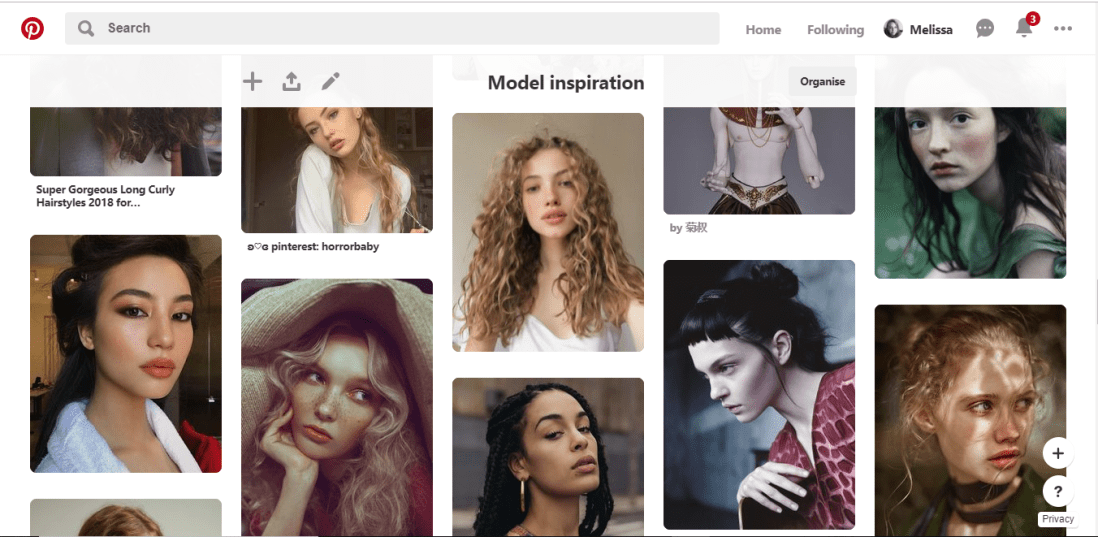
Pinterest has been my main source of inspiration throughout this project so far and during many previous projects. Over time I have built a collection of ‘Model Inspiration’ which include photos of different faces shapes, hairstyles different ethnicities and so on. I constantly refer to this board for inspiration, and if you were to look in it, you would most likely see the faces I have used as inspiration/reference during this challenge.
2.Sketchbook
Throughout the challenge, I have been sketching each design out within my sketchbook, this allows me to make any changes necessary before I start inking the design.
3.A4 Light Pad
Once I am happy with the sketch, I rip out a page from the back of the book to create the inked design on, (yes my sketchbook is probably going to be very thin by the end of the challenge), then using an A4 light tray, which I had purchased from Amazon, and plugs into your computer or laptop with a USB, I start lining the sketch.
4.Derwent pens
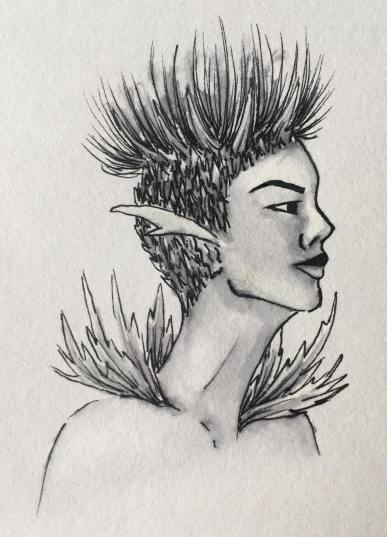
For the inking process, I use Derwent Graphik Line Maker Drawing Pens, which are a pack of 6, varying from 0.05mm, to 0.8mm. I often use 0.1mm for the facial features, 0.2 for face or petal outlines, 0.05 for very fine details, sometimes even cross-hatched shading, and for flat black areas, I use 0.3 or 0.8.
5.Water + Paint brush
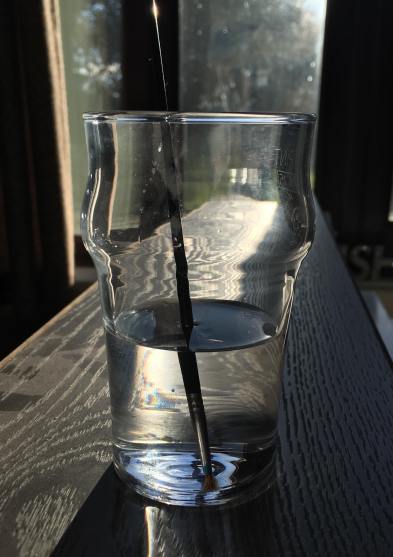
To add more shading with a softer blend, to the linework, I dip a thin paintbrush into a glass of water and bleed, drag and blend out some of the inked line work. If I feel it is bleeding too much or is too wet, I have often blotted it down with my sleeve or a piece of tissue.
6.White pen
In some area, possibly where I have lost any highlights or the ink may have bled too much, once the piece is dry, I use a white ink pen and start adding back in the highlights or cleaning up some of the areas that may have come out too dark. If the white pen has gone slightly over some of the linework, I then just go back over with one of the fine liners.
7.Phone camera
Once the piece is complete, I take the design to a place which has good natural lighting, then take a picture of the piece using my iPhone camera. I do feel the lighting is an important factor, as you want to take the best photo you can of your design, and if taken too late on in the day, it can make your piece look more cool toned, or if you are using the lights within your house, I don’t know about yours, but mine are very orange/yellow, so would make my designs look too warm toned.
8.Whitagram for editing
With the photo, I then crop the design, making the illustration the only part visible, removing any background or any white, unused space from the page. I then take the photo into an app called Whitagram, which I originally solely used as to make my images square, for the way in which Instagram is set out, but for this project, I have also been using the editing tools within the app, playing with the lighting, exposure and shadows, as to make my pieces as white as possible.
This step would be much easier if I had scanned in the designs and edited them within Photoshop instead, however, I do not have a scanner at home, and as this was a daily challenge, I would not have been able to take advantage of the colleges each day of the week. So for the time being, I just have to make do with the resources I do have.
When it comes to creating my zine, however, I will be doing this step properly, by scanning in all of my designs and editing them with photoshop. I believe it will give me better results especially with quality, which I feel is very important for the product I will be producing, as I do want any potential buyers of the zine, to get their money worth.
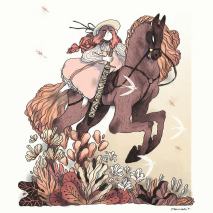
She is an illustrator who I would like to potentially take inspiration from when creating work for my ‘Wizard of Oz themed project. As her work is very textural in style, (as I believe she uses pencil for tonal work, then scans the design in and colours it digitally) I felt if I were to create work in a similar method, I would be able to create work that may appeal more to a younger audience, as they could potentially recognise the textures as mediums they use too.
Figure 1 – Tina Nass, 2017
Another reason that I had chosen this artist, is again, because of the methods and techniques she uses. As I have been playing around with traditional and digital skills in my own illustrations over the holidays, and I have been enjoying the process of doing so, but have felt that my designs have been on the more ‘sketchy’ side, not being up to my usual standard of quality (even though I do love the outcomes), I wanted to take inspiration and learn from Tina Nass’s particular process, to potentially help in creating more refined designs whilst using these techniques.
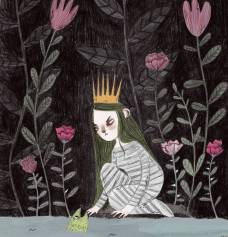
Like Tina Nass, I believe Nuria Tamarit works in a similar process, creating all of her linework and textural qualities by hand, then colouring the designs digitally. I will be using her work as well as Nass’s for inspiration during my ‘Wizard of Oz’ project, however, I will be taking more inspiration from her characters rather than her textures or methods.
Figure 2 – Nuria Tamarit, 2017
Her characters will typically have a cartoon aesthetic, with exaggerated anatomy, especially in the limbs. From looking at some of her pieces, I would say that she creates a lot of Amazonian type of figures, as they are lengthier in the leg, and thicker proportioned.
When taking inspiration from her work, I will be playing around with my own characters proportions and anatomy, seeing which areas that I can potentially exaggerate as to possibly give the characters more personality, for instance, when creating the cowardly lion, I could give him more of a barreled chest, as he is supposed to be a fighter, and I feel this element would help to suggest that quality.
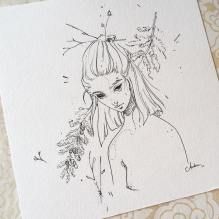
Audra Auclair is one of my favourite artists, I have mentioned her countless of times in previous projects throughout this course, the art and design course beforehand, and I may have even mentioned her within my secondary school projects. I am in love with her work and proudly own 3 of her prints and the book ‘fragments’ that she had made.
Figure 3 – Audra Auclair, 2017
My reason for mentioning her yet again within this course is because I wanted to take inspiration from her inked illustrations, (especially from figure 3 to the left) for my own inktober designs. As I will be creating flower people/pixie type characters, I would like them to be quite delicate and soft in style, so I will try to take inspiration from this specific piece of work, creating my own characters with similar line weights, as I feel the use of fine liners within this piece, has possibly made it even more delicate, as it is less heavy than a brush-tip pen, which she has also used in the past.
Bibliography
A. Auclair. (2018) Instagram [Online] Available at: https://www.instagram.com/audraauclair/ [Accessed on 24 Sep. 2018]
This year, it being my last in college, I want to make the most of it to improve my work. I will do this by trying new mediums and techniques, more so in the realm of traditional work as in the previous years I have mostly worked digitally. I also want to explore more areas of illustration, especially in the areas which my portfolio may be lacking, so I want to create more narrative based work, i.e book illustrations or covers, and I would like to create more editorial-based pieces, illustrations based on articles, current topics I feel strongly about, etc. Although I do enjoy creating pretty pieces with next to no context behind them, I do want to start creating more work that does contain stronger messages or can depict a story through them. I don’t feel I have done this a lot in my previous work, so would like to try to do so in my final year.
Strengths and Weaknesses:
I feel my current strengths are in digital work, but I have started trying to incorporate more traditional mediums, mostly within the linework. At the end of last year, I was using a Tombow calligraphy pen for my linework then colouring the pieces digitally, and during summer I wanted to be more experimental and had digitally coloured more sketch-based characters, either created with a pencil or a ball-point pen.
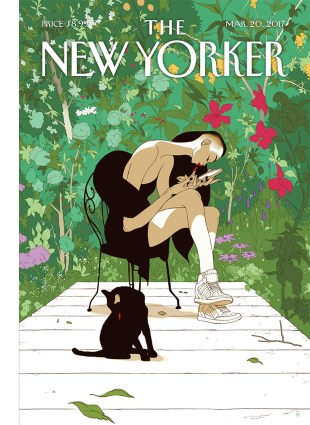
T. Hanuka, Spring Awakening (2017)
Another strength I believe is my colour palettes. I feel I have a good idea of colour theory, so I don’t tend to struggle when choosing a colour palette, but if I do, when working digitally I just have a play around with hue and saturation option in photoshop, until I reach a tone that I feel fits well with the others and allow the piece to be visually appealing to the eye. My palettes are usually inspired by the themes and/or content of the pieces I create, but I do also find inspiration from other artists, for instance, Tomer Hanuka has influenced a lot of my previous work as I love his work with colour. In his work, he uses quite a monochromatic palette, but then uses a complementary colour which helps offset the piece, and is very attractive to the eye. I have found a lot of inspiration from his work in the past and I feel I have learnt while doing so, so I have been able to form my own palettes from the knowledge of his, knowing which colours work well, what themes they may suggest, what other colours can I add to make the piece more intriguing or which I can add to make my work more easy on the eyes.
I believe my most common weakness is with traditional mediums. Before starting the course I did work more traditionally, using fine liners, markers, paints, pencils etc, but I feel as I have learnt more digital skills and my work has become more refined and of a higher standard over the years, I have lost more confidence with these mediums as the marks they make are a lot more set in stone than working digitally is, for instance, if you make a mistake digitally, you can just edit and undo it, but if you make a mistake with a traditional medium it is a lot harder to erase (unless you’re working with pencil).
I also had less confidence with traditional mediums when it came to linework as I felt my hand/line control would be a lot more wobbly than I intended, not creating as smooth of a line as I could in a program like Illustrator. I have however been trying to improve on my confidence with these issues, for instance in my last few projects last year, I had created the linework by hand, and although some of my lines were more wobbly than I would have liked, I would enjoy the overall piece as I felt they would be less static than my linework from illustrator was. Since not every line was smooth and perfect, I feel it added a more personal touch to my work and I would like to carry on creating my linework by hand, possibly using more mediums than fine liners or my Tombow pen in the future.
Like I had mentioned, I did try experimenting with sketch-based work in the holidays, so ideally I would like to try find a way to use these mediums and techniques but in a more refined way, so that my work would be of an industry standard and quality and would not look as ‘sketchy’.
Professional Development Plan:
As this first module is based around development, I would like to use it as a way to experiment and expand my knowledge. Ideally, I would like to take part in inktober, creating an inked illustration per day every day for the month of October, I believe it would help in improving my confidence with a traditional medium, specifically with my line control, but as I rarely work with ink, it would allow me to experiment with it, learning what marks I can make, if I can create gradients, etc, I’d be gaining more knowledge of the medium from my experience with it and potentially taking that information further into my future work.
Staying along the lines of traditional methods, I would also like to experiment more with printing methods, for instance, screenprinting, etching, linocut printing, printing with a laser cut plate, etc. With this, I would be gaining more knowledge in the form of output, how I could potentially create prints in the future, rather than just using a normal printer. I could potentially still work digitally with some of these methods, but if I were to output my illustrations through an alternative method to a normal printer, for instance using screenprint, it would add more of a personal touch to a possible product, being that I would have created it myself by hand and would have put more thought into how the design would work when printed, i.e with colours, specific layers, how they would be arranged and so on. In the past, I have not had great experiences with screenprinting, however, I know it is a common method used by other artists to create their own products i.e. prints, t-shirts, tote bags etc. so I do want to give it another try, to see if I just had a bad experience the first time, whether it was the design I was using, the method, if I was doing something wrong or whether screenprinting is just not for me?
As I mentioned before, I do want to create more narrative-based work, whether this is book illustrations, covers, or pieces with more backstory. Over the holidays we were asked to think about personal projects we’d like to do and I thought of making illustrations for the Wonderful Wizard of Oz and the Lion, the Witch and the Wardrobe. Both of these stories already have well-known imagery behind them, but I feel the imagery has mostly come from the movies as opposed to the books, so I want to read both of these books, see for myself if there are any differences from book to film, as is very common with movie adaptations, but I want to illustrate as true to the book’s descriptions as possible so that I may potentially give a fresh perspective to the stories, renewing them in my own style.
Looking into competitions for the more commercial side of this module, the ones coming soonest and the ones I feel most interested in are the more narrative-based ones. I have been looking into the Penguin Student Design Awards and House of Illustration – Book Illustration Competition. In both, I would be designing book covers, but for the House of Illustration one, I would also be creating a set of illustrations of the book they choose. In the Penguin Competition, you do get a choice in categories of stories, either adult’s fiction, adults non-fiction and children’s books.
So if I were to participate in both of these competitions, as well as my ideas for personal projects, I would be creating a lot of narrative-based work, but I would have to consider which routes to take, as I would not want my projects to clash or potentially come across as too similar, I do want to create a range of work for a range of different clients and audiences throughout this year.
As I assume my work is going to be based around existing stories, I believe my research will mostly be coming directly from the books, using quotes, finding characters, backgrounds and element descriptions straight from the sources so that I can create illustrations as accurate to the original stories as possible. I feel by not working from the imagery I already know that it will set me apart from other illustrations that may exist, especially if it is in context of a competition as other artists may rely too much on the imagery that is already known as opposed to reading the book themselves, especially if there is a time constraint.
As of other research, I mostly find style, artists or concept inspiration from social media, scrolling through the many artists I follow on Instagram or finding work/images on Pinterest, normally suggested to me by images I may have already pinned, or from a direct search of a theme. It may be due to being a Gen-Z…
(TANGENT – I like term post-millennial better for myself as although I missed the millennial status by 2 years, I do feel closer to those than the extremes of Gen-Z. I did probably grow up with more access to technology than the previous generation, but I believe I still had a ‘normal’ childhood without needing to have a phone in my hand, actually playing outside with my friends on a day to day basis. I hate when I see toddler nowadays with a tablet in their hands. I’m hoping that when my generation becomes parents, they will recognise this as a problem and will try to raise their children as they were. This in no way was supposed to be read as a hate to Gen-Z, I actually watched a video comparing millennials against Gen-Z’s and they did come out the more positive minded generation, I just don’t like the thought of being judged for having resources available to me now that older generations have not, but having that supposedly affect me in a negative way. All generations will have had factors that could have affected them, whether it has been war, politics, economy, but no one would want it to be held against them and told: “your generation is like … because of …” but the news especially loves to blame millennials and probably Gen-Z next for any changes going on, but they say it in such a negative light. I could make a whole seprate blog post about my views on this topic, but would you want to read that? Feel free to leave a comment if so! BACK TO THE TOPIC)
…but I love finding inspiration online, when I find new artwork on Pinterest, I love seeing the suggested images afterwards then falling down a rabbit hole of going from one piece to the next and to the next, by doing this I have formed a lot of ‘boards’ two of which I add to and use for inspiration the most you can go check them out here, one is of people, of all different ages, genders, nationalities and so on, and the other is of illustrations, these are pieces that I will have found over the past few years, which I enjoy for some reason or another, but I feel I can come back to at some point to use as inspiration. It’s actually funny when I don’t know what to create and I haven’t looked at the board for a while, as I do forget what is in there and I always refind something that I saved once upon a time which inspires a new concept, colour palette or style I want to use, and it does encourage me to create new work.
Anticipated Challenges:
Time management will always be a hidden challenge, especially with this year if I am estimating the dates of the competitions (when they start and their deadlines). As a module, I do need to plan out my semesters setting out my projects over the given timeframe so I will do my best to stick to the timetables I give myself. As to hopefully not have any issues with time, I do want to keep a planner with me at all times, keeping track of what I’m doing, what I still need to do, when does that task need to be achieved by and so on. I feel this will keep me more organised, keeping me on track of what needs to be done and when, and hopefully the organisation will encourage more workflow. In the past when I have not kept myself organised, I have battled with motivation, lost myself to procrastination and so on, but this year, my final one, I do want the best results for myself and I know I need to put in all the time, effort and motivation get myself those results. So I am determined to keep myself on track, and if I can achieve my goals with the least amount of stress, then that will be perfect.
If I am to work with multiple printing methods, another challenge could possibly be trying to book space within the printing room or the workshop. Since I am within a college with lots of other course and lots of other students, there may be times in which the print room or workshop will be full or the queue for the laser cutter will be too long, so to combat these potential problems, I will try to book a time in the print room if needed earlier on rather than later, as well as creating a plate on the laser cutter sooner rather than later. This will just ensure that I do not run out of time, I do not clash with any other classes and will have my prints created in time for the deadline.
List of Illustrations
Hanuka, T. (2017) Spring Awakening, The New Yorker. [Online] Available from: http://thanuka.com/#/spring/[Accessed on 17 Sep. 2018]
All other pieces are my own unless stated otherwise.
The Infographics Show. (2019). Millennials vs Generation Z – How Do They Compare & What’s the Difference?. YouTube. [online] Available at: https://www.youtube.com/watch?v=aqdm6aBUZII [Accessed 27 Apr. 2019].







 Melon.R