Learning Plan: Semester Two

Overall Objective:

Since the last learning plan I created back at the beginning of semester 1, I believe I did achieve some of my goals within that time and have made improvements within my work. My main goal with this year is still to keep on improving, but within semester one I was able to gain more confidence with traditional mediums and printing techniques, I did this through my inktober challenge and the Lion, the Witch and the Wardrobe project. I was also able to achieve my goal of creating more narrative based illustrations, as again, I had created chapter illustrations for the story of the Lion, the Witch and the Wardrobe, I made two book covers for the Penguin Student Design Awards, these were based on Wonder (the children’s book category) and Norwegian Wood (for the adults fiction category) and finally, I did make a set of 3 illustrations for House of Illustrations Book Illustration Competition, which were based on the book Howls Moving Castle, which I had also made a cover for.

In my previous learning plan, click here to read, I had mentioned that I would like to potentially create more editorial pieces, so as I could not do this during the first semester, I would like to try create something along those lines this time. I wouldn’t necessarily be illustrating an article, but I would like to create a piece with a deeper meaning, possibly more thought-provoking as this is not an area that I have really ventured in as of yet, but by doing so I may be able to show themes or communicate current topics that I feel strongly about through my work, potentially allowing the audience to get to know me better.

As I had worked on the Lion, the Witch and the Wardrobe project during semester one instead of the Wizard of Oz one as I had initially planned (I swapped the two around as I felt the LWW project would be better suited to the module as it was going to be more experimental testing out the multiple printing techniques) this semester I will be working on the Wizard of Oz series, and I still wish to work somewhat in the style of Tina Nass, who I had mentioned in a previous blog post which you can read here.  This means again I will be working with more traditional mediums, this time pencil, which hopefully I will gain more confidence with.

In my original proposal for the year, I had planned to work on branding throughout the year, and although I did redesign my business cards, created a depop and did sell two inktober zines along with a couple of prints, there is still a lot more that I want to create before finishing college later this year. This includes: creating a website, (including my portfolio and possibly a shop) creating more products, i.e. prints, t-shirts, pins, bags, stickers and so on. Then working on a promo pack which I can send to possible clients/agencies, I believe this will include a creative cv, business card, a print, stickers, a pin and then I want to create a sort of box that will contain all of these elements.

I did have a better experience with screenprinting so I believe this will be the main method used to create my products especially for the fabric based items like the t-shirts and tote bags, for the prints, however, I may use the risograph. In the past when I have created riso prints, I have really enjoyed how the textures and colours turned out, especially since I used a bright pink combined with a deep blue, so when making my prints I may stick with this form of output as when imagining all of my prints together (old and new) there will be a sense of uniform, right now I’m not sure if that is a good or bad thing though but I will give it more thought closer to the time.

Strengths and Weaknesses:

From the last module, my biggest issue was that my projects ended up overlapping one another, which ended up making me more confused and more stressed towards the end of semester two. I believe this was because I was reading the books one straight after the other, so when I should have been focusing on just one project I would be reading a book for another and feeling like I should be taking notes and creating work for that specific story. So this may not be as much of a problem within semester two if I am not working with as many books, but I will still try my best to remain organised and on top of things, and just focus on one project at a time.

I believe my strengths last semester were my book covers for the Penguin competition, I was able to create them within a short space of time and do feel they are of an industry standard. What I underestimated when starting and initially planning this year was the time frame of the projects. I had thought that since the personal projects were of my own doing that they could be done quicker, however, I had found that they were actually the lengthier projects. Since the commercial ones did have set deadlines I believe I had more incentive to finish them, but with the personal ones, as I did not have a set deadline for myself, I believe there was more time and room for doubt and I always felt I could add more or make changes and so on, but that took time and time which I did not have. Saying this, however, I believe the most improvements came from the personal projects as I did become more confident working traditional, specifically with ink, lining my designs with fine liners then bleeding the ink out with water as to create tone within my work. I also gained more experience and knowledge with certain printing methods, I learnt what worked well and what did not, i.e laser cutting plates as one had not worked as well as the other, as the ink had bled into the sections that were supposed to be left white. This project also renewed my faith in screenprinting, you can read about it here, so it does encourage me to use it more as an output method in the future.


Professional Development Plan:

Within the next few months, I do want to create more commercial work, exploring more areas of illustration such as editorial, so that I can expand my portfolio and potentially gain experience from doing so. I will attempt to do this through competitions and live briefs, the only one I am currently aware of and interested in is the Cheltenham Illustration Awards, which I have created work for in the past, but I hope to find more competitions as the module goes on, as some may not have been announced yet and may come out later in the year. If this is the case then I may have to make quick turnarounds so that the potential addition of another project won’t clash with the ones I already have set in place.

As of my personal projects, my goal is to create a series of illustrations based on the story of The Wonderful Wizard of Oz, so with this project I will gain more experience showing narrative within my work, (in a different sense to how I worked in the previous module, for instance, I want to show the characters continuously from one piece to another, whereas in the previous projects I just drew backgrounds, items or a created a slight suggestion of a character) but in this project I also want to try working more traditionally, using pencil to create the linework and textures within the piece, then I would scan each of the illustrations to colour them digitally, adding the vibrant colour palette that the story already suggests, for instance, the yellow brick road, the emerald city and so on. (I would have also mentioned the ruby red slippers, however, in the book the shoes are actually silver).

When focusing on my branding, I’m sure I will gain a lot of knowledge from that experience as well, as I have never made a website before, I’ve never created pins, screen-printed designs onto clothing and so on. I feel I will also learn more about myself, as to create your own branding I feel you do have to do a lot of self-reflection, thinking about your style of work, what imagery you feel would best suit you, how best to sell yourself and your work through elements such as business cards, websites or creative cv’s. Then there is more thought about promo pack’s, who would you be sending them off to? Agencies, potential clients? You have to consider who you feel your work is best suited to and who would most likely give you a job. All of this I believe will help more once I’ve left college, as I feel it will create a strong base in which I can establish myself as a freelance illustrator, applying to agencies, gaining work, but also selling work like prints, pins or t-shirts etc, on the side as I will hopefully have more knowledge of how to make/where I am able to get these products after this project, for instance, if I am to order pins or any product for that matter, from online, if I have a bad experience I will know not to use a company again, but if it is a good experience I will have a reliable source to create more products with.

Research:

In terms of research, I don’t believe there will be as much as I had in the previous module. With my Wizard of Oz project, I do intend to read the book and take quotes directly from it, so that I can illustrate the specific scenes as accurate as possible. I also intend to research artists, looking more into their process, how they may create their work, and I will try to take in that knowledge and apply it to my own work in my own style.

For the more unknown projects, I believe I will mostly be forming research from social media, for instance, Pinterest or Instagram, finding artists, illustration styles, colour palettes, or images to inspire my own work. When doing this, I do try to go in more depth, researching the artists and their processes, inspiration or thought process behind the piece more. If I do work with stronger themes (as I intend to) I will be doing more research into that theme as well, because although I may feel strongly about it, I would want to know all the facts and information first before creating the piece, so that I could best communicate the issue and strongly stand behind it if someone were to question it or if they wanted to know more information.  This information could potentially be sourced from websites, articles, blogs, interviews and so on.

Anticipated Challenges:

Time again may be a big challenge, but I believe with this module I am going to work more loosely with my timetable. In the last module, my projects did overlap too much which did get me confused and did cause more stress as I ended up trying to work on multiple projects at once. Although this was a bad experience, I do believe I learnt from it, as I feel I now have a better idea of how long my commercial projects may last in comparison to my personal projects, as I was able to produce commercial work a lot quicker as I felt I was more critical of my personal work and since I didn’t have as short of a deadline, I was allowed to be more critical, but that allowed me to take more time on the project, time which I did not necessarily have. SO, with this next module, my projects will not overlap with one another and I will only be focusing on one at a time. When I say that I am going to be working more loosely with the timetable, however, I mean that  I’m going to try making a loose plan of what I believe the dates will be, for instance, what time competitions will be released, how long I will be giving myself on certain projects, but as this module is more unknown, these deadlines will not be set in stone, and if the competitions are announced earlier or later than expected, it will be alright as I can swap around some of my personal projects times. This may seem like a recipe for disaster but it does make sense in my head. My main goal for the next couple of months is to just solely work on one project at a time, without any overlapping, and if I can do that I will be happy.

Another possible challenge will be with access to resources, especially when it comes to the last couple of months as a lot of the courses within the college will be trying to print or produce products for their own deadlines. This may make it harder to use the print room, the workshop, or the printers within CAAD. So as an attempt to battle this, I will try to produce everything earlier, at least within time for my own deadline. This means printing for my portfolio, producing merch: if I use screenprinting for t-shirts or tote bags, if I create another laser cut plate for prints, if I need to use the risograph. The closer it gets to the deadline I feel it will be harder to use these resources so I will try to plan in advance.


All images used are my own unless stated otherwise.


Learning Plan: Semester One

Overall Objective:

This year, it being my last in college, I want to make the most of it to improve my work. I will do this by trying new mediums and techniques, more so in the realm of traditional work as in the previous years I have mostly worked digitally. I also want to explore more areas of illustration, especially in the areas which my portfolio may be lacking, so I want to create more narrative based work, i.e book illustrations or covers, and I would like to create more editorial-based pieces, illustrations based on articles, current topics I feel strongly about, etc. Although I do enjoy creating pretty pieces with next to no context behind them, I do want to start creating more work that does contain stronger messages or can depict a story through them. I don’t feel I have done this a lot in my previous work, so would like to try to do so in my final year.

Strengths and Weaknesses:

I feel my current strengths are in digital work, but I have started trying to incorporate more traditional mediums, mostly within the linework. At the end of last year, I was using a Tombow calligraphy pen for my linework then colouring the pieces digitally, and during summer I wanted to be more experimental and had digitally coloured more sketch-based characters, either created with a pencil or a ball-point pen.

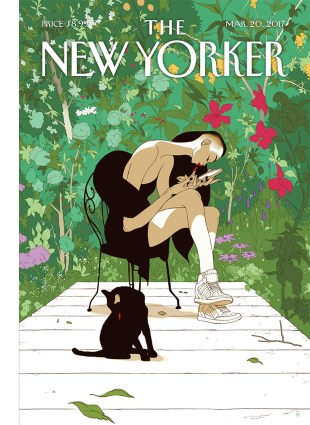
hanuka_style_flowers_FM_cv_wShadow_WHITE_strap_030217.jpg
T. Hanuka, Spring Awakening (2017)

Another strength I believe is my colour palettes. I feel I have a good idea of colour theory, so I don’t tend to struggle when choosing a colour palette, but if I do, when working digitally I just have a play around with hue and saturation option in photoshop, until I reach a tone that I feel fits well with the others and allow the piece to be visually appealing to the eye.  My palettes are usually inspired by the themes and/or content of the pieces I create, but I do also find inspiration from other artists, for instance, Tomer Hanuka has influenced a lot of my previous work as I love his work with colour. In his work, he uses quite a monochromatic palette, but then uses a complementary colour which helps offset the piece, and is very attractive to the eye. I have found a lot of inspiration from his work in the past and I feel I have learnt while doing so, so I have been able to form my own palettes from the knowledge of his, knowing which colours work well, what themes they may suggest, what other colours can I add to make the piece more intriguing or which I can add to make my work more easy on the eyes.

I believe my most common weakness is with traditional mediums. Before starting the course I did work more traditionally, using fine liners, markers, paints, pencils etc, but I feel as I have learnt more digital skills and my work has become more refined and of a higher standard over the years, I have lost more confidence with these mediums as the marks they make are a lot more set in stone than working digitally is, for instance, if you make a mistake digitally, you can just edit and undo it, but if you make a mistake with a traditional medium it is a lot harder to erase (unless you’re working with pencil).

I also had less confidence with traditional mediums when it came to linework as I felt my hand/line control would be a lot more wobbly than I intended, not creating as smooth of a line as I could in a program like Illustrator. I have however been trying to improve on my confidence with these issues, for instance in my last few projects last year, I had created the linework by hand, and although some of my lines were more wobbly than I would have liked, I would enjoy the overall piece as I felt they would be less static than my linework from illustrator was. Since not every line was smooth and perfect, I feel it added a more personal touch to my work and I would like to carry on creating my linework by hand, possibly using more mediums than fine liners or my Tombow pen in the future.

Like I had mentioned, I did try experimenting with sketch-based work in the holidays, so ideally I would like to try find a way to use these mediums and techniques but in a more refined way, so that my work would be of an industry standard and quality and would not look as ‘sketchy’.


Professional Development Plan:

As this first module is based around development, I would like to use it as a way to experiment and expand my knowledge. Ideally, I would like to take part in inktober, creating an inked illustration per day every day for the month of October, I believe it would help in improving my confidence with a traditional medium, specifically with my line control, but as I rarely work with ink, it would allow me to experiment with it, learning what marks I can make, if I can create gradients, etc, I’d be gaining more knowledge of the medium from my experience with it and potentially taking that information further into my future work.

Staying along the lines of traditional methods, I would also like to experiment more with printing methods, for instance, screenprinting, etching, linocut printing, printing with a laser cut plate, etc. With this, I would be gaining more knowledge in the form of output, how I could potentially create prints in the future, rather than just using a normal printer. I could potentially still work digitally with some of these methods, but if I were to output my illustrations through an alternative method to a normal printer, for instance using screenprint, it would add more of a personal touch to a possible product, being that I would have created it myself by hand and would have put more thought into how the design would work when printed, i.e with colours, specific layers, how they would be arranged and so on. In the past, I have not had great experiences with screenprinting, however, I know it is a common method used by other artists to create their own products i.e. prints, t-shirts, tote bags etc. so I do want to give it another try, to see if I just had a bad experience the first time, whether it was the design I was using, the method, if I was doing something wrong or whether screenprinting is just not for me?

As I mentioned before, I do want to create more narrative-based work, whether this is book illustrations, covers, or pieces with more backstory. Over the holidays we were asked to think about personal projects we’d like to do and I thought of making illustrations for the Wonderful Wizard of Oz and the Lion, the Witch and the Wardrobe. Both of these stories already have well-known imagery behind them, but I feel the imagery has mostly come from the movies as opposed to the books, so I want to read both of these books, see for myself if there are any differences from book to film, as is very common with movie adaptations, but I want to illustrate as true to the book’s descriptions as possible so that I may potentially give a fresh perspective to the stories, renewing them in my own style.

Looking into competitions for the more commercial side of this module, the ones coming soonest and the ones I feel most interested in are the more narrative-based ones. I have been looking into the Penguin Student Design Awards and House of Illustration – Book Illustration Competition. In both, I would be designing book covers, but for the House of Illustration one, I would also be creating a set of illustrations of the book they choose. In the Penguin Competition, you do get a choice in categories of stories, either adult’s fiction, adults non-fiction and children’s books.

So if I were to participate in both of these competitions, as well as my ideas for personal projects, I would be creating a lot of narrative-based work, but I would have to consider which routes to take, as I would not want my projects to clash or potentially come across as too similar, I do want to create a range of work for a range of different clients and audiences throughout this year.

As I assume my work is going to be based around existing stories, I believe my research will mostly be coming directly from the books, using quotes, finding characters, backgrounds and element descriptions straight from the sources so that I can create illustrations as accurate to the original stories as possible. I feel by not working from the imagery I already know that it will set me apart from other illustrations that may exist, especially if it is in context of a competition as other artists may rely too much on the imagery that is already known as opposed to reading the book themselves, especially if there is a time constraint.

As of other research, I mostly find style, artists or concept inspiration from social media, scrolling through the many artists I follow on Instagram or finding work/images on Pinterest, normally suggested to me by images I may have already pinned, or from a direct search of a theme.  It may be due to being a Gen-Z…

(TANGENT – I like term post-millennial better for myself as although I missed the millennial status by 2 years, I do feel closer to those than the extremes of Gen-Z. I did probably grow up with more access to technology than the previous generation, but I believe I still had a ‘normal’ childhood without needing to have a phone in my hand, actually playing outside with my friends on a day to day basis. I hate when I see toddler nowadays with a tablet in their hands. I’m hoping that when my generation becomes parents, they will recognise this as a problem and will try to raise their children as they were. This in no way was supposed to be read as a hate to Gen-Z, I actually watched a video comparing millennials against Gen-Z’s and they did come out the more positive minded generation,  I just don’t like the thought of being judged for having resources available to me now that older generations have not, but having that supposedly affect me in a negative way. All generations will have had factors that could have affected them, whether it has been war, politics, economy, but no one would want it to be held against them and told: “your generation is like … because of …” but the news especially loves to blame millennials and probably Gen-Z next for any changes going on, but they say it in such a negative light. I could make a whole seprate blog post about my views on this topic, but would you want to read that? Feel free to leave a comment if so! BACK TO THE TOPIC)

…but I love finding inspiration online, when I find new artwork on Pinterest, I love seeing the suggested images afterwards then falling down a rabbit hole of going from one piece to the next and to the next, by doing this I have formed a lot of ‘boards’ two of which I add to and use for inspiration the most you can go check them out here, one is of people, of all different ages, genders, nationalities and so on, and the other is of illustrations, these are pieces that I will have found over the past few years, which I enjoy for some reason or another, but I feel I can come back to at some point to use as inspiration. It’s actually funny when I don’t know what to create and I haven’t looked at the board for a while, as I do forget what is in there and I always refind something that I saved once upon a time which inspires a new concept, colour palette or style I want to use, and it does encourage me to create new work.


Anticipated Challenges:

Time management will always be a hidden challenge, especially with this year if I am estimating the dates of the competitions (when they start and their deadlines). As a module, I do need to plan out my semesters setting out my projects over the given timeframe so I will do my best to stick to the timetables I give myself. As to hopefully not have any issues with time, I do want to keep a planner with me at all times, keeping track of what I’m doing, what I still need to do, when does that task need to be achieved by and so on. I feel this will keep me more organised, keeping me on track of what needs to be done and when, and hopefully the organisation will encourage more workflow. In the past when I have not kept myself organised, I have battled with motivation, lost myself to procrastination and so on, but this year, my final one, I do want the best results for myself and I know I need to put in all the time, effort and motivation get myself those results. So I am determined to keep myself on track, and if I can achieve my goals with the least amount of stress, then that will be perfect.

If I am to work with multiple printing methods, another challenge could possibly be trying to book space within the printing room or the workshop. Since I am within a college with lots of other course and lots of other students, there may be times in which the print room or workshop will be full or the queue for the laser cutter will be too long, so to combat these potential problems, I will try to book a time in the print room if needed earlier on rather than later, as well as creating a plate on the laser cutter sooner rather than later. This will just ensure that I do not run out of time, I do not clash with any other classes and will have my prints created in time for the deadline.


List of Illustrations

Hanuka, T. (2017) Spring Awakening, The New Yorker. [Online] Available from: http://thanuka.com/#/spring/ [Accessed on 17 Sep. 2018]

All other pieces are my own unless stated otherwise.
Reading List

Dimock, M. (2019). Defining generations: Where Millennials end and Generation Z begins. [online] Pew Research Center. Available at: https://www.pewresearch.org/fact-tank/2019/01/17/where-millennials-end-and-generation-z-begins/ [Accessed 27 Apr. 2019].

The Infographics Show. (2019). Millennials vs Generation Z – How Do They Compare & What’s the Difference?. YouTube. [online] Available at: https://www.youtube.com/watch?v=aqdm6aBUZII [Accessed 27 Apr. 2019].