(End of Year Evaluation) Reflective Practice Presentation – Part 2

In part one of this post I had reflected on my performance in my reflective practice presentation, it wasn’t really the best experience, but you can click here if you would like to read more about it. In this post, I will be going through each of my slides along with the script I made, but I have added more detail as I am able to go into more depth on my blog, but in the presentation, I did have a time limit so the initial script was more brief. If you have read my previous post then you will know how well the script and time limit worked for me.

Slide1

1

For this final year I had set myself goals that I wanted to achieve.

I created two learning plans for both semesters, the reason for this is that with semester one I had more of a plan than I did with semester 2, for instance I knew which competitions I would be doing and had a better idea of when they would be released.

Starting with learning plan one. I wanted more experience and confidence with traditional mediums, as I have tended to work more digitally in the past.

Another goal was to work with more narrative based projects, creating book covers or illustrating stories, as this is an area my portfolio that was lacking, and I wanted to expand.

If you would like to read more about my learning plan for semester one, you can click here.


Slide2

2

In the first project, Inktober, I had created an inked illustration every day for the month of October.

I used fine liners for the line work and then with a brush and water, I bled the ink which allowed me to create tone and shadows within my characters.

I chose to illustrate flower girls as this was imagery I was confident with, and a theme which I believed would last me the full month.

Other than viewing previous art for Inktober, there was not a lot of research needed for this project, but I had used reference images of women and flowers to help inform my designs.

By the end of this project I did feel a lot more confident with the medium. There were a few times where the ink may have bled or faces/features may have been drawn wrong, but I was able to fix these errors digitally and I was able to create a zine of the 31 illustrations which I have sold since. If you would like to purchase a zine you can have a look at my store at: www.melon-r.com/shop-1
 

Slide3

3

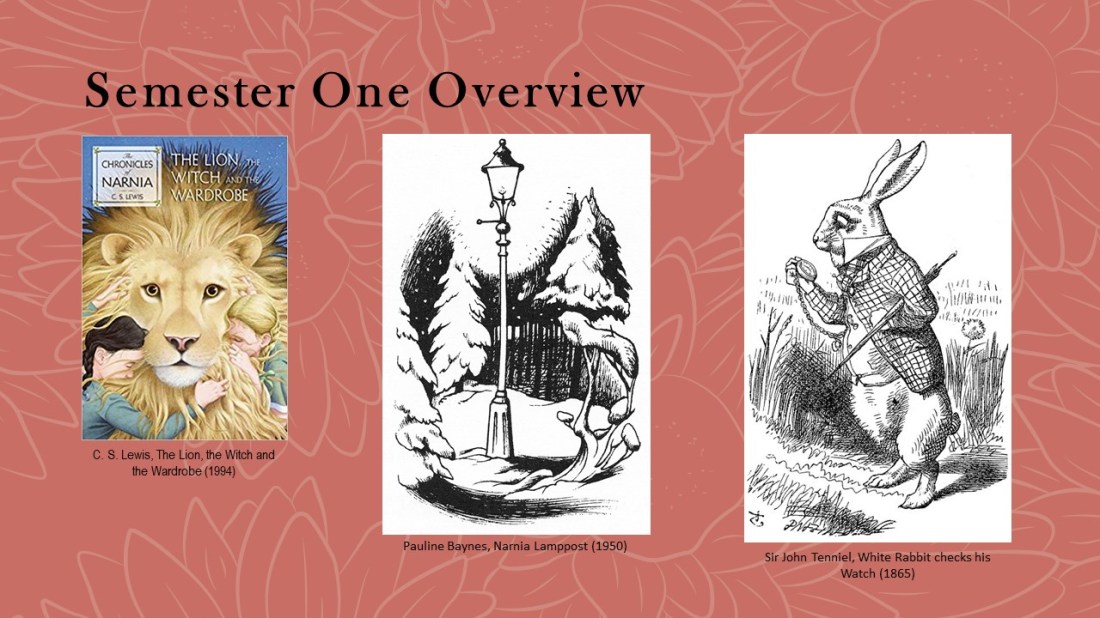
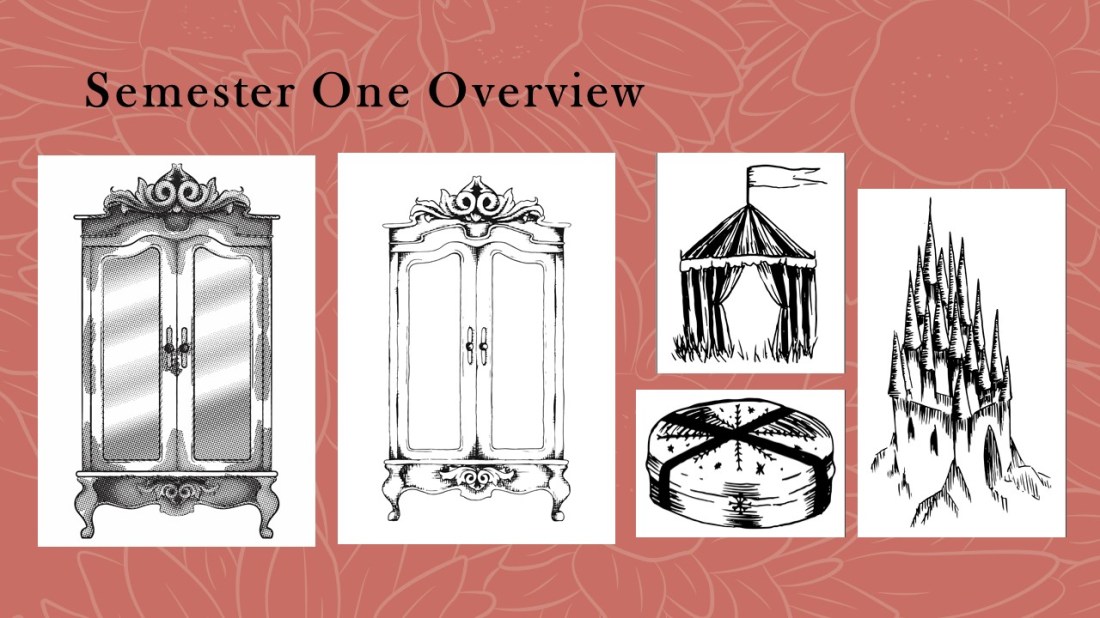
Moving onto the next project: the Lion, the Witch and the Wardrobe, I wanted to experiment with multiple printing techniques to give me more experience for potential output methods that I could use in the future. I also wanted to work with more narrative, following the goals set within my learning plan.

For research, I quoted directly from the book so that I could create accurate depictions of the story, rather than creating illustrations from the imagery I already knew. Initially, I was inspired by Sir John Tenniel and his intricate line work but had later found Pauline Baynes, who was the original illustrator of the Lion, the Witch and the Wardrobe, had worked in a similar style, but she had incorporated colour into her designs which I did not want to do with my own design so I felt my designs would still be different from illustrations already created for the story.
 

Slide4

4

When I first started this project, I felt I had started strong, using the wardrobe imagery to test out each of the printing methods, I.e. screen-printing, etching, using a laser cut plate and lino printing.

With the inclusion of more projects, however, I do feel I lost momentum and felt like I rushed the pieces to the right in the last couple of weeks/days.

Given more time I would’ve refined the last pieces by creating them in illustrator, drawing the line work by hand then using the laser cut method to print them, as I had felt this was the best and cleanest methods from my wardrobe print tests. I believe the addition of illustrator would have made the pieces more proportional, fixing the errors within the symmetry and potentially making the linework straighter and cleaner.
 

Slide5

5

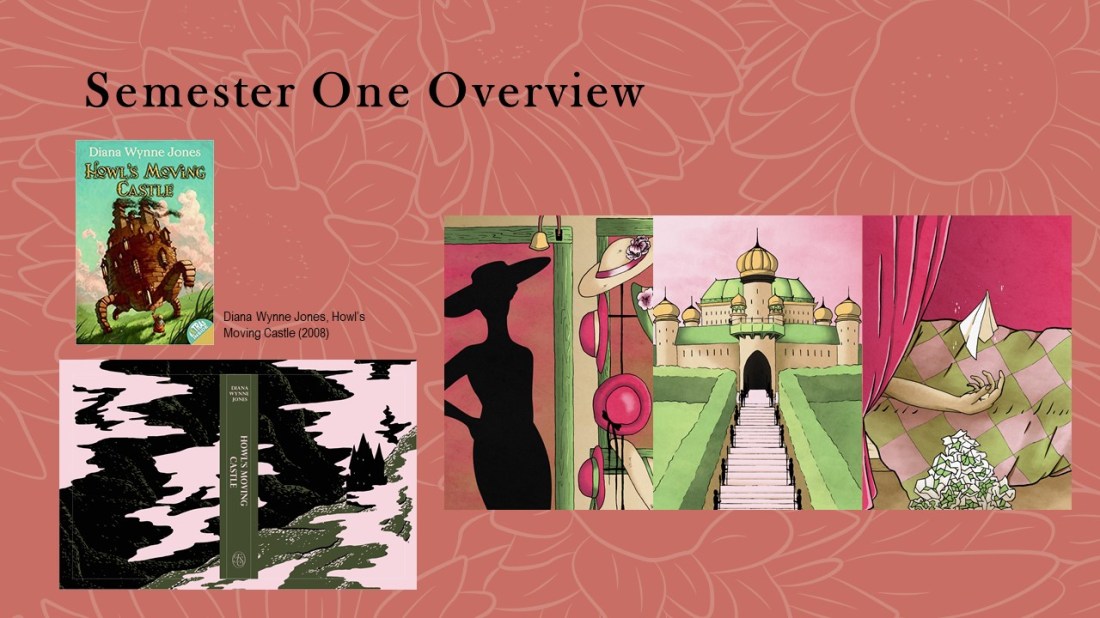
My next project was the House of Illustrations Book Illustration Competition. I had to create a set of 3 illustrations and a book cover for howls moving castle. Again this was narrative based brief, so it fit within the goals of my first learning plan. The only research that I had done for this project was just reading the book so that I again, could create an accurate depiction of the story, as opposed to working with content I may have already seen, for instance with Studio Ghibli’s adaptation of the book. (If you want to know my opinion of the original book and the movie adaptation, also listing the differences between the two, you can read about that here.)

Not researching other artists and styles may have been my downfall during this project as I did struggle when creating the pieces as I didn’t have a strong concept of the styles I wanted to use. I did, however, enjoy my choice of colour palette, as it is easy on the eyes and translates the themes of the book well, showing the magical essence without it being too being direct. The palace piece is my favourite, as I love the symmetry and perspective and it is how I had envisioned the king’s palace within the book. I have been able to translate my thoughts onto the page.
 

Slide6

6

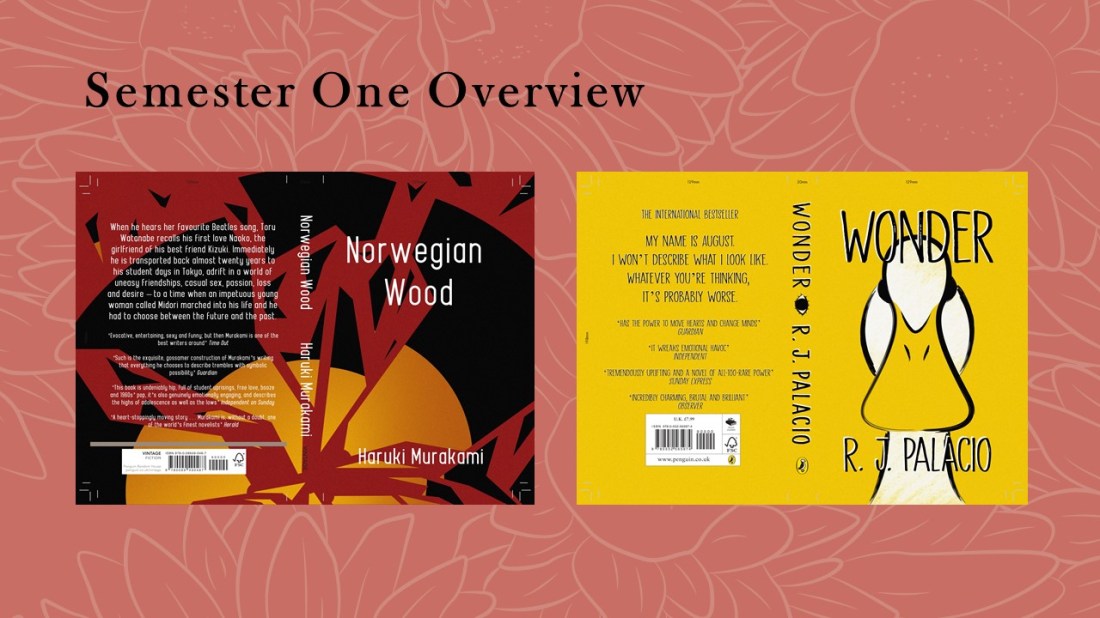
For the next project which was also a competition, this time for the Penguin Student Design Awards, I created 2 book covers for 2 separate categories; the adult’s fiction which was Norwegian Wood and the children’s book was Wonder.

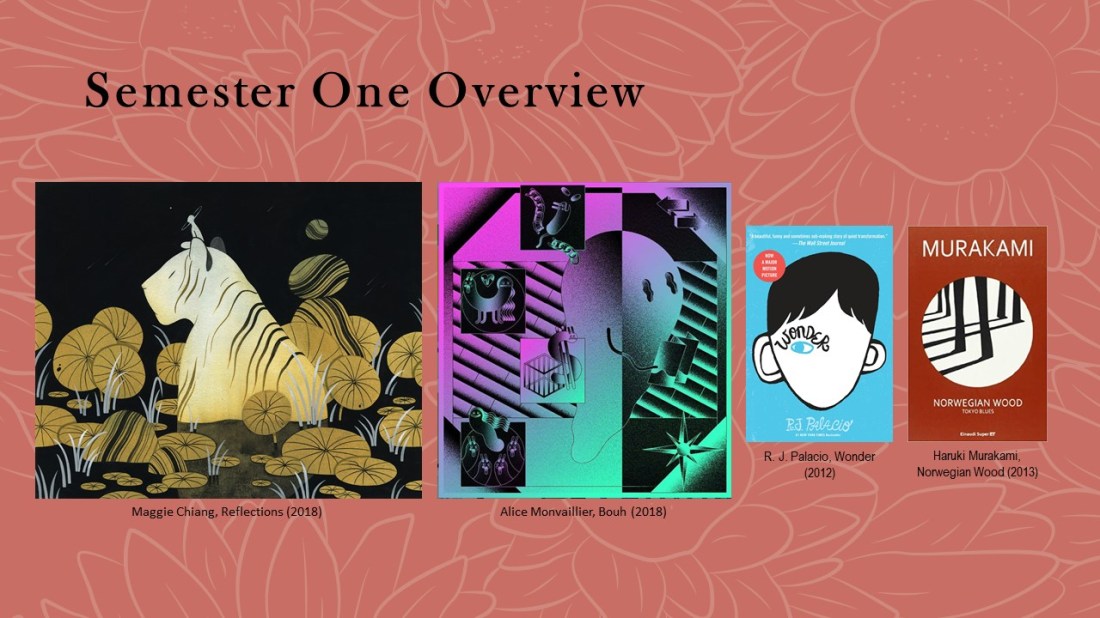
For research I looked at entries from previous years, looking for common trends that I could potentially apply to my own work. I had noticed that a lot of the covers were minimal, and some had a noise effect applied, this had led me to think of artists such as Maggie Chiang and Alice Monvaillier as I believed their styles would work well among the other entries, so would be a good source of inspiration for myself during this project.

Again, I had read both of the books as research.  This allowed me to get a better understanding of the stories so that I could know the type of content I would be creating for the covers, especially considering both books have completely different themes and audiences.
 

Slide7

7

These are the two covers I created. I did complete them within a short amount of time, but I don’t feel as if they look rushed and I feel like these are a lot different from my usual style, as they are minimalistic within the colour pallets and imagery, which are styles/palettes that I have tried to dip into but have not fully achieved until these two creations.

I had struggled a lot with the text and titles, being able to make them readable against the illustrations. In the future, I will consider the type a lot further in advance so that I can work my illustrations around the text, instead of just trying to work the text around the images as I had in this project.
 

Slide8

8

My weaknesses from the first semester were definitely to do with my time keeping and having too many projects in general which ended up overlapping, causing me confusion and stress.

From the first learning plan, I did achieve the goals I had set, working more traditionally and creating more narrative based pieces, so in the next learning plan my goal was to still try working more traditionally, this time using pencils, but I also wanted to create more thought-provoking pieces, that could potentially lean more towards the area of editorial.

I also wanted to use the last semester to focus on my branding, this would mean making a website, business cards, promo packs, merch etc. So that I had a base that I could grow from once I’ve finished the course.

From this point onwards, I vowed to not overlap any more projects, focusing on just one at a time. With the time plan I created for semester two, I was going to work more loosely with it, not having anything set in stone as at that time I still didn’t know when the competitions would be announced.
 

Slide9

9

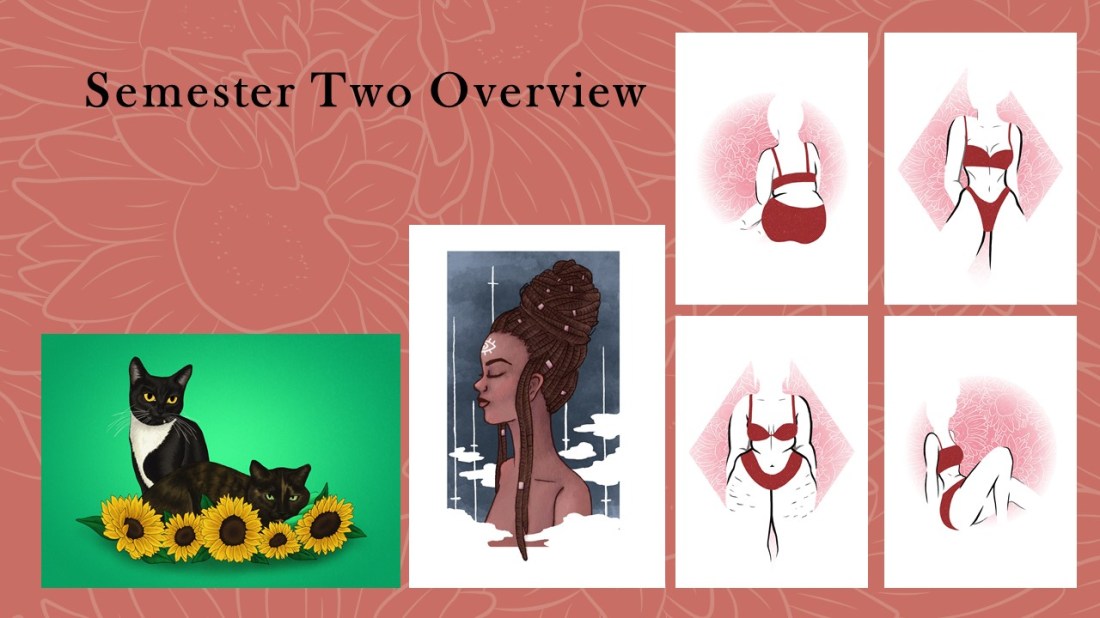
These are unplanned side projects which I ended up spending more time on than I necessarily had.

The first on the left was a commission piece for my friend.

The second was a ‘draw this in your style’ challenge in which I had to recreate an artist’s drawing in my own style, the piece here being a recreation of Chelsea Gracei’s work.

Then the final pieces on the right were a collection I created for ‘A Canny Collective’ which was a local exhibition that I was asked to be a guest artist for.

Although I had spent longer on these pieces than I should have, I do feel like I gained a lot of experience from them, especially with the exhibition pieces, as there was a whole process of creating the pieces and setting them up within the space, but I also worked on the stall on the opening night, so I was able to gain more experience of selling my own and others work one to one, which is something I do believe I will do again in the future. All of these pieces will also go towards my portfolio, hopefully allowing me to show more range of style, techniques and skill within it.
 

Slide10

10

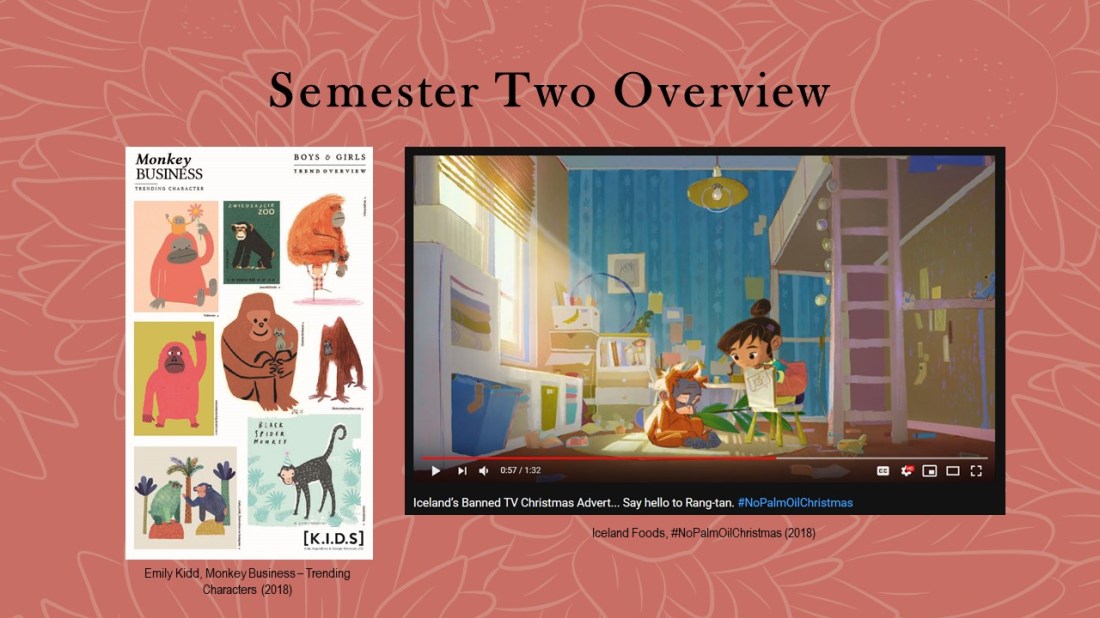
My goal with this specific project was to create a more thought-provoking illustration, which links back to the goals I set in my second learning plan.

For the Northern Illustration Awards, a competition by the AOI, the brief was ‘monkey.’ When searching Pinterest for inspiration I came across the image on the left, and in the corner saw an orangutan which had been created in a looser style which helped suggest the animal’s fur. I wanted to work in a similar style to create my own monkey, but I did want to use a stronger theme. Thinking of Orangutans, it had reminded me of the banned Iceland advert, in which it discusses the destruction of rainforests (the orangutan’s habitats) for palm oil.
 

Slide11

11

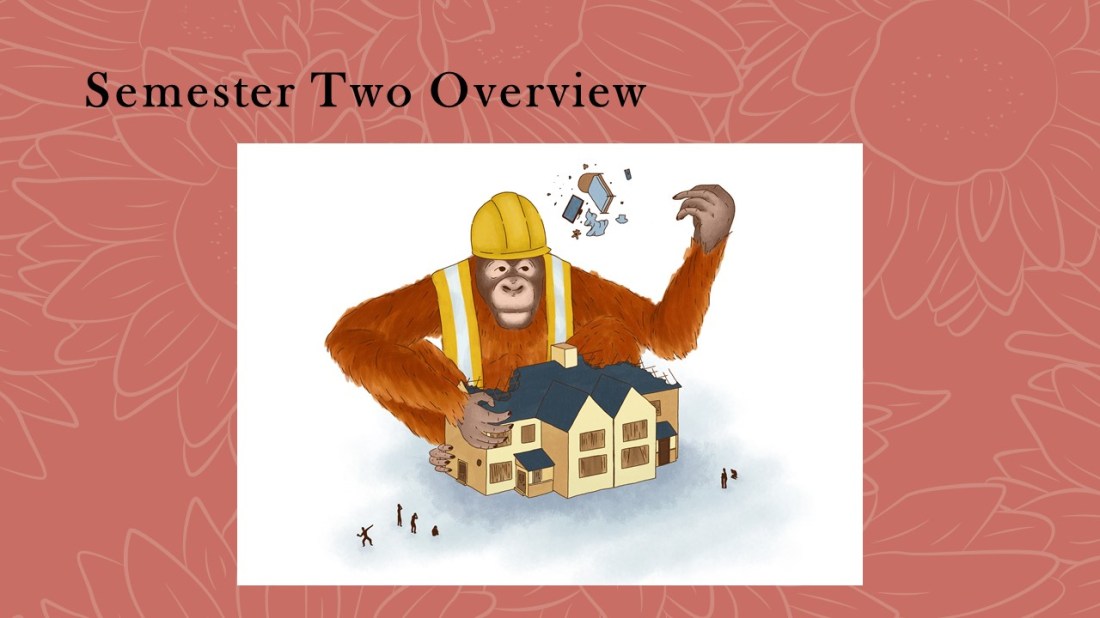
Within this piece, I wanted to show a role reversal between humans and the orangutans, they being the ones that are destroying our homes with such carelessness instead.

I enjoyed working on this piece as it was more experimental and I was able to work more loosely. I was able to play around with different brushes, (in the end, I had used a gouache brush for the fur and a ‘scratchy pen’ for the linework, both from Kyle T. Webster brush packs) and these, in turn, allowed me to build up my own impression of fur, which helped give a sense of realism but the style was still loose and quite painterly for digital art.

I designed this piece to fit within a white page, so it is more minimal in that sense, but this factor could potentially make it more editorial as I could imagine it fitting within a magazine as an illustration for an article.

With this illustration, I had recorded the process and created my first ever YouTube video which was a speed paint of this piece. I do want to carry on uploading more speed paint process videos, potentially giving more information in the form of a voice-over, but one day I do want to live stream as well as/opposed to recording, as I believe I would prefer to talk live to an audience, having an active conversation as I go, rather than feeling like I am talking to myself in a voice over.


Slide12

12

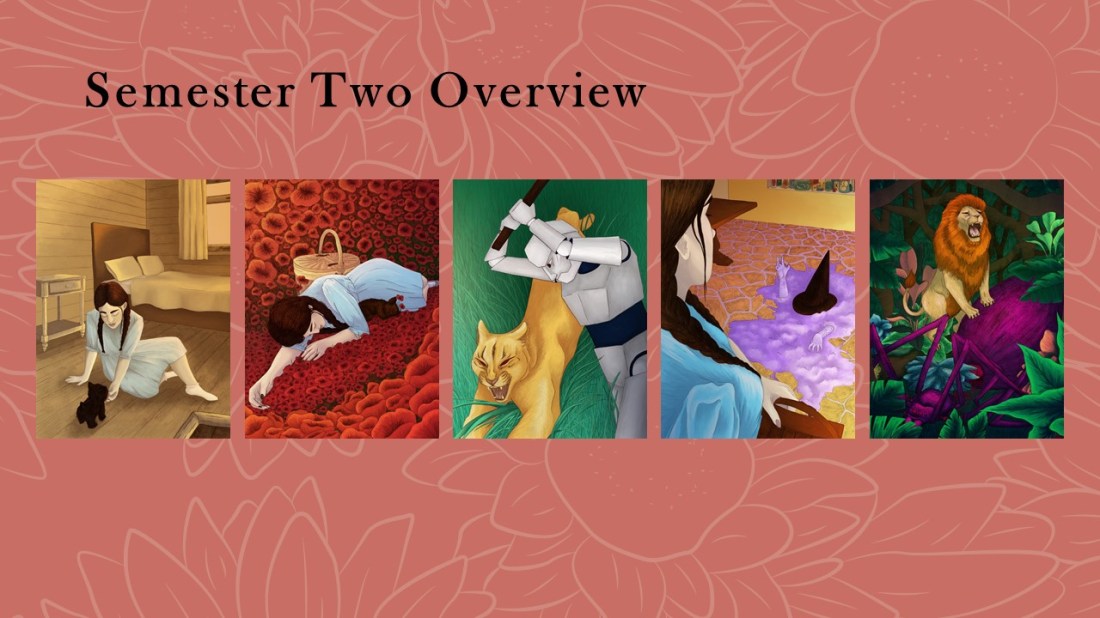
The next project was the Wizard of Oz, my goal with this project was to work more traditionally using pencil and then colouring the pieces digitally as I believed it would give me a better choice in colour palette. With this project, I did want to work with a more fun and vibrant colour palette than I may have used before, as I wanted my pieces to suit the colour themes suggested within the story, such as ‘Emerald City’ and the ‘yellow brick road’.

The idea for the mediums and techniques were initially inspired by Tina Nass, but as my project developed and I moved to a more realistic style within the project, I tended to take more inspiration from an artist named Chantal Hores as she still works with the same mediums and techniques as Tina Nass, however her style is more realistic, especially with her characters.

Again, my research had come directly from the book, finding quotes that would allow me to create an accurate depictions as possible, but in this project I did find it more useful as the movie adaptations were not completely true to the descriptions within the book, for instance, the famous ruby red slippers were actually silver in the story.
 

Slide13

13

These pieces have come a long way from the start, as I had originally sketched them out in a layout that looked flat and boring, I later repositioned and redrew the pieces using my own reference photos, as well as reference images online (more so for the animals) which allowed me to create more organic and dynamic viewpoints within my illustrations.

I’m extremely proud of the outcomes as there is a strong narrative throughout, one that I wouldn’t have thought that I would have been able to achieve at the beginning of the year. I love the colours as they are vibrant and express the themes of Oz. I did try to stay away from the known imagery when working on these pieces, and I do believe I’ve created my own unique interpretations of the story.

I loved the style of work and mediums that I had used and I hope to use them again more often in the future. If I find myself in a spot again where I feel my composition or layout of a piece is a bit boring, I will try to take my own reference images again, exploring different viewpoints and angles etc, so that I can potentially create more dynamic illustrations which are less boring and flat in the future.
 

Slide15

14

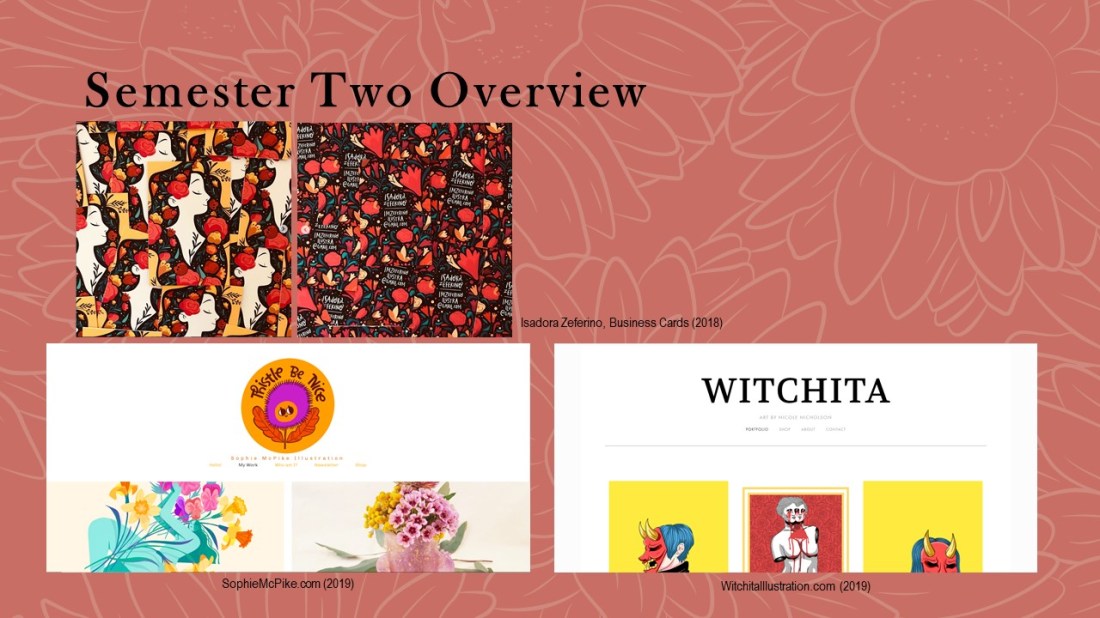
Branding has a lot of components within it, for instance I needed to create business cards, a website, a portfolio, creative CV and products and all of these would go into a promo pack which would be sent off to potential clients and or agencies.

As far as research goes, I initially started the process of creating my business cards within semester one, so that they could be sent off with my zines. I was inspired by an artist named Isadora Zererino as on her cards she has an illustration on the front and her information on the back, they are also portrait, which is something that I hadn’t seen very often and this is how I wanted my own to be laid out.

When creating websites, I was researching as I was going, looking at how other artists laid their work out, what their buttons were, how they ordered them, and how they described themselves in their about pages etc. For this, I had used Sophie McPike and Nicole Nicholson’s (who is a student in my class and made her site first) websites as inspiration. I also took information from a talk we had with someone from AOI who had explained that a client will make their impression of you within the first couple of seconds of looking at your website, so it’s good to have 6-9 pieces on display on the front page.
 

Slide14

15

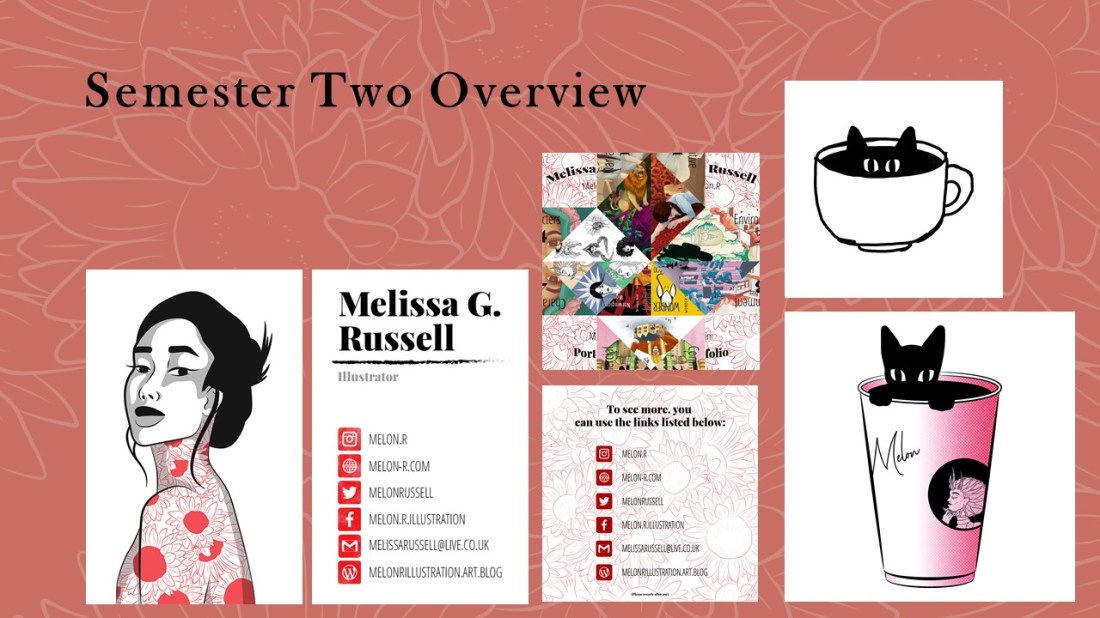
On this slide, to the left, I have shown my current business card with my website included which wasn’t present in semester one.

A mini-portfolio, which is actually a paper fortune teller. I felt this would be an interesting piece for someone to receive in my promo pack as it is a unique way for them to view mini clips of my work. On the back, I did provide links so that the receiver would be able to look at my portfolio more in depth, seeing the pieces that I have cropped down for this mini-portfolio in more detail.

The two pieces on the right side are merchandise ideas. On the top is a sketch of a potential pin. I want to create these in wood using the laser cutter in the workshop as ordering enamel pins is not in my budget or audience range at this moment in time. Maybe in the future, if I do build more of an audience, I could have a pre-order or made-to-buy system which would allow me to make a profit and would ensure that none would go to waste.

The second image on the right is going to be a sticker, potentially a little print.
 

Slide16

16

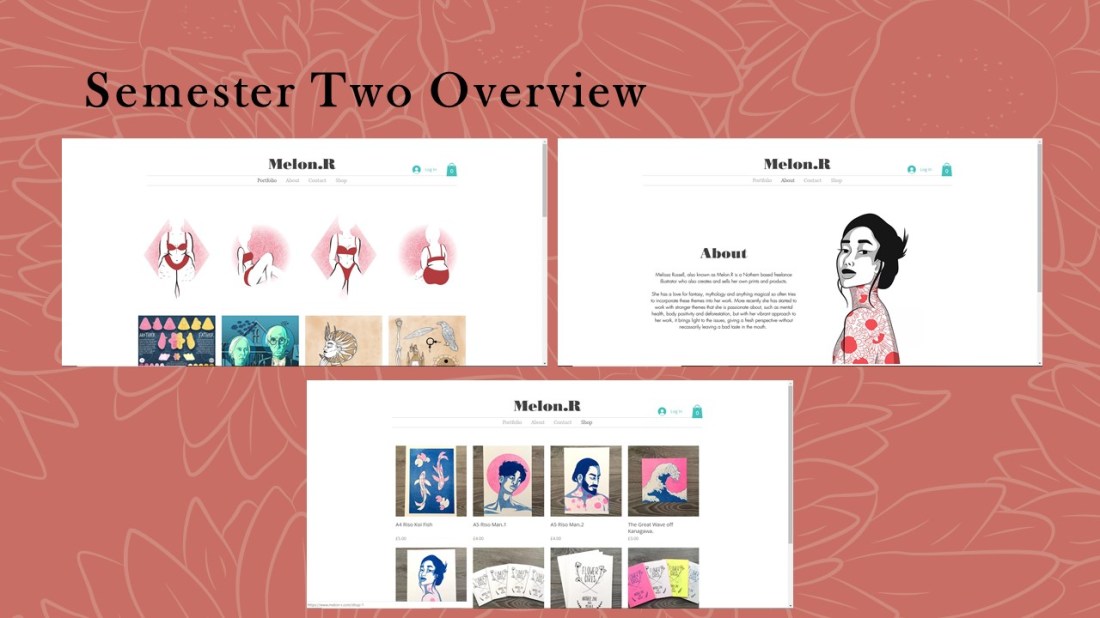
These are pages from my website. I still have work that needs to be added to the portfolio but I will want them to fit within a layout that is organised by colour or theme, which I believe will make the website more aesthetically pleasing to the eye, so I can potentially catch a client’s attention within the first couple of seconds, as the member of AOI had suggested. The website also has a shop which I do plan to work from in the future.
 

Slide17

17

Going into the future, I have applied for a teaching course within the college that will start in September. Before teaching properly, I do wish to have more experience in the industry so that I can teach from my knowledge and experience that I may have gained.

With my portfolio, I plan to visit the AOI to get a review and more information about which direction it should go, if I need to take anything out, if I need to add anything more and so on.

I will also be applying to agencies hoping to get more freelance based work.

I will be continuing to create products and selling them through my website.

I will still try to keep an eye out for competitions.

I will also continue creating YouTube videos, ones that are more in-depth with voiceovers added. I also want to live stream more, having a more relaxed experience, potentially talking one to one with my audience as I create my work.

Overall my goal for the next 5 years is to be a freelance illustrator, working with clients and potentially have an agent. I will also be creating and selling my own work on the side, as well as hopefully teaching level 3 students within a college.
 

Slide18

18

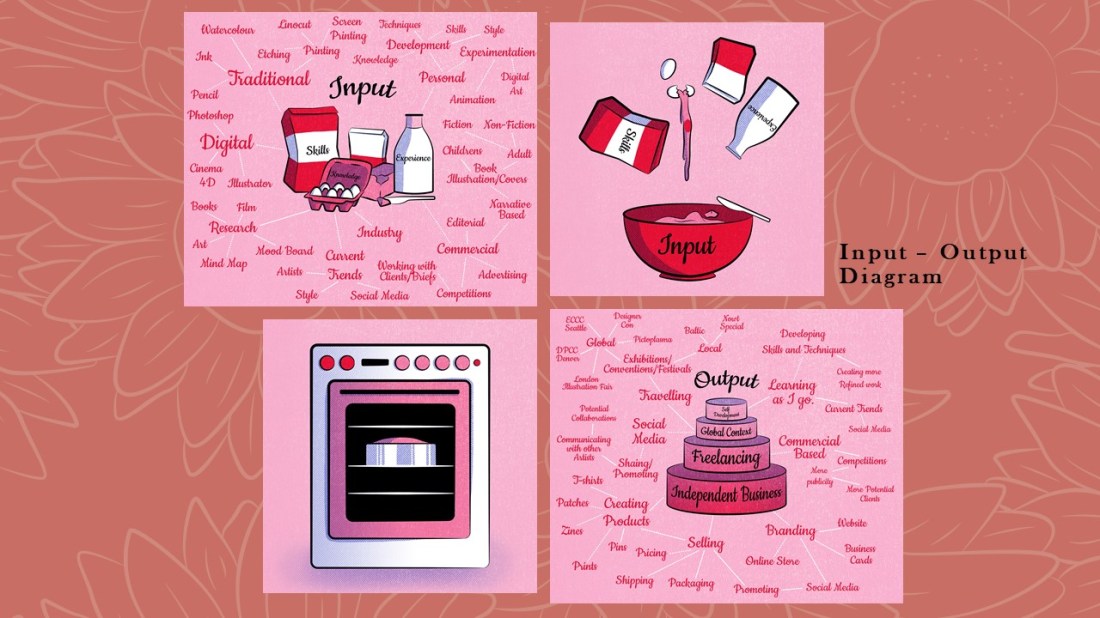
Following on with more self-reflection, I created a couple of diagrams within the space of the year that are up on my blog. This one is an input and output diagram, it describes the skills, knowledge and experience that goes into my work and what is output from it, being anything to do with business, freelance work, self-development and live briefs.

If you would like to read more about my Input-Output diagram, click here.
Slide19

19

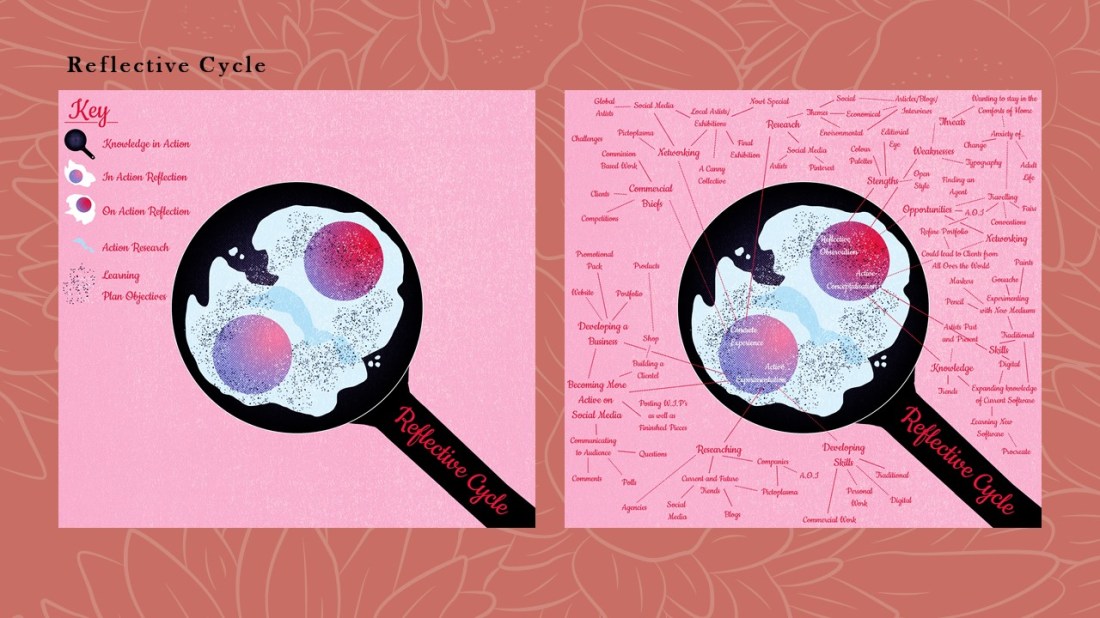
This next diagram is my reflective cycle, it shows my process of planning a project, the research that goes into it, my action plan, the actual practical work and the experience from said practical work. This then carries on and the cycle starts again.

The explanations of both of these diagrams are on my blog, as I wanted to have an easier explanation for someone who may not understand these types of reflective practices, but may want to understand my process of working, thinking etc.

If you would like to read more about my Reflective Cycle, click here.
 

Slide20

20:

This is my bibliography. Thanks for your time do you have any questions?

Although this was more directed at my presentation if you do have any questions feel free to comment and I will try to answer as best as I can!


List of Illustrations
These are all jpeg images of the slides from my Reflective Practice Presentation. Within the slides, I have cited the images that were not mine, so if an image does not have a caption, it is my own work.
Figure 1.Amazon (1994). The Lion, the Witch and the Wardrobe: C. S. Lewis. [image] Available at: https://www.amazon.com/Lion-Witch-Wardrobe-Chronicles-Narnia/dp/0064404994/ref=sr_1_1?crid=1ZYCJ0GH8FLC2&keywords=the+lion+the+witch+and+the+wardrobe&qid=1556748222&s=books&sprefix=the+lion+%2Cstripbooks-intl-ship%2C236&sr=1-1 [Accessed 1 May 2019].
Figure 2.Baynes, P. (1950). Narnia Lamppost. [image] Available at: https://www.paulinebaynes.com/?what=artifacts&image_id=532&cat=69 [Accessed 1 May 2019].
Figure 3.Tenniel, J. (1865). White Rabbit checks his Watch. [image] Available at: https://medium.com/alice-s-adventures-in-wonderland/sir-john-tenniel-s-classic-illustrations-of-alice-in-wonderland-2c3bbdca3a77 [Accessed 1 May 2019].
Figure 4.Amazon (2008). Howls Moving Castle: Diana Wynne Jones. [image] Available at: https://www.amazon.com/Howls-Moving-Castle-Diana-Wynne/dp/0061478784/ref=sr_1_1?crid=1U66801S7NAFP&keywords=howls+moving+castle&qid=1556747151&s=books&sprefix=howls%2Cstripbooks-intl-ship%2C219&sr=1-1 [Accessed 1 May 2019].
Figure 5.Chiang, M. (2018). Reflections. [image] Available at: http://www.hellomaggiec.com/2018/3vwq57poq1ezpl0a78wkarcwx3qiae [Accessed 1 May 2019].
Figure 6.Monvaillier, A. (2018). Bouh. [image] Available at: https://www.instagram.com/p/BhdoARQD1jA/ [Accessed 1 May 2019].
Figure 7.Amazon (2012). Wonder: R. J. Palacio. [image] Available at: https://www.amazon.com/Wonder-R-J-Palacio/dp/0375869026 [Accessed 1 May 2019].
Figure 8.Amazon (2013). Norwegian Wood: Haruki Murakami. [image] Available at: https://www.amazon.com/Norwegian-Wood-Tokyo-Blues-Italian/dp/8806216465/ref=sr_1_12?crid=IINWGD0DLUSW&keywords=norwegian+wood&qid=1556746704&s=books&sprefix=norwe%2Cstripbooks-intl-ship%2C259&sr=1-12 [Accessed 1 May 2019].
Figure 9.Kidd, E. (2018). Monkey Business – Trending Characters. [Blog] Emily Kiddy. Available at: http://frame.bloglovin.com/?post=6540277057&blog=3758402&group=0&frame=1&frame_type=none&avpp=true&context=&context_ids=&feed_order=&click=0&user=0 [Accessed 1 May 2019].
Figure 10.Iceland Foods (2018). Iceland’s Banned TV Christmas Advert… Say hello to Rang-tan. #NoPalmOilChristmas. Available at: https://www.youtube.com/watch?v=JdpspllWI2o [Accessed 1 May 2019].
Figure 11.Nass, T. (2017). [image] Available at: https://www.instagram.com/p/BcFQm-hHS6I/ [Accessed 2 May 2019].
Figure 12.Nass, T. (2017). [image] Available at: https://www.instagram.com/p/BcFQm-hHS6I/ [Accessed 2 May 2019].
Figure 13.Horeis, C. (2019). [image] Available at: https://www.instagram.com/p/BuG3ws5F53Y/ [Accessed 2 May 2019].
Figure 14.Horeis, C. (2019). [image] Available at: https://www.instagram.com/p/BuG3ws5F53Y/ [Accessed 2 May 2019].
Figure 15.Amazon (2015). The Wizard of Oz: L. Frank Baum. [image] Available at: https://www.amazon.co.uk/Wizard-Oz-L-Frank-Baum/dp/1604335424/ref=sr_1_14?keywords=wizard+of+oz+book&qid=1557071553&s=gateway&sr=8-14 [Accessed 2 May 2019].
Figure 16.Zeferino, I. (2019). Business Cards. [image] Available at: https://www.instagram.com/p/BqSkrJllskE/ [Accessed 2 May 2019].
Figure 17.Zeferino, I. (2019). Business Cards. [image] Available at: https://www.instagram.com/p/BqSkrJllskE/ [Accessed 2 May 2019].
Figure 18.McPike, S. (2019). Work — Thistle Be Nice. [online] Thistle Be Nice. Available at: http://www.sophiemcpike.com/mywork [Accessed 2 May 2019].
Figure 19.Nicholson, N. (2019). WITCHITA. [online] Witchita Illustration. Available at: https://witchitaillustrations.com/ [Accessed 2 May 2019].

IT’S CRUNCH TIME!

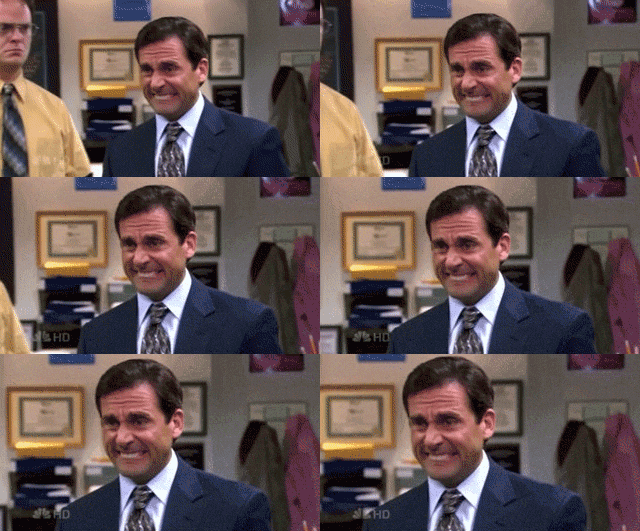
It’s now a week before the deadline and guess who still has a lot of work to do? ME! But is that a surprise? PROBABLY NOT!

(Giphy, 2015)

As it has been the holidays, I felt myself falling into the trap of procrastination, using the excuse of “it’s Christmas!” or “it’s New Years!” far too much. Although I did need this break for my sanity, I did feel the guilt when I would just be sitting around not doing work, when I knew full well that I could.

I had started my break for the holidays on the 22nd of December, after completing illustrations and a cover design for the House of Illustration competition and creating potential covers for the Penguin Student Awards Competition. So, getting back into the swing of things earlier this week, on January the 2nd, I realised that I had and still have a lot of writing up to do.

Today, I have only just finished writing up all of the days for Inktober. Although I have made blog posts about each of the days, I felt for academic purposes, I would have to write them up more formally and in more detail for hand-in.  So with this project, all I have left to do is to write up the process of making the zines, how I formatted the pages for printing, the different printing methods which I tried, what went well, what had not, which I had decided to use for final products etc. I then need to evaluate the final product and project as a whole, then that should be one project out of the way.

I’m going to be honest now, the rest of the projects aren’t as close to being completed as I would have hoped, and I do have a lot of writing up to do in the upcoming week.

House of Illustration project, I still need to:

  • Ask my peers for their opinions, if there are any changes I should make.
  • Potentially make the changes they suggest.
  • Get the illustration and cover ready for submission in the format the competition wants.
  • Print and mount the final design for hand-in.
  • Write up artist/influences
  • Write up creation process (I did take screenshots throughout, so this should make it easier to recall the steps I took and choices I made)
  • Evaluate the final design and the project as a whole.


Penguin Student Design project, I still need to:

  • Ask my peers for their opinions, if there are any changes I should make.
  • Potentially make the changes they suggest.
  • Get the Cover/s ready for submission in the format the guidelines of the competition state.
  • Print and mount the final design for hand-in.
  • Write up artist/influences
  • Write up creation process (I did take screenshots throughout, so this should make it easier to recall the steps I took and choices I made)
  • Evaluate the final design and the project as a whole.


The Lion, the Witch and the Wardrobe project, I still need to:

  • Write up my experiences with the different printing methods, how they work, what I enjoyed, what I did not etc.
  • Compare the printing methods.
  • Make new designs with the best printing method (if I have the time to do so).
  • Evaluate the final products and the project as a whole.


So from this to do list, my plan for the week is to write up my projects whilst I’m at home, then whilst I am at college I will focus on practical work. The reason I don’t want to write up my work at college is because I feel I am easily distracted, zoning in and out of work a lot, often losing my place or sentence etc, but when I’m at home, it is quieter and although there is a potential threat of tv, during deadline week this is not an issue, as stress me is on the ball! Or at least tries to be!

So whilst I am at college, I think I will try to get the final illustrations for the Lion, the Witch and the Wardrobe project, as the facilities I need are within the college, so I feel it will be the best use for my time.

Final Notes

I probably will get all of my work complete in time, but the more that I think I won’t, the more stress I will put on myself, meaning more pressure, meaning more focus on the work, meaning ALL WORK COMPLETED ON TIME. Let’s hope!

I am always surprised at how much work I get done the day before a deadline as the pressure pushes me through, and I always end up handing in on time. Myself and stress just work together well, it’s probably not the healthiest of relationships, but if it works it works! If it ain’t broke, don’t fix it! But ideally, I’m gonna try better to not leave all of my work till the last minute in the next semester/deadline, 2019 should be the stress-free year!.. Starting January 15th!

Bibliography

Giphy. (2015). Awkward Michael Scott Gif [online] Available at: https://giphy.com/gifs/jOpLbiGmHR9S0 [Accessed 06 Jan. 2018].

The week from Hell.

Due to my incapability to follow my own timetable, which I had even reorganised after not managing to follow it the first time, this week was supposed to be the last week I had given myself to work on the House of Illustration, Book Illustration Competition, in which I had to create 3 illustrations and a book cover for the story ‘Howls Moving Castle’ by Diana Wynne Jones.

Instead, for the majority of this 3-week project, I spent a lot of time trying to catch up or finish off previous projects that I had fallen behind on. I also decided to work on an illustration which would be a gift for my boyfriends mum. This was supposed to be completed and printed for her birthday in September, but as we all know by now, I can’t follow my own time plans! So I said I would give it to her for Christmas instead, not that she knows (a blog post for this piece will be coming soon). So, the time I should have been spending on this project had been spent on others, but I refused to fall behind on the project starting next week, so I decided I had to finish this one by today!

In what should have been one week of researching, one week of creating concepts and experimenting and the final week creating the final design, I have basically had to do all of this in the space of a week.

When creating my pieces, I didn’t really have an idea of styles or techniques I was going to use, I had thought about artists, but I hadn’t thought about potential ways in which I could apply the styles or techniques to my own work, so basically in the process of creating my pieces, I have just been winging it, seeing “does this thing work? No, not really, scrap it! Does this? Okay, we’ll just roll with it”. I had kept doing right up until now.

I am currently happy with these designs, but I would say I do still need critique and outsiders perspectives so that I can potentially make further improvements. At this moment in time, however, I still have a lot of work to complete within other projects so this one may have to fall to the back of the pack. Because of this, I may not end up submitting my designs to the competition, as I’m not sure if it fits the standards of previous entries in the years before, especially not without further refinement. And since the competition does have a fee to enter, I feel it could be a waste of my money.

Even if I don’t submit these design to the competition, I will still include them in my portfolio, as through this project, I have been able to show more skills with narrative, and I have created more landscape designs, two areas of which I felt were lacking in my portfolio.

SO, what have we learnt from this post? I am my own worst enemy and I only have myself to blame! From this experience, I will strive to keep myself more organised and actually follow my own set time plans. I believe this information will be very important for when starting next semester, as I will try to plan out my time better, using my experience from this first semester, as I feel I will have more knowledge of my pace of working and what I am capable of doing in specific timeframes.

Just a little update..

I currently have only 5 weeks left of the first semester, before I have to hand in all of my projects for the development module. So, as I have been updating my blog, but not so much in terms of my progression, I thought I’d briefly talk about the work I’ve done so far, what I still need to do, and discuss the goals that I want to achieve, which will be more long-term based.

The Lion, the Witch and the Wardrobe

  • Research is complete – both directly from the book and my artist research.
  • I have created a mind map and chose the imagery I’d like to create.
  • Drawn up on of the quotes, the Wardrobe.
  • Experimented with digital techniques.
  • Experimented with different printing methods – screen printing, and adding foils, etching, Linocut, laser cut plate.
  • I’ve chosen that I want to create the rest of my illustrations with the laser cut plate technique as I feel I had gotten the cleanest results.

Still to do:

  • Create the other illustration with the printing method.
  • Possibly edit the outcomes digitally.
  • Mount them.
  • Evaluate the final products and project as a whole.


Inktober

  • I have completed the challenge, creating 31 illustrated characters for each day of October.
  • I have fixed or edited the designs digitally. Compiling them all into a zine format.
  • I’ve experimented with different forms of printing – through the colleges normal printer, reprographics and creating some on the zine.
  • With the finished products, I have begun to sell them online.

Still to do:

  • Write up some of the days – I have written them up on this blog, however, I feel I need to write them more formally and with much more information, for my actual project.
  • Write up the experimentation with printing methods. Opinions of the different outcomes of the zines.
  • Evaluate the final products and project as a whole.


House of Illustration – Howls Moving Castle

  • Read the book, highlighting areas and quotes that I could possibly illustrate.
  • Created sketches from the quotes.
  • Narrowed down my selection and had drawn thumbnails.
  • Narrowed down my selection yet again, so that I was left with 3 potential illustrations and 1 potential cover.
  • Started sketching the thumbnails digitally.

Still to do:

  • Write up artist research.
  • Refine the digital sketches with traditional line work.
  • Scan in the line work.
  • Colour digitally and potentially add a textured overlay.
  • Write up all of the progression, thoughts and opinions throughout.
  • Mount/submit the final designs.
  • Evaluate the final product and the project as a whole.


Penguin Illustration Awards

  • Read the children’s book – Wonder by R.J.Paolo
  • Read the adults fiction book – Norwegian Wood by Haruki Murakami.
  • Have thought about the imagery I could potentially illustrate for both of the books.
  • Have thought about the styles I could potentially use.

Still to do:

  • Actually start the project, not next week but the one after.
  • Write up research – from the books and potential artists/styles I will be using.
  • Form a mind map/mood board of potential imagery I could create.
  • Create 3 thumbnail sketches for each book.
  • Refine my choices and refine the designs digitally.
  • Choose which concept I think is best, possibly refine it more if needed.
  • Write up progression, thoughts and opinions throughout the project.
  • Mount and submit the final design.
  • Evaluate the final product and the project as a whole.


Long-Term Targets

  • Get better at time management. Thinking more practically, how long will it take me to work on a project, then follow my timetables as efficiently as I can.
  • Draw more full-length bodies. Over the year I feel I have gotten better at drawing faces, however, I do still struggle with the anatomy of the body, so I do wish to practise more in the future.
  • Boosting effort levels, getting rid of that ‘it’ll do’ attitude. I believe this can be done by just taking a break from my work then going back to it again with a fresh mindset, ready to make further improvements, as opposed to just being sick of the piece and wanting to just get it out of the way. I don’t think this can be done overnight, hence why it is in my long-term goals, as I feel in a way I will have to train my mind to do this more often, especially during future projects, in college and out.

The Timeplan

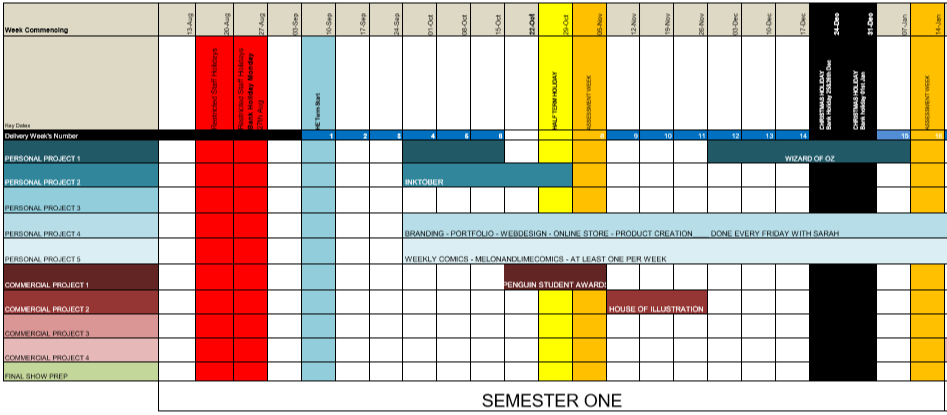
9 weeks into the first semester and I’m already not following the timetable I had originally planned within my proposal for the year.


original
Original Timetable (Before I had switched the Wizard of Oz project with the L.W.W project in Semester 2)

I believe this is due to multiple confusing factors from the beginning till now, one of them being that I have chosen to read all of the books. After finishing The Lion the Witch and the Wardrobe, and realising how long it had taken, (which wasn’t exactly long, but longer than I had initially expected) I decided to start reading ‘Howls Moving Castle’ for the House of Illustration competition, then after I finished that, I started and am currently reading Norwegian Wood, but I still have to read Wonder, both books being apart of the Penguin competition.

Another factor to my confusion is that my tutor has been wanting specific things done by a certain point, such as a statement of intents or the research for the projects, so instead of working at my own pace, following my set timetable, I have been trying to complete them all at once which has not done me very well.

So, with these factors, I feel I have just gotten confused in which project I should be working on, so probably have not done as much as I could have if I were specifically concentrating on one.

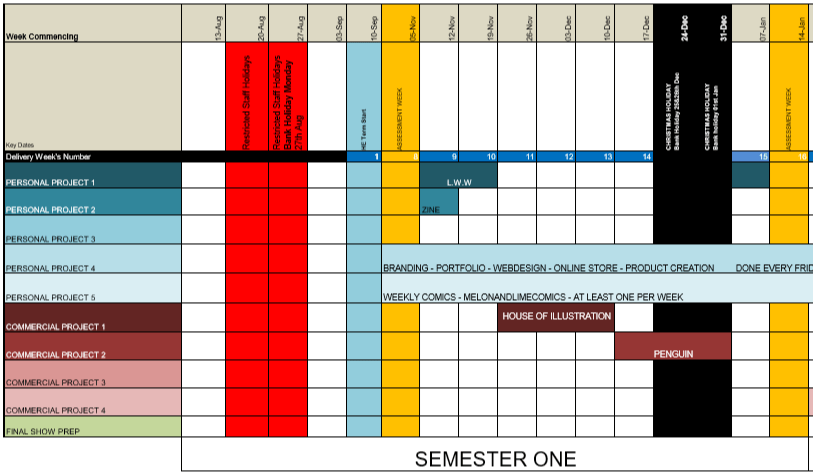
SO, with 9 weeks left, (8 now that I am posting this) I am going to replan my timetable so that I can properly concentrate on one project at a time.

newtime
New and Improved Timetable, Starting 12/11/18

Inktober – I have spent wayyyy too long on this project, so this week (and possibly a bit of next) I am going to try round off this project, getting the zines printed, making sure that everything is fully annotated, making an evaluation, and just getting this project out of the way so that I can concentrate on the others properly.

The Lion, the Witch and the Wardrobe – I know I need time to work within the college, using the facilities available, so I believe I am going to work on this project next week, then break off for a month or so to do the competitions, then during the last 2 weeks before deadline, I will print my final designs and round off the project

House of Illustration – 3 (now 2) weeks from now, I plan to focus on my House of Illustration project, creating a book cover and set of illustrations for the book ‘Howls Moving Castle, over a 3-week time period. This time will be spent on researching, sketching, experimenting, then producing the final designs.

Penguin Student Design Awards – 6 (now 5) weeks from now, I will start working on yet another competition, which again I plan to do within a 3-week timeframe. Again, I will be working in a similar routine/method to the previous project, researching, sketching, experimenting, then producing the final designs, however, this time I will be doing this process with two books, one being Wonder by R. J. Palacio, and Norweigan Wood by Haruki Murakami.

I hope that with this new timetable, that there will be less confusion, I will be able to focus on one project at a time, and inevitably, I will be able to get more work done.

Learning Plan: Semester One

Overall Objective:

This year, it being my last in college, I want to make the most of it to improve my work. I will do this by trying new mediums and techniques, more so in the realm of traditional work as in the previous years I have mostly worked digitally. I also want to explore more areas of illustration, especially in the areas which my portfolio may be lacking, so I want to create more narrative based work, i.e book illustrations or covers, and I would like to create more editorial-based pieces, illustrations based on articles, current topics I feel strongly about, etc. Although I do enjoy creating pretty pieces with next to no context behind them, I do want to start creating more work that does contain stronger messages or can depict a story through them. I don’t feel I have done this a lot in my previous work, so would like to try to do so in my final year.

Strengths and Weaknesses:

I feel my current strengths are in digital work, but I have started trying to incorporate more traditional mediums, mostly within the linework. At the end of last year, I was using a Tombow calligraphy pen for my linework then colouring the pieces digitally, and during summer I wanted to be more experimental and had digitally coloured more sketch-based characters, either created with a pencil or a ball-point pen.

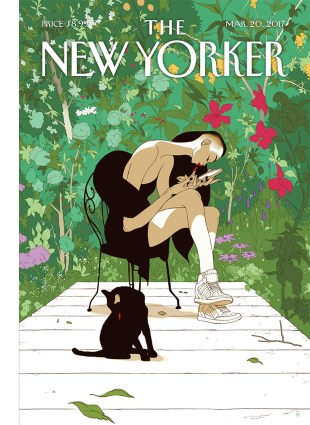
hanuka_style_flowers_FM_cv_wShadow_WHITE_strap_030217.jpg
T. Hanuka, Spring Awakening (2017)

Another strength I believe is my colour palettes. I feel I have a good idea of colour theory, so I don’t tend to struggle when choosing a colour palette, but if I do, when working digitally I just have a play around with hue and saturation option in photoshop, until I reach a tone that I feel fits well with the others and allow the piece to be visually appealing to the eye.  My palettes are usually inspired by the themes and/or content of the pieces I create, but I do also find inspiration from other artists, for instance, Tomer Hanuka has influenced a lot of my previous work as I love his work with colour. In his work, he uses quite a monochromatic palette, but then uses a complementary colour which helps offset the piece, and is very attractive to the eye. I have found a lot of inspiration from his work in the past and I feel I have learnt while doing so, so I have been able to form my own palettes from the knowledge of his, knowing which colours work well, what themes they may suggest, what other colours can I add to make the piece more intriguing or which I can add to make my work more easy on the eyes.

I believe my most common weakness is with traditional mediums. Before starting the course I did work more traditionally, using fine liners, markers, paints, pencils etc, but I feel as I have learnt more digital skills and my work has become more refined and of a higher standard over the years, I have lost more confidence with these mediums as the marks they make are a lot more set in stone than working digitally is, for instance, if you make a mistake digitally, you can just edit and undo it, but if you make a mistake with a traditional medium it is a lot harder to erase (unless you’re working with pencil).

I also had less confidence with traditional mediums when it came to linework as I felt my hand/line control would be a lot more wobbly than I intended, not creating as smooth of a line as I could in a program like Illustrator. I have however been trying to improve on my confidence with these issues, for instance in my last few projects last year, I had created the linework by hand, and although some of my lines were more wobbly than I would have liked, I would enjoy the overall piece as I felt they would be less static than my linework from illustrator was. Since not every line was smooth and perfect, I feel it added a more personal touch to my work and I would like to carry on creating my linework by hand, possibly using more mediums than fine liners or my Tombow pen in the future.

Like I had mentioned, I did try experimenting with sketch-based work in the holidays, so ideally I would like to try find a way to use these mediums and techniques but in a more refined way, so that my work would be of an industry standard and quality and would not look as ‘sketchy’.


Professional Development Plan:

As this first module is based around development, I would like to use it as a way to experiment and expand my knowledge. Ideally, I would like to take part in inktober, creating an inked illustration per day every day for the month of October, I believe it would help in improving my confidence with a traditional medium, specifically with my line control, but as I rarely work with ink, it would allow me to experiment with it, learning what marks I can make, if I can create gradients, etc, I’d be gaining more knowledge of the medium from my experience with it and potentially taking that information further into my future work.

Staying along the lines of traditional methods, I would also like to experiment more with printing methods, for instance, screenprinting, etching, linocut printing, printing with a laser cut plate, etc. With this, I would be gaining more knowledge in the form of output, how I could potentially create prints in the future, rather than just using a normal printer. I could potentially still work digitally with some of these methods, but if I were to output my illustrations through an alternative method to a normal printer, for instance using screenprint, it would add more of a personal touch to a possible product, being that I would have created it myself by hand and would have put more thought into how the design would work when printed, i.e with colours, specific layers, how they would be arranged and so on. In the past, I have not had great experiences with screenprinting, however, I know it is a common method used by other artists to create their own products i.e. prints, t-shirts, tote bags etc. so I do want to give it another try, to see if I just had a bad experience the first time, whether it was the design I was using, the method, if I was doing something wrong or whether screenprinting is just not for me?

As I mentioned before, I do want to create more narrative-based work, whether this is book illustrations, covers, or pieces with more backstory. Over the holidays we were asked to think about personal projects we’d like to do and I thought of making illustrations for the Wonderful Wizard of Oz and the Lion, the Witch and the Wardrobe. Both of these stories already have well-known imagery behind them, but I feel the imagery has mostly come from the movies as opposed to the books, so I want to read both of these books, see for myself if there are any differences from book to film, as is very common with movie adaptations, but I want to illustrate as true to the book’s descriptions as possible so that I may potentially give a fresh perspective to the stories, renewing them in my own style.

Looking into competitions for the more commercial side of this module, the ones coming soonest and the ones I feel most interested in are the more narrative-based ones. I have been looking into the Penguin Student Design Awards and House of Illustration – Book Illustration Competition. In both, I would be designing book covers, but for the House of Illustration one, I would also be creating a set of illustrations of the book they choose. In the Penguin Competition, you do get a choice in categories of stories, either adult’s fiction, adults non-fiction and children’s books.

So if I were to participate in both of these competitions, as well as my ideas for personal projects, I would be creating a lot of narrative-based work, but I would have to consider which routes to take, as I would not want my projects to clash or potentially come across as too similar, I do want to create a range of work for a range of different clients and audiences throughout this year.

As I assume my work is going to be based around existing stories, I believe my research will mostly be coming directly from the books, using quotes, finding characters, backgrounds and element descriptions straight from the sources so that I can create illustrations as accurate to the original stories as possible. I feel by not working from the imagery I already know that it will set me apart from other illustrations that may exist, especially if it is in context of a competition as other artists may rely too much on the imagery that is already known as opposed to reading the book themselves, especially if there is a time constraint.

As of other research, I mostly find style, artists or concept inspiration from social media, scrolling through the many artists I follow on Instagram or finding work/images on Pinterest, normally suggested to me by images I may have already pinned, or from a direct search of a theme.  It may be due to being a Gen-Z…

(TANGENT – I like term post-millennial better for myself as although I missed the millennial status by 2 years, I do feel closer to those than the extremes of Gen-Z. I did probably grow up with more access to technology than the previous generation, but I believe I still had a ‘normal’ childhood without needing to have a phone in my hand, actually playing outside with my friends on a day to day basis. I hate when I see toddler nowadays with a tablet in their hands. I’m hoping that when my generation becomes parents, they will recognise this as a problem and will try to raise their children as they were. This in no way was supposed to be read as a hate to Gen-Z, I actually watched a video comparing millennials against Gen-Z’s and they did come out the more positive minded generation,  I just don’t like the thought of being judged for having resources available to me now that older generations have not, but having that supposedly affect me in a negative way. All generations will have had factors that could have affected them, whether it has been war, politics, economy, but no one would want it to be held against them and told: “your generation is like … because of …” but the news especially loves to blame millennials and probably Gen-Z next for any changes going on, but they say it in such a negative light. I could make a whole seprate blog post about my views on this topic, but would you want to read that? Feel free to leave a comment if so! BACK TO THE TOPIC)

…but I love finding inspiration online, when I find new artwork on Pinterest, I love seeing the suggested images afterwards then falling down a rabbit hole of going from one piece to the next and to the next, by doing this I have formed a lot of ‘boards’ two of which I add to and use for inspiration the most you can go check them out here, one is of people, of all different ages, genders, nationalities and so on, and the other is of illustrations, these are pieces that I will have found over the past few years, which I enjoy for some reason or another, but I feel I can come back to at some point to use as inspiration. It’s actually funny when I don’t know what to create and I haven’t looked at the board for a while, as I do forget what is in there and I always refind something that I saved once upon a time which inspires a new concept, colour palette or style I want to use, and it does encourage me to create new work.


Anticipated Challenges:

Time management will always be a hidden challenge, especially with this year if I am estimating the dates of the competitions (when they start and their deadlines). As a module, I do need to plan out my semesters setting out my projects over the given timeframe so I will do my best to stick to the timetables I give myself. As to hopefully not have any issues with time, I do want to keep a planner with me at all times, keeping track of what I’m doing, what I still need to do, when does that task need to be achieved by and so on. I feel this will keep me more organised, keeping me on track of what needs to be done and when, and hopefully the organisation will encourage more workflow. In the past when I have not kept myself organised, I have battled with motivation, lost myself to procrastination and so on, but this year, my final one, I do want the best results for myself and I know I need to put in all the time, effort and motivation get myself those results. So I am determined to keep myself on track, and if I can achieve my goals with the least amount of stress, then that will be perfect.

If I am to work with multiple printing methods, another challenge could possibly be trying to book space within the printing room or the workshop. Since I am within a college with lots of other course and lots of other students, there may be times in which the print room or workshop will be full or the queue for the laser cutter will be too long, so to combat these potential problems, I will try to book a time in the print room if needed earlier on rather than later, as well as creating a plate on the laser cutter sooner rather than later. This will just ensure that I do not run out of time, I do not clash with any other classes and will have my prints created in time for the deadline.


List of Illustrations

Hanuka, T. (2017) Spring Awakening, The New Yorker. [Online] Available from: http://thanuka.com/#/spring/ [Accessed on 17 Sep. 2018]

All other pieces are my own unless stated otherwise.

Reading List

Dimock, M. (2019). Defining generations: Where Millennials end and Generation Z begins. [online] Pew Research Center. Available at: https://www.pewresearch.org/fact-tank/2019/01/17/where-millennials-end-and-generation-z-begins/ [Accessed 27 Apr. 2019].

The Infographics Show. (2019). Millennials vs Generation Z – How Do They Compare & What’s the Difference?. YouTube. [online] Available at: https://www.youtube.com/watch?v=aqdm6aBUZII [Accessed 27 Apr. 2019].