(End of Year Evaluation) Reflective Practice Presentation – Part 2

In part one of this post I had reflected on my performance in my reflective practice presentation, it wasn’t really the best experience, but you can click here if you would like to read more about it. In this post, I will be going through each of my slides along with the script I made, but I have added more detail as I am able to go into more depth on my blog, but in the presentation, I did have a time limit so the initial script was more brief. If you have read my previous post then you will know how well the script and time limit worked for me.

Slide1

1

For this final year I had set myself goals that I wanted to achieve.

I created two learning plans for both semesters, the reason for this is that with semester one I had more of a plan than I did with semester 2, for instance I knew which competitions I would be doing and had a better idea of when they would be released.

Starting with learning plan one. I wanted more experience and confidence with traditional mediums, as I have tended to work more digitally in the past.

Another goal was to work with more narrative based projects, creating book covers or illustrating stories, as this is an area my portfolio that was lacking, and I wanted to expand.

If you would like to read more about my learning plan for semester one, you can click here.


Slide2

2

In the first project, Inktober, I had created an inked illustration every day for the month of October.

I used fine liners for the line work and then with a brush and water, I bled the ink which allowed me to create tone and shadows within my characters.

I chose to illustrate flower girls as this was imagery I was confident with, and a theme which I believed would last me the full month.

Other than viewing previous art for Inktober, there was not a lot of research needed for this project, but I had used reference images of women and flowers to help inform my designs.

By the end of this project I did feel a lot more confident with the medium. There were a few times where the ink may have bled or faces/features may have been drawn wrong, but I was able to fix these errors digitally and I was able to create a zine of the 31 illustrations which I have sold since. If you would like to purchase a zine you can have a look at my store at: www.melon-r.com/shop-1
 

Slide3

3

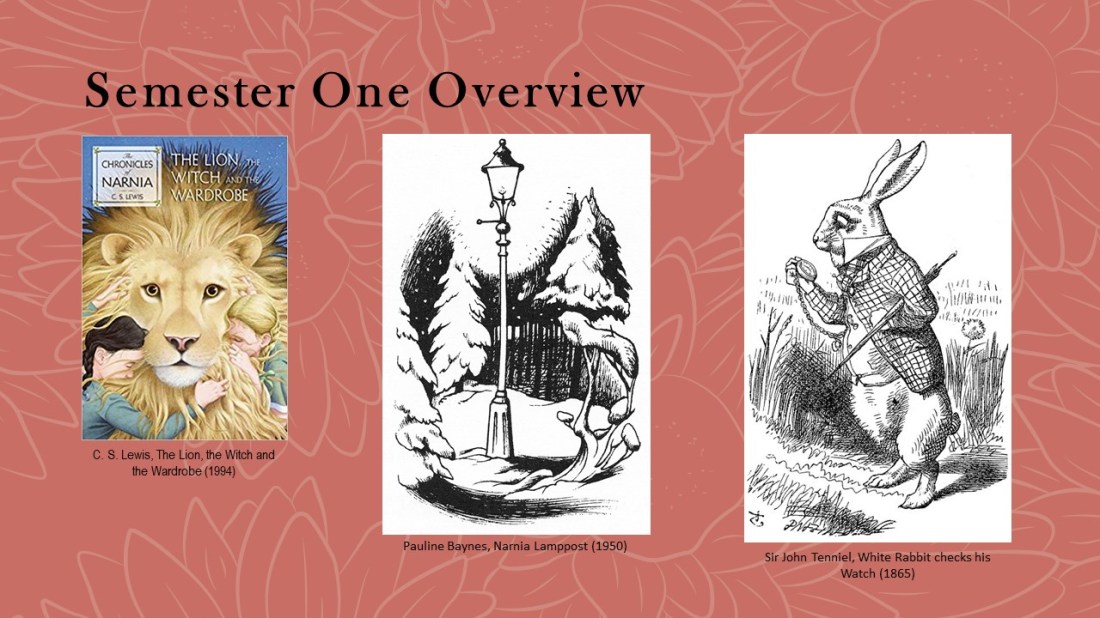
Moving onto the next project: the Lion, the Witch and the Wardrobe, I wanted to experiment with multiple printing techniques to give me more experience for potential output methods that I could use in the future. I also wanted to work with more narrative, following the goals set within my learning plan.

For research, I quoted directly from the book so that I could create accurate depictions of the story, rather than creating illustrations from the imagery I already knew. Initially, I was inspired by Sir John Tenniel and his intricate line work but had later found Pauline Baynes, who was the original illustrator of the Lion, the Witch and the Wardrobe, had worked in a similar style, but she had incorporated colour into her designs which I did not want to do with my own design so I felt my designs would still be different from illustrations already created for the story.
 

Slide4

4

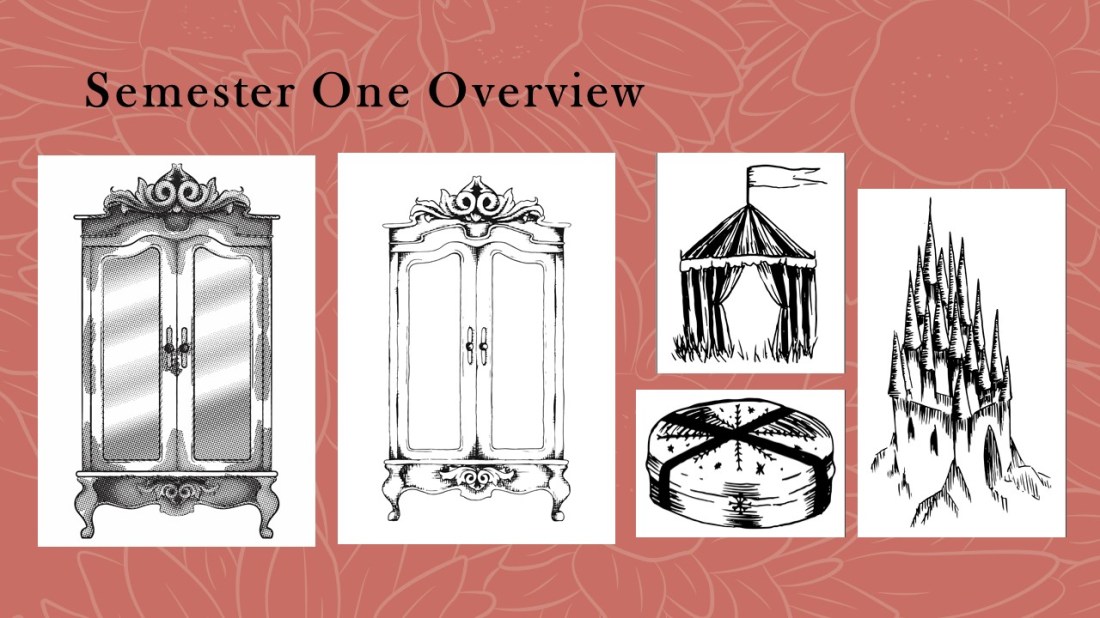
When I first started this project, I felt I had started strong, using the wardrobe imagery to test out each of the printing methods, I.e. screen-printing, etching, using a laser cut plate and lino printing.

With the inclusion of more projects, however, I do feel I lost momentum and felt like I rushed the pieces to the right in the last couple of weeks/days.

Given more time I would’ve refined the last pieces by creating them in illustrator, drawing the line work by hand then using the laser cut method to print them, as I had felt this was the best and cleanest methods from my wardrobe print tests. I believe the addition of illustrator would have made the pieces more proportional, fixing the errors within the symmetry and potentially making the linework straighter and cleaner.
 

Slide5

5

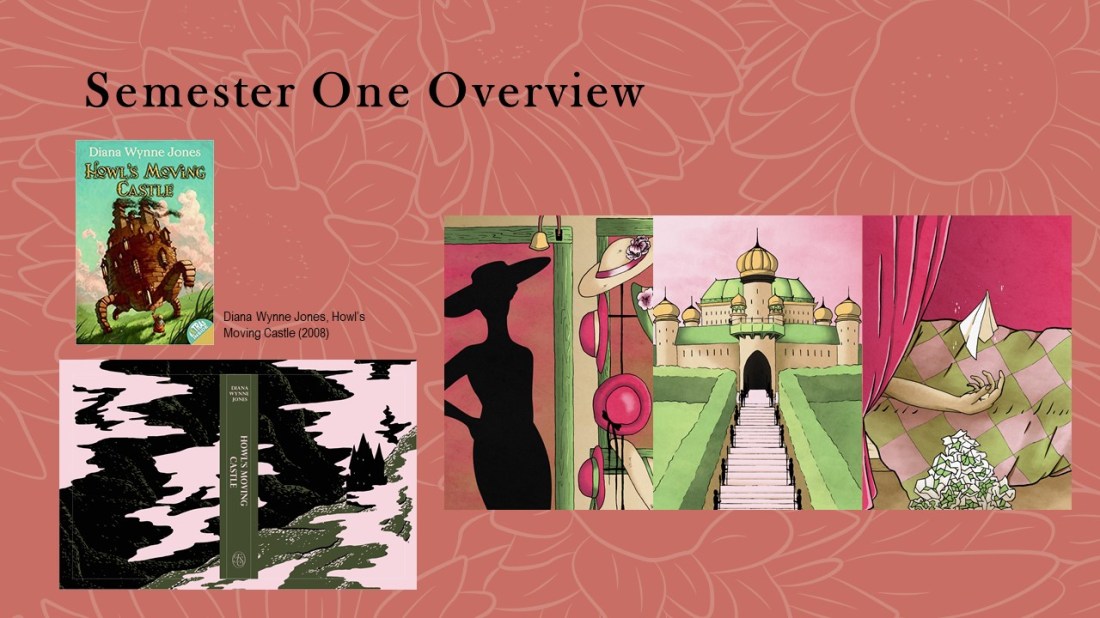
My next project was the House of Illustrations Book Illustration Competition. I had to create a set of 3 illustrations and a book cover for howls moving castle. Again this was narrative based brief, so it fit within the goals of my first learning plan. The only research that I had done for this project was just reading the book so that I again, could create an accurate depiction of the story, as opposed to working with content I may have already seen, for instance with Studio Ghibli’s adaptation of the book. (If you want to know my opinion of the original book and the movie adaptation, also listing the differences between the two, you can read about that here.)

Not researching other artists and styles may have been my downfall during this project as I did struggle when creating the pieces as I didn’t have a strong concept of the styles I wanted to use. I did, however, enjoy my choice of colour palette, as it is easy on the eyes and translates the themes of the book well, showing the magical essence without it being too being direct. The palace piece is my favourite, as I love the symmetry and perspective and it is how I had envisioned the king’s palace within the book. I have been able to translate my thoughts onto the page.
 

Slide6

6

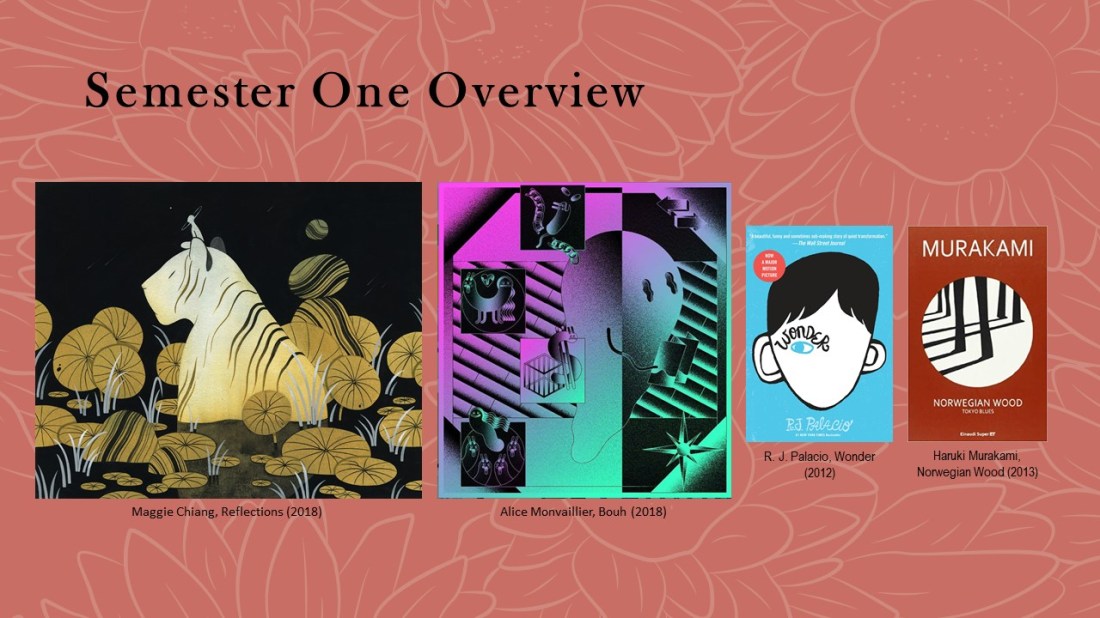
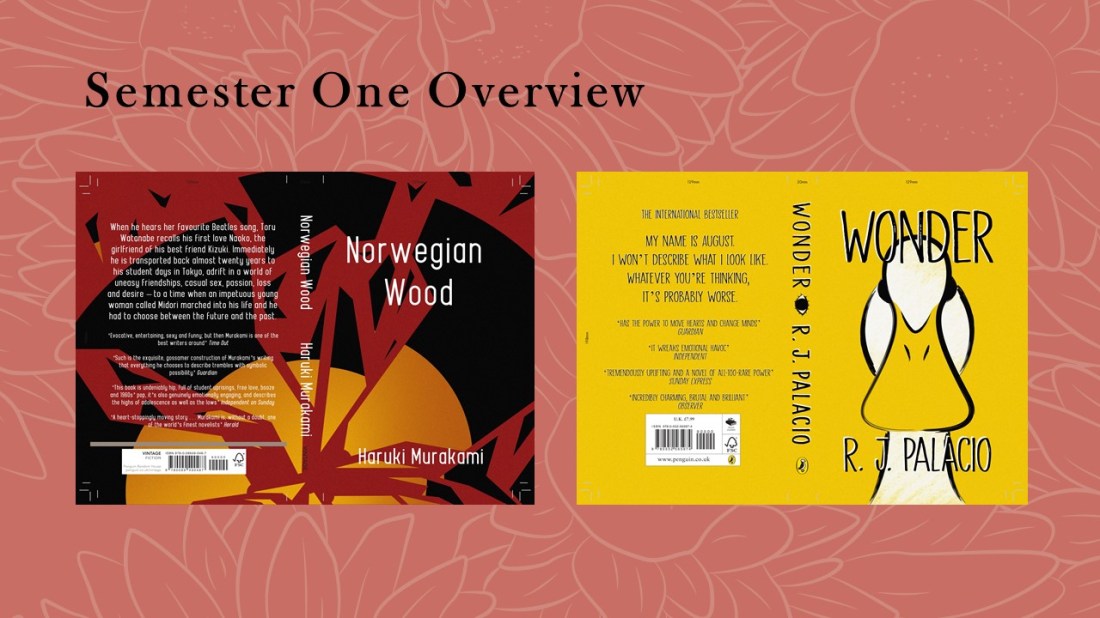
For the next project which was also a competition, this time for the Penguin Student Design Awards, I created 2 book covers for 2 separate categories; the adult’s fiction which was Norwegian Wood and the children’s book was Wonder.

For research I looked at entries from previous years, looking for common trends that I could potentially apply to my own work. I had noticed that a lot of the covers were minimal, and some had a noise effect applied, this had led me to think of artists such as Maggie Chiang and Alice Monvaillier as I believed their styles would work well among the other entries, so would be a good source of inspiration for myself during this project.

Again, I had read both of the books as research.  This allowed me to get a better understanding of the stories so that I could know the type of content I would be creating for the covers, especially considering both books have completely different themes and audiences.
 

Slide7

7

These are the two covers I created. I did complete them within a short amount of time, but I don’t feel as if they look rushed and I feel like these are a lot different from my usual style, as they are minimalistic within the colour pallets and imagery, which are styles/palettes that I have tried to dip into but have not fully achieved until these two creations.

I had struggled a lot with the text and titles, being able to make them readable against the illustrations. In the future, I will consider the type a lot further in advance so that I can work my illustrations around the text, instead of just trying to work the text around the images as I had in this project.
 

Slide8

8

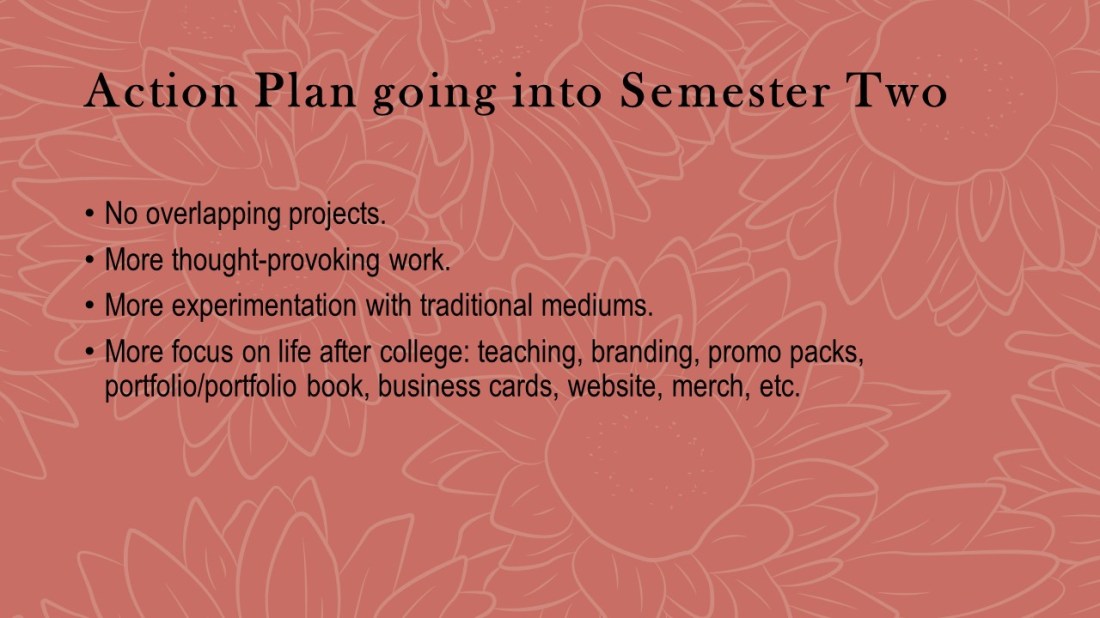
My weaknesses from the first semester were definitely to do with my time keeping and having too many projects in general which ended up overlapping, causing me confusion and stress.

From the first learning plan, I did achieve the goals I had set, working more traditionally and creating more narrative based pieces, so in the next learning plan my goal was to still try working more traditionally, this time using pencils, but I also wanted to create more thought-provoking pieces, that could potentially lean more towards the area of editorial.

I also wanted to use the last semester to focus on my branding, this would mean making a website, business cards, promo packs, merch etc. So that I had a base that I could grow from once I’ve finished the course.

From this point onwards, I vowed to not overlap any more projects, focusing on just one at a time. With the time plan I created for semester two, I was going to work more loosely with it, not having anything set in stone as at that time I still didn’t know when the competitions would be announced.
 

Slide9

9

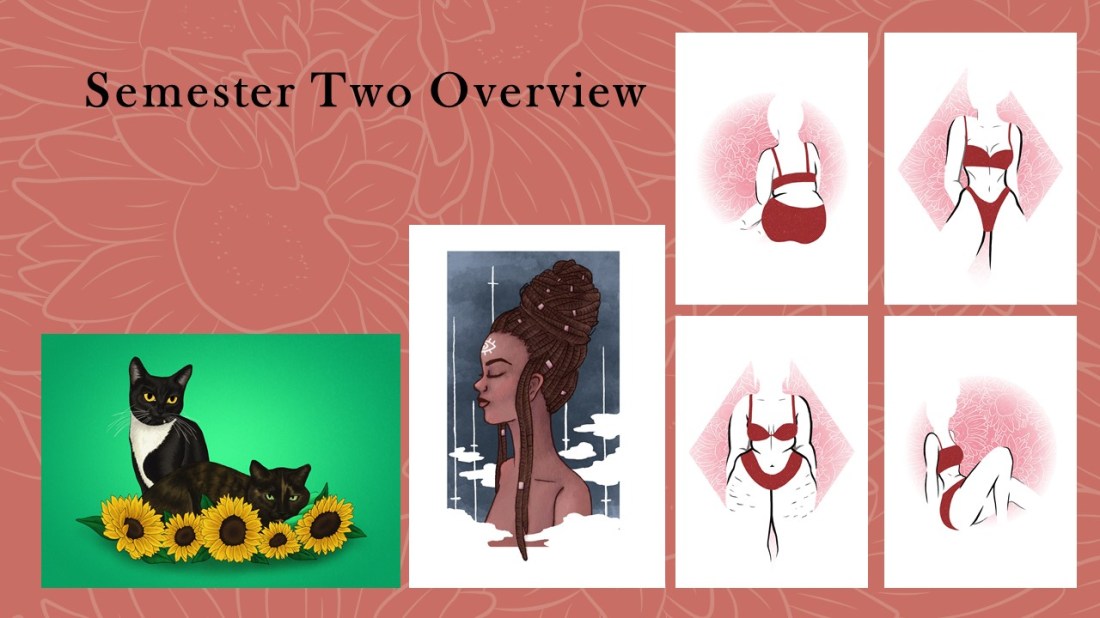
These are unplanned side projects which I ended up spending more time on than I necessarily had.

The first on the left was a commission piece for my friend.

The second was a ‘draw this in your style’ challenge in which I had to recreate an artist’s drawing in my own style, the piece here being a recreation of Chelsea Gracei’s work.

Then the final pieces on the right were a collection I created for ‘A Canny Collective’ which was a local exhibition that I was asked to be a guest artist for.

Although I had spent longer on these pieces than I should have, I do feel like I gained a lot of experience from them, especially with the exhibition pieces, as there was a whole process of creating the pieces and setting them up within the space, but I also worked on the stall on the opening night, so I was able to gain more experience of selling my own and others work one to one, which is something I do believe I will do again in the future. All of these pieces will also go towards my portfolio, hopefully allowing me to show more range of style, techniques and skill within it.
 

Slide10

10

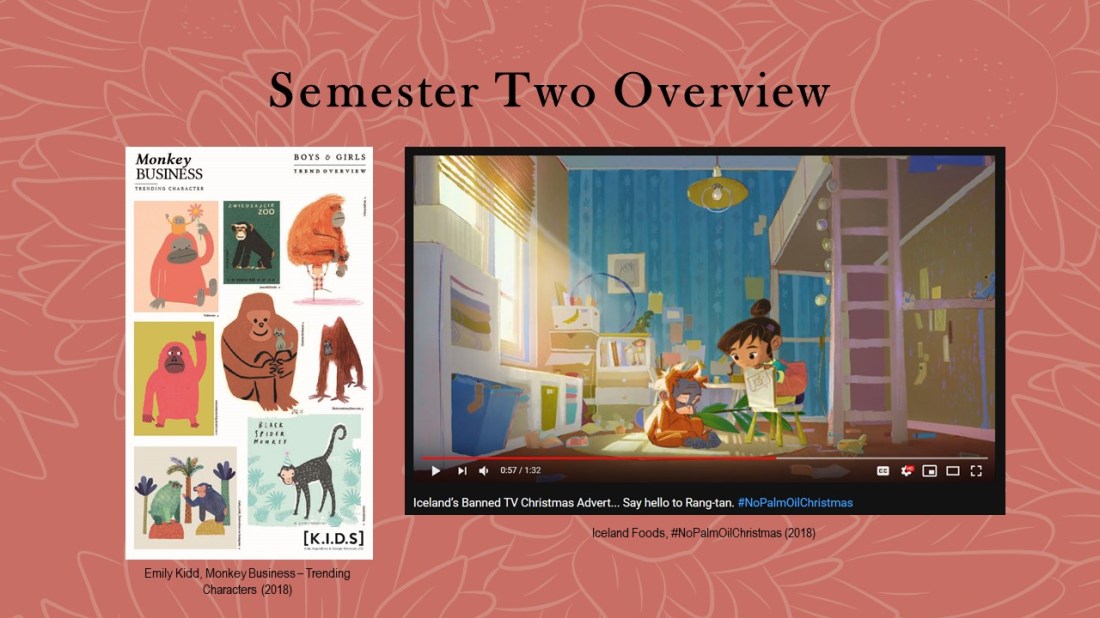
My goal with this specific project was to create a more thought-provoking illustration, which links back to the goals I set in my second learning plan.

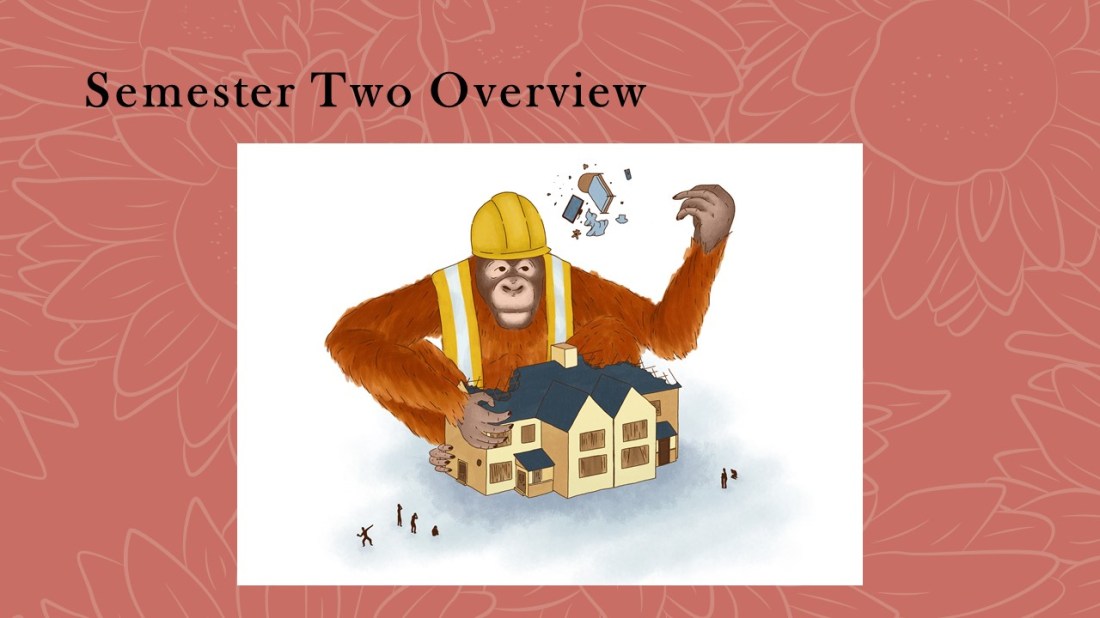
For the Northern Illustration Awards, a competition by the AOI, the brief was ‘monkey.’ When searching Pinterest for inspiration I came across the image on the left, and in the corner saw an orangutan which had been created in a looser style which helped suggest the animal’s fur. I wanted to work in a similar style to create my own monkey, but I did want to use a stronger theme. Thinking of Orangutans, it had reminded me of the banned Iceland advert, in which it discusses the destruction of rainforests (the orangutan’s habitats) for palm oil.
 

Slide11

11

Within this piece, I wanted to show a role reversal between humans and the orangutans, they being the ones that are destroying our homes with such carelessness instead.

I enjoyed working on this piece as it was more experimental and I was able to work more loosely. I was able to play around with different brushes, (in the end, I had used a gouache brush for the fur and a ‘scratchy pen’ for the linework, both from Kyle T. Webster brush packs) and these, in turn, allowed me to build up my own impression of fur, which helped give a sense of realism but the style was still loose and quite painterly for digital art.

I designed this piece to fit within a white page, so it is more minimal in that sense, but this factor could potentially make it more editorial as I could imagine it fitting within a magazine as an illustration for an article.

With this illustration, I had recorded the process and created my first ever YouTube video which was a speed paint of this piece. I do want to carry on uploading more speed paint process videos, potentially giving more information in the form of a voice-over, but one day I do want to live stream as well as/opposed to recording, as I believe I would prefer to talk live to an audience, having an active conversation as I go, rather than feeling like I am talking to myself in a voice over.


Slide12

12

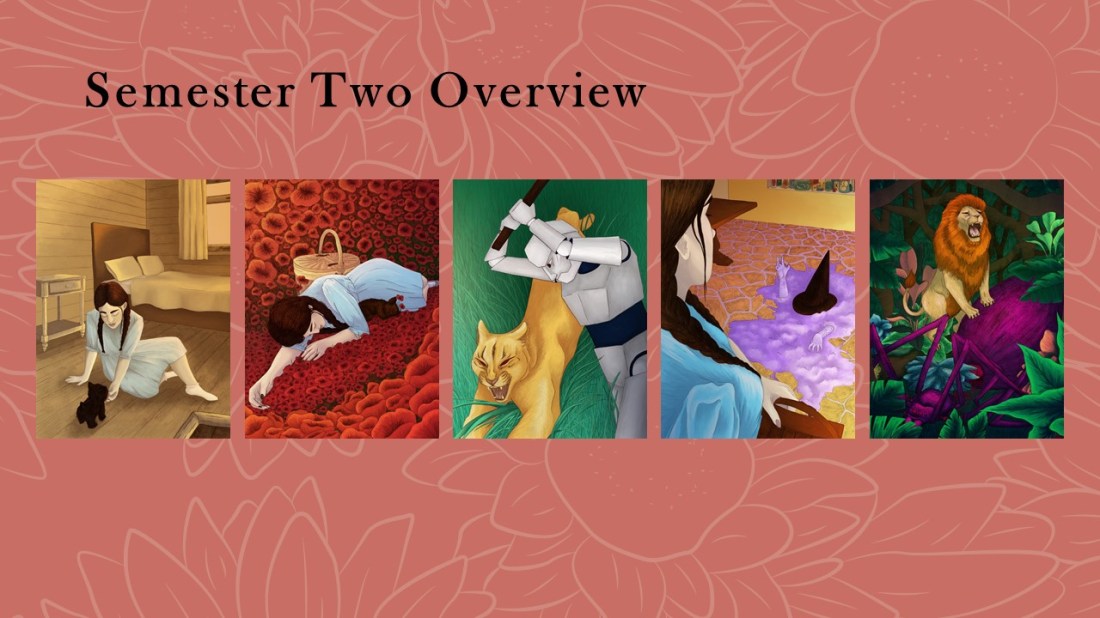
The next project was the Wizard of Oz, my goal with this project was to work more traditionally using pencil and then colouring the pieces digitally as I believed it would give me a better choice in colour palette. With this project, I did want to work with a more fun and vibrant colour palette than I may have used before, as I wanted my pieces to suit the colour themes suggested within the story, such as ‘Emerald City’ and the ‘yellow brick road’.

The idea for the mediums and techniques were initially inspired by Tina Nass, but as my project developed and I moved to a more realistic style within the project, I tended to take more inspiration from an artist named Chantal Hores as she still works with the same mediums and techniques as Tina Nass, however her style is more realistic, especially with her characters.

Again, my research had come directly from the book, finding quotes that would allow me to create an accurate depictions as possible, but in this project I did find it more useful as the movie adaptations were not completely true to the descriptions within the book, for instance, the famous ruby red slippers were actually silver in the story.
 

Slide13

13

These pieces have come a long way from the start, as I had originally sketched them out in a layout that looked flat and boring, I later repositioned and redrew the pieces using my own reference photos, as well as reference images online (more so for the animals) which allowed me to create more organic and dynamic viewpoints within my illustrations.

I’m extremely proud of the outcomes as there is a strong narrative throughout, one that I wouldn’t have thought that I would have been able to achieve at the beginning of the year. I love the colours as they are vibrant and express the themes of Oz. I did try to stay away from the known imagery when working on these pieces, and I do believe I’ve created my own unique interpretations of the story.

I loved the style of work and mediums that I had used and I hope to use them again more often in the future. If I find myself in a spot again where I feel my composition or layout of a piece is a bit boring, I will try to take my own reference images again, exploring different viewpoints and angles etc, so that I can potentially create more dynamic illustrations which are less boring and flat in the future.
 

Slide15

14

Branding has a lot of components within it, for instance I needed to create business cards, a website, a portfolio, creative CV and products and all of these would go into a promo pack which would be sent off to potential clients and or agencies.

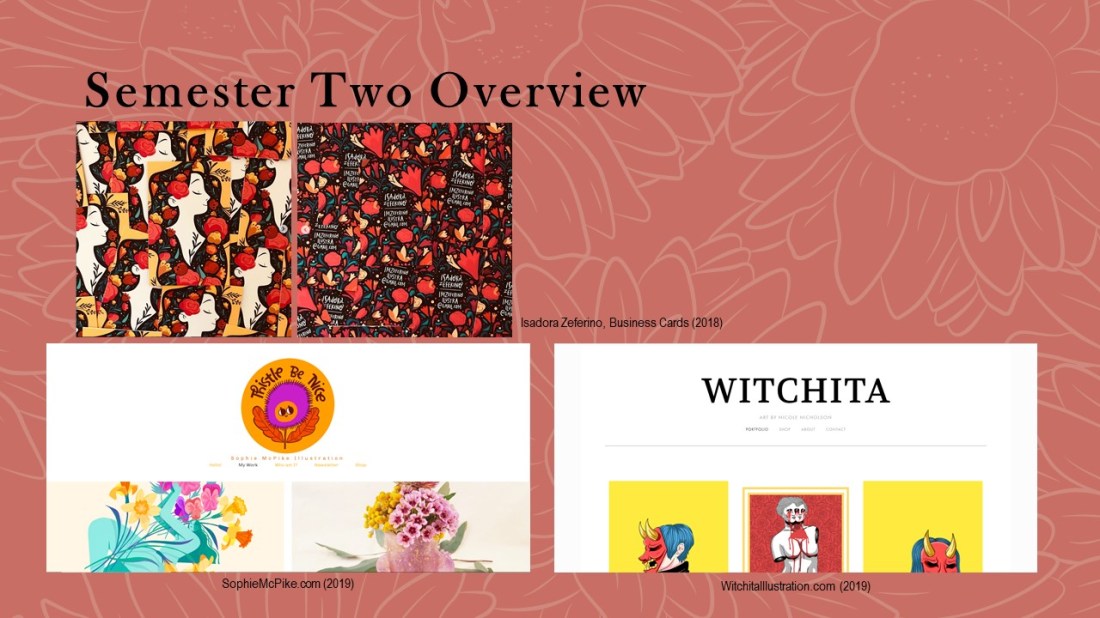
As far as research goes, I initially started the process of creating my business cards within semester one, so that they could be sent off with my zines. I was inspired by an artist named Isadora Zererino as on her cards she has an illustration on the front and her information on the back, they are also portrait, which is something that I hadn’t seen very often and this is how I wanted my own to be laid out.

When creating websites, I was researching as I was going, looking at how other artists laid their work out, what their buttons were, how they ordered them, and how they described themselves in their about pages etc. For this, I had used Sophie McPike and Nicole Nicholson’s (who is a student in my class and made her site first) websites as inspiration. I also took information from a talk we had with someone from AOI who had explained that a client will make their impression of you within the first couple of seconds of looking at your website, so it’s good to have 6-9 pieces on display on the front page.
 

Slide14

15

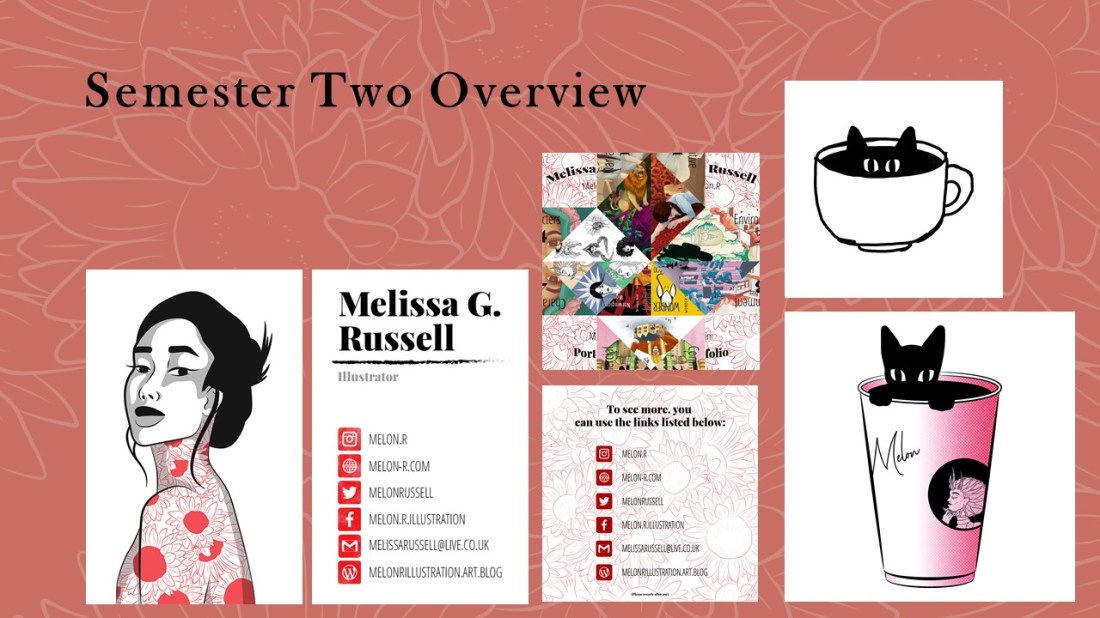
On this slide, to the left, I have shown my current business card with my website included which wasn’t present in semester one.

A mini-portfolio, which is actually a paper fortune teller. I felt this would be an interesting piece for someone to receive in my promo pack as it is a unique way for them to view mini clips of my work. On the back, I did provide links so that the receiver would be able to look at my portfolio more in depth, seeing the pieces that I have cropped down for this mini-portfolio in more detail.

The two pieces on the right side are merchandise ideas. On the top is a sketch of a potential pin. I want to create these in wood using the laser cutter in the workshop as ordering enamel pins is not in my budget or audience range at this moment in time. Maybe in the future, if I do build more of an audience, I could have a pre-order or made-to-buy system which would allow me to make a profit and would ensure that none would go to waste.

The second image on the right is going to be a sticker, potentially a little print.
 

Slide16

16

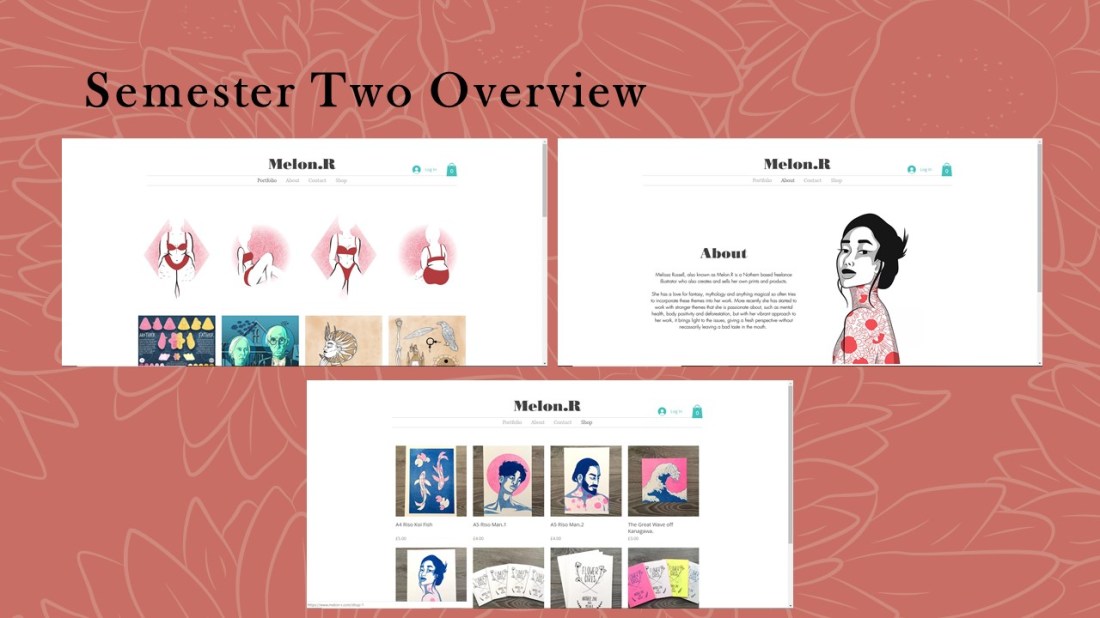
These are pages from my website. I still have work that needs to be added to the portfolio but I will want them to fit within a layout that is organised by colour or theme, which I believe will make the website more aesthetically pleasing to the eye, so I can potentially catch a client’s attention within the first couple of seconds, as the member of AOI had suggested. The website also has a shop which I do plan to work from in the future.
 

Slide17

17

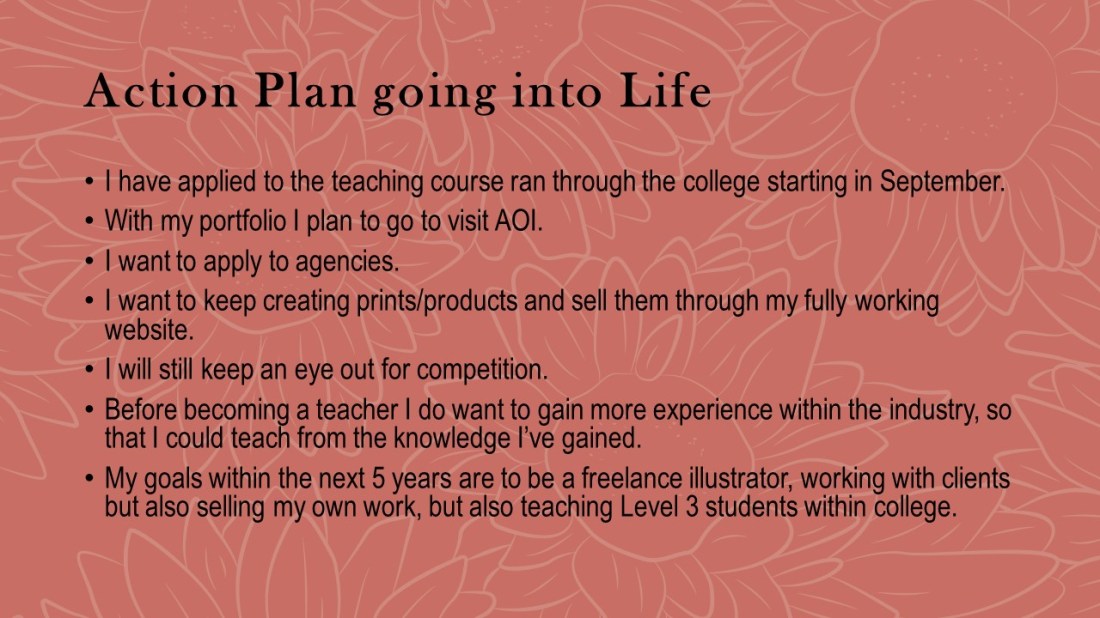
Going into the future, I have applied for a teaching course within the college that will start in September. Before teaching properly, I do wish to have more experience in the industry so that I can teach from my knowledge and experience that I may have gained.

With my portfolio, I plan to visit the AOI to get a review and more information about which direction it should go, if I need to take anything out, if I need to add anything more and so on.

I will also be applying to agencies hoping to get more freelance based work.

I will be continuing to create products and selling them through my website.

I will still try to keep an eye out for competitions.

I will also continue creating YouTube videos, ones that are more in-depth with voiceovers added. I also want to live stream more, having a more relaxed experience, potentially talking one to one with my audience as I create my work.

Overall my goal for the next 5 years is to be a freelance illustrator, working with clients and potentially have an agent. I will also be creating and selling my own work on the side, as well as hopefully teaching level 3 students within a college.
 

Slide18

18

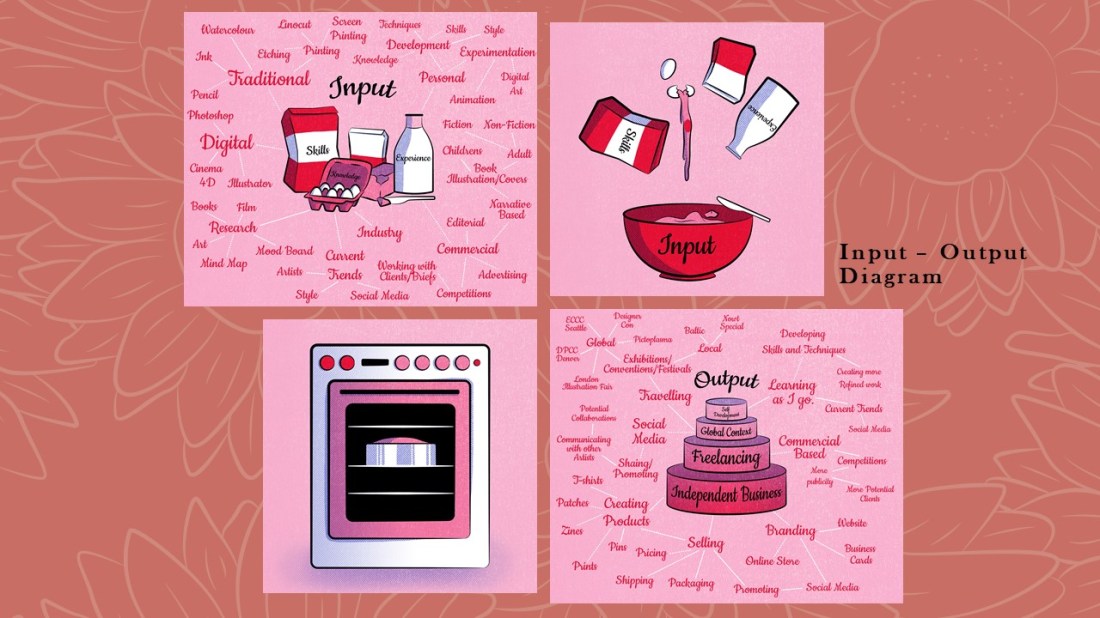
Following on with more self-reflection, I created a couple of diagrams within the space of the year that are up on my blog. This one is an input and output diagram, it describes the skills, knowledge and experience that goes into my work and what is output from it, being anything to do with business, freelance work, self-development and live briefs.

If you would like to read more about my Input-Output diagram, click here.
Slide19

19

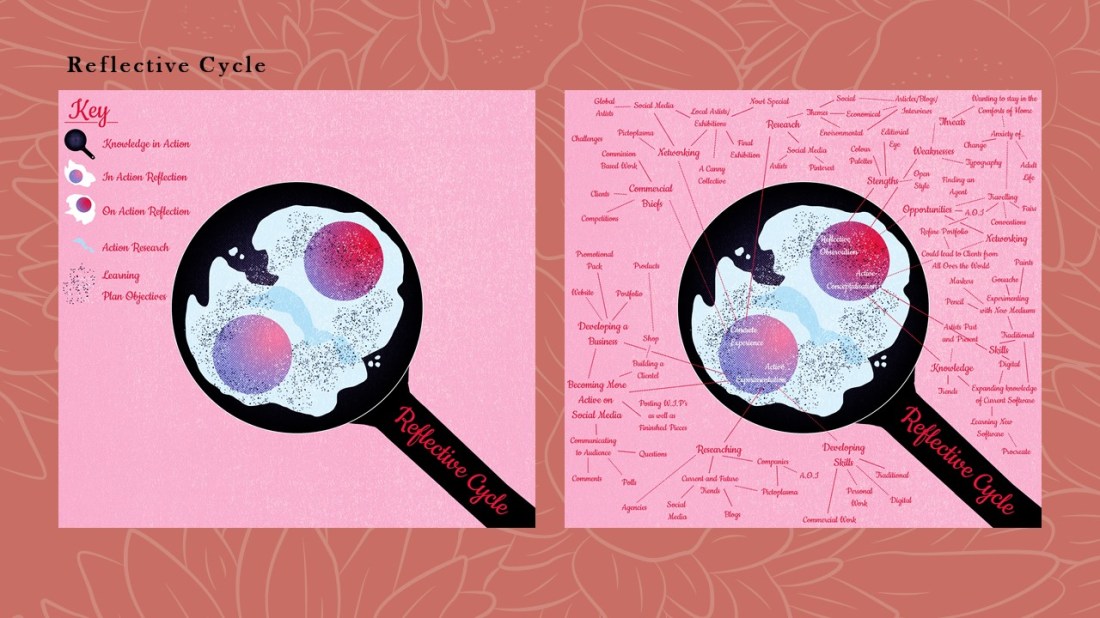
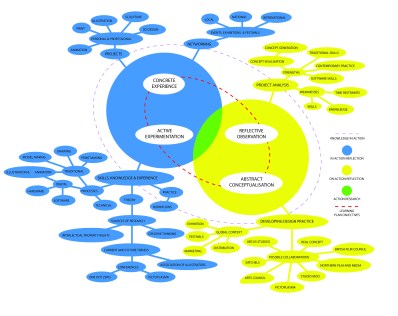
This next diagram is my reflective cycle, it shows my process of planning a project, the research that goes into it, my action plan, the actual practical work and the experience from said practical work. This then carries on and the cycle starts again.

The explanations of both of these diagrams are on my blog, as I wanted to have an easier explanation for someone who may not understand these types of reflective practices, but may want to understand my process of working, thinking etc.

If you would like to read more about my Reflective Cycle, click here.
 

Slide20

20:

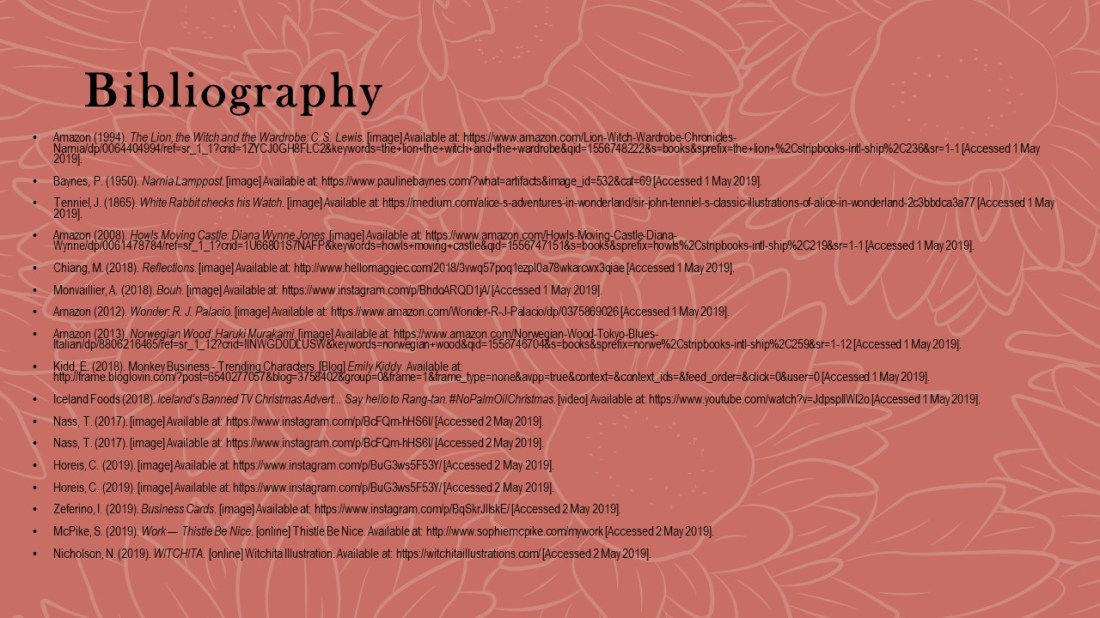
This is my bibliography. Thanks for your time do you have any questions?

Although this was more directed at my presentation if you do have any questions feel free to comment and I will try to answer as best as I can!


List of Illustrations
These are all jpeg images of the slides from my Reflective Practice Presentation. Within the slides, I have cited the images that were not mine, so if an image does not have a caption, it is my own work.
Figure 1.Amazon (1994). The Lion, the Witch and the Wardrobe: C. S. Lewis. [image] Available at: https://www.amazon.com/Lion-Witch-Wardrobe-Chronicles-Narnia/dp/0064404994/ref=sr_1_1?crid=1ZYCJ0GH8FLC2&keywords=the+lion+the+witch+and+the+wardrobe&qid=1556748222&s=books&sprefix=the+lion+%2Cstripbooks-intl-ship%2C236&sr=1-1 [Accessed 1 May 2019].
Figure 2.Baynes, P. (1950). Narnia Lamppost. [image] Available at: https://www.paulinebaynes.com/?what=artifacts&image_id=532&cat=69 [Accessed 1 May 2019].
Figure 3.Tenniel, J. (1865). White Rabbit checks his Watch. [image] Available at: https://medium.com/alice-s-adventures-in-wonderland/sir-john-tenniel-s-classic-illustrations-of-alice-in-wonderland-2c3bbdca3a77 [Accessed 1 May 2019].
Figure 4.Amazon (2008). Howls Moving Castle: Diana Wynne Jones. [image] Available at: https://www.amazon.com/Howls-Moving-Castle-Diana-Wynne/dp/0061478784/ref=sr_1_1?crid=1U66801S7NAFP&keywords=howls+moving+castle&qid=1556747151&s=books&sprefix=howls%2Cstripbooks-intl-ship%2C219&sr=1-1 [Accessed 1 May 2019].
Figure 5.Chiang, M. (2018). Reflections. [image] Available at: http://www.hellomaggiec.com/2018/3vwq57poq1ezpl0a78wkarcwx3qiae [Accessed 1 May 2019].
Figure 6.Monvaillier, A. (2018). Bouh. [image] Available at: https://www.instagram.com/p/BhdoARQD1jA/ [Accessed 1 May 2019].
Figure 7.Amazon (2012). Wonder: R. J. Palacio. [image] Available at: https://www.amazon.com/Wonder-R-J-Palacio/dp/0375869026 [Accessed 1 May 2019].
Figure 8.Amazon (2013). Norwegian Wood: Haruki Murakami. [image] Available at: https://www.amazon.com/Norwegian-Wood-Tokyo-Blues-Italian/dp/8806216465/ref=sr_1_12?crid=IINWGD0DLUSW&keywords=norwegian+wood&qid=1556746704&s=books&sprefix=norwe%2Cstripbooks-intl-ship%2C259&sr=1-12 [Accessed 1 May 2019].
Figure 9.Kidd, E. (2018). Monkey Business – Trending Characters. [Blog] Emily Kiddy. Available at: http://frame.bloglovin.com/?post=6540277057&blog=3758402&group=0&frame=1&frame_type=none&avpp=true&context=&context_ids=&feed_order=&click=0&user=0 [Accessed 1 May 2019].
Figure 10.Iceland Foods (2018). Iceland’s Banned TV Christmas Advert… Say hello to Rang-tan. #NoPalmOilChristmas. Available at: https://www.youtube.com/watch?v=JdpspllWI2o [Accessed 1 May 2019].
Figure 11.Nass, T. (2017). [image] Available at: https://www.instagram.com/p/BcFQm-hHS6I/ [Accessed 2 May 2019].
Figure 12.Nass, T. (2017). [image] Available at: https://www.instagram.com/p/BcFQm-hHS6I/ [Accessed 2 May 2019].
Figure 13.Horeis, C. (2019). [image] Available at: https://www.instagram.com/p/BuG3ws5F53Y/ [Accessed 2 May 2019].
Figure 14.Horeis, C. (2019). [image] Available at: https://www.instagram.com/p/BuG3ws5F53Y/ [Accessed 2 May 2019].
Figure 15.Amazon (2015). The Wizard of Oz: L. Frank Baum. [image] Available at: https://www.amazon.co.uk/Wizard-Oz-L-Frank-Baum/dp/1604335424/ref=sr_1_14?keywords=wizard+of+oz+book&qid=1557071553&s=gateway&sr=8-14 [Accessed 2 May 2019].
Figure 16.Zeferino, I. (2019). Business Cards. [image] Available at: https://www.instagram.com/p/BqSkrJllskE/ [Accessed 2 May 2019].
Figure 17.Zeferino, I. (2019). Business Cards. [image] Available at: https://www.instagram.com/p/BqSkrJllskE/ [Accessed 2 May 2019].
Figure 18.McPike, S. (2019). Work — Thistle Be Nice. [online] Thistle Be Nice. Available at: http://www.sophiemcpike.com/mywork [Accessed 2 May 2019].
Figure 19.Nicholson, N. (2019). WITCHITA. [online] Witchita Illustration. Available at: https://witchitaillustrations.com/ [Accessed 2 May 2019].

(End of Year Evaluation) Reflective Practice Presentation – Part 1

First thing I should explain is that I am bad when it comes to presenting within a specific timeframe, for this presentation it needed to be within 10 minutes. At the start of the year, I had given another presentation based on my proposal for the year and although I do believe I did well, I was told that I had gone over my time (not by how long though), so from this experience, I already had the fear of going over my time limit but little did I know of how much more of a concern this should have been.

In prep for this presentation, which was basically a review of the whole year, discussing projects, research outcomes and swot analysis throughout, I had tried to practice with my boyfriend, but he had noticed how long I was taking to get my words out just with the first slide, so suggested I make a script. We did this by having me first write out my information for the specific slide, then he would go in and brief it down, taking out any information that I may have repeated or rewording sentences so there was less babble. We had gotten the script done at half 12 in the morning of the presentation, so we had one run through before we went to bed. He had timed himself reading through it at his normal pace and it had taken him 10 minutes and 27 seconds, but this was without any breathing space between points and section so it was concerning. When I had read through it there were certain words I wanted to change, I didn’t add anything more, but I wanted the script just to sound more like me again, so, I decided I would make these changes once I had got to college.

I got to college at half 8 and my presentation was at 9:45, so I believed I would have enough time to make the changes and read through before I started. I believe this would have been the case if the colleges PC’s logged in at a normal speed, and did not have a Microsoft updating/loading screen every time anyone tries to log in. I tried turning off the computer from the plug socket, as my tutor normally suggests, I tried logging into another PC but the messages just ended up on that screen as well, so eventually, I ended up just moving to a Mac, which logged me in instantly. I’m not trying to put blame on the computers, but I do believe I lost practice time due to these issues. As well as making changes to the wording I had decided to highlight specific words or phrases from the specific slides and points so that I wouldn’t be reading directly from the script but I could look down, see the highlighted words and know what I’m talking about.

By the time I had finished making my changes ready to print my cards off, my tutor had come in and told me it was my time, meaning that I did not have time left to do my run through. I was panicking because of this, but I hoped with the addition of the highlighted words that I would be able to follow the script without having to constantly look down at it.

This, however, was not the case as I ended up going completely off script, using the highlighted words as starting points which I ended up expanding on. So, the whole night of myself and partner working on the script, shortening it so that I wouldn’t be babbling or going over my time limit was completely thrown out of the window, as I did go over; I had in fact gone on for 37 minutes.

When going back to my peers and talking about my presentation, we did all have a laugh at my timing as no one could believe it, I could barely believe it! It definitely did not feel that long to me at the time! Once more and more of my peers had done their own presentations and had come back with such good results though, I was extremely proud of them but it made me realise how better I could have done myself. I was told that from my presentation I had still got 60% which is a 2-1 (which could still be changed when others come to mark it) but I started questioning if I had lost a certain percentage due to going over my time and how much that percentage was? Could I have gotten the first if I had just been within time or would I still have gotten a 2-1 because I had missed information? Before this presentation, I had gotten a first in both modules I completed, so although I know 2-1 is still a good mark (especially for going over my limit by so much) I did build a higher expectation for myself, so I am gutted that I couldn’t achieve that level this time.

The presentation was 30% of my reflective practice module, my blog being 70%, so a 2-1 is not necessarily my overall grade for this module as of yet, but I was told that I would need to achieve 75% in my blog to pick it back up to a first, so I hope that I can make it to that level, making sure that I have hit all the criteria within the brief, but have also gone beyond and above that so that I can potentially achieve the higher grade.

What I wish I had done:

  • Started writing my script sooner.
  • Started practising with it sooner.
  • If it could have helped me more I would have just read directly from my cards, which could have allowed me to finish within the 10-minute mark as my boyfriends run through had, but I believe that this wouldn’t have shown good presentation skills and might’ve taken my marks down further.

What I can learn from this experience:

  •   Start making my presentations sooner. This would allow me to potentially write a script, practice with it, and possibly learn it off by heart so that I wouldn’t even need any cards.
  • I need to babble less. One of my teachers once said to me that I write very directly, I get to the point but I wouldn’t necessarily expand. Since this comment I do feel my written work has gotten more detailed, I am still direct with my points but then I do expand on them further now. I feel this has translated to my communication skills as well though, so although this habit may be good for my written work (or may not as it may just come across as more babble, but I haven’t had any complaints?) it may not be good when it comes to a presentation, especially one with a time limit, as I evidently will babble on.
  • I do believe I have taken more priority with my blog this year than I have in previous and I do feel it is strong, but I will make sure that I have been hitting the criteria within my brief and I will try to go above and beyond so that hopefully I will get my mark back up.
  • It’s not useful to focus on everything that went wrong and what more you could have done, but it is good to reflect on that experience and refocus on the things you can still do. I do wish I could redo my presentation but I know that I can’t and it is done, so what I can do now is focus on my blog, as well as my other projects, to make sure I am still working at the level I want to be at within those modules and hopefully achieve my goals of a first overall.


In part two of this blog, I show the slides and script of my presentation. I have expanded on the initial briefer script, going into more depth with the specific projects, discussing my goals, overview of the projects, outcomes, self-reflection and so on. What will be ironic about this is that the expanded version of the briefer script will probably be closer to what I had said within the actual presentation, allowing me to go on for 37 minutes.

Reflective Cycle


Reflective cycle radial thinking-01.jpg
David Hails, Reflective Cycle (2012)

As a class, we were asked to produce a reflective cycle based on ourselves and our working process, to the right is an example we were given which was created by my tutor David Hails. I have created my own as you will see when you scroll down, and I’m going to try to explain it in a way that would make sense, but the particular wording still confuses me so bear with me.

Following the example, to make it my own, I imagined the circles as two eggs so wanted to try convert the diagram into that imagery. So in my piece, in place of the two circles, I have made eggs (I tried to differentiate the two slightly, one yolk being pink and the other being more red) and coloured the centre where the two overlap as that indicates to a specific section within the diagram. The pan that holds them is significant of the outer circle, then the inner circle that connects the eggs is formed from pepper and salt.

Starting with the red egg, it represents ‘on action-reflection’, which is the more research-based side of my working process. This egg includes two factors, ‘reflective observation’ which is self-reflection, assessing my strengths, weaknesses, threats and opportunities. You then move onto the next factor ‘abstract conceptualisation’ which is almost like an action plan. Looking at your weaknesses or threats based on the last factor, you make a plan of how you can improve on them, what you can do to better your process/craft.

Moving onto the pink egg, which represents ‘in action-reflection’ meaning the more practical side of the working process, it also has two factors, the one following the last being ‘active experimentation’ which I believe is the execution of the points you had made within your action plan. The last factor following that one is ‘concrete experience’ which I believe is the experience from work you create, ie what skills you’ve gained, whether its with commercial work or personal, traditional or digital etc. Your experience then follows back on to the reflective observations, reassessing your strengths and weaknesses so onwards the cycle goes.

The inner circle of this diagram otherwise shown as the salt and pepper, represents ‘learning plan objectives’ and I believe this shows how the cycle of the elements within the eggs works within a project setting, for instance, when you get a brief you may do a SWOT analysis first, noting what you want to work on, then you will create an action plan and set your targets, then you will do the practical work, achieving the goals you set, and afterwards you will have the experience from working on the project, and will be able to start all over again, giving yourself SWOT analysis of the work or project you’ve just completed.

The outer circle, or the pan, represents ‘knowledge in action’, which I believe just encapsulates all of these elements and the cycle as a whole, as it is a process which you learn to do automatically whilst working and I personally believe its how you grow as an artist, as you learn to be critical but then you learn to improve and then you gain more experience and more knowledge which will better your strengths onwards in the cycle. I believe that an artist should never stop learning or trying to improve, they can be amazing at what they do, but that shouldn’t mean that they should just stop trying out new skills or techniques or expanding their genre of work/themes as they could become more informed on certain topics, which would then allow their work to reach new audiences and so on.  With this theory in mind, the reflective cycle would never stop.

eggkeyegginfo

Within the diagram, I have added my own information stemming from the steps within the eggs. Hopefully, with my explanation, the diagram is more understandable, as I know from an outsiders perspective it may just look like a lot of information.

Reflective Observation: In this section, I have just listed some of my current strengths, weaknesses, threats and opportunities.

As of strengths, I feel my work is very open, I don’t necessarily have a set style or colour palette and I have been told that I have quite an editorial eye, possibly within the way I layout my designs or how I have thought about the composition and set out my work within my portfolio and book. So I feel these qualities are good in terms of employability with potential agencies and clients.

My weaknesses and threats seem to link a bit as I believe my biggest threat and weakness is myself at times. I’m not a big fan of change so it often holds me back from moving onwards (on a bit of a tangent, I’ve been in education for all of my life so I’m so scared of when it comes to finishing this course because when I say I’m leaving the comforts of college, I’m really leaving the comforts, I have to find work myself, I will have to apply to agencies, I will most likely need to create more work for them, its just having that incentive to do so. I don’t want to leave college with a degree and just do nothing with it, I do want it to have had a purpose) I have linked some of the threats to my opportunities as they could prevent one another, for instance one of my opportunities is that I could go down to London and have my portfolio checked by the AOI, I however have a fear of travelling as I don’t really travel, the only times that I have is when I’ve had other people with me who were more in charge of things like travel bookings, hotel booking, how to get about etc, (I have planned a couple of trips this summer with my partner, so hopefully I may overcome these fears) I’m basically scared of becoming an adult, but I know I need to overcome that and fast, as I don’t want to be living with my mam forever. I guess I will grow and learn more with experience, so I guess I’ve just got to jump straight in head first, I just fear that I’ll lose the motivation to keep growing and I’ll find myself in an endless job I don’t enjoy.

With my opportunities, as I mentioned, visiting the AOI to get my portfolio checked would be a great opportunity as they would give me advice on what direction my portfolio should go, they could suggest me agencies or find me, clients,, so although I’d have to pay for the membership, it would definitely be worth the money in my eyes. Most of the opportunities I thought of included travelling, whether it was for illustration fairs like the one in London, London Illustration Fair, which runs in winter but applications open in summertime. If I were to apply for this, I would like to go to one of their events first just to see what I’d be getting myself into, but I believe it would be a good networking opportunity. I would also like to go to some American conventions at some point as well, not to sell but I would like to see and purchase art from some of my favourite artists firsthand, one convention in particular that I am most interested in is DesignerCon. I’m not sure if it changes destination each year, but for 2019 it is being held in Anaheim, California in November time. Again I see this being a good networking experience, but it is where I aspire to be, creating my own work and products and selling them in conventions or fairs as well as online.

Active Conceptualisation: Networking links onto the next step within the egg, my action plan, as I do plan to visit more fairs and conventions in the future, I want to get more involved in the illustration community whether it be in person or on social media. I feel artists are the most aware of the algorithms on social media, especially on Instagram, so I really respect the artists I follow supporting one another, whether its sharing their favourite artists or pieces, like some I follow, have a ‘feature Friday’ on their Instagram stories, but you can also show support by just commenting or liking a post. You could also become more involved in the community through challenges, there’s one coming up called Mermay where you would draw mermaids for the month of May, or there’s Inktober which I participated in last year, or there is #DrawThisInYourStyle challenges. I do believe the art community is very open, it’s just a case of becoming more active, posting more, communicating more and becoming apart of that community which I do aspire to do.

The rest of my points for this step relate to knowledge and growth, learning new skills, whether it is with new software like using procreate, or whether it is developing my knowledge with current programs I use. I do feel I know the basics of illustrator, but I could always learn more, who knows, maybe some of the things I do now could be a lot easier if I learnt another way to do it? I do want to gain more experience with traditional mediums though, a lot of the artists I follow use gouache or have recently started to, so I would like to try out the medium for myself. I know it is quite pricey so I have held back from purchasing it before, but I have been recently working with a gouache brush in photoshop, but I obviously don’t believe it gives you the full experience as I believe it is supposed to dry lighter and you build it up? So I would like to experiment and experience the true qualities of gouache for myself.

Active Experimentation: As I mentioned before, this group is based on the more practical side of the cycle, it is the doing part of your action plan. So, in my own process, I usually research for inspiration, whether it is from artists, social media, or blogs and companies like pictoplasma. The sources I use I feel are regularly updated so it is easier to keep on track with trends within the industry, whether its specific colour palettes, patterns, a method of working etc. I believe last year risograph was a big trend and I did see a few riso prints in Berlin for Pictoplasma. This year, I believe I was noticing a trend of the comic halftone effect coming back after the release of Spider-man: Into the Spider-verse, but have not really seen much of it since. I have still tried to incorporate it into my illustrations though, for example in the diagrams the effect has been used as shading to the egg yolks.

In my projects, especially personal ones, I do try to develop my skills, whether it’s working within new areas of illustration, for instance, more editorial as I have tried to do with my Orangutan illustration, or learning new digital techniques, or experimenting with more traditional mediums like pencil as I have done in my recent Wizard of Oz project, mixing the traditional linework and textures with digital colouring.

As I had mentioned in my action plan, I do want to become more active on social media so this would mean posting more often, whether its final pieces, initial sketches or W.I.P’S. I only tend to post finished pieces and don’t really show my audience the process so it may give unrealistic expectations, or just make it seem like there’s no human behind the account, so if I were to post more, giving updates of how a piece is developing, it may make my audience feel closer to me, more connected and possibly more relatable if they could see that I do make mistakes during the process. By building an audience it does give me a higher chance of potential customers. As I have a little following I do overthink when making or ordering products, especially when recently looking into making enamel pins, as the minimum amount to buy is 50 pieces but if you buy more it would make the selling amount per pin cheaper, but I doubt I could even sell 50, so I feel like I would end up under profit and with product still left over. I am going to try to make the pins through college using the laser cutter, but if one day I do have a bigger following, I would feel better about putting more money into my products, especially if I could make a pre-order system so that I would know all of the product would definitely sell and I’d be making money back.

Concrete Experience: Although I feel I gain more skill when working on personal projects, I definitely gain more experience when working on commercial projects. Whether its creating commission based work, working one to one with a client, working on live briefs and competitions, I enjoy these projects more as it’s not just me creating my own brief that I can be as lenient or as harsh with as possible, I’m actually working with a brief or a client, creating concepts and pieces that I would never have imagined creating. I feel with personal briefs the work is what I want to create, but with commercial projects, they open me up to new content, working with new subjects or new styles, forming work that may be new to the work already in my portfolio but could potentially show a client the areas/themes/styles I can work with. If I was left to my own devices, I would just draw women and flowers all day, whereas with my commercial projects I have been able to work with a range of themes and audiences. In this year alone I have created 3 book covers, a set of illustrations and an editorial piece based on deforestation and the loss of habitats for Orangutans, and these were all from live briefs.

Relating back to current trends, I feel I also gain experience when researching as I take in the knowledge from looking at recent artwork, whether it in a magazine like Juxtapoz or just on social media, I keep note if there are any particular trends that I can spot then I feel I start adding these to my own work, whether subliminally or not, using the comic halftone pattern as a reference again, I don’t believe I would have started incorporating it into my own work unless I had seen other artists using it and noting how they apply the pattern to their designs.  Another way that research helps is with themes, especially when creating a more thought-provoking piece, as you could use social, economic or environmental themes, using current stories that are potentially affecting a lot of people or the world, themes that you feel strongly about but maybe need more information so that you can best communicate your views.

Networking is also a good method of gaining experience, whether it’s going to local events/exhibitions, or travelling further, like to Pictoplasma in Berlin or New York as an example. I feel it may be a good place to meet others with the same interests, potentially in the same position as you, so in a way, it would allow you to find new artists but also sell yourself/work to them in an indirect sense.

In this section, I had included A Canny Collective, a local exhibition which I was a guest artist for, and although I did not necessarily network much, (as I was mostly selling work) I did gain a lot of experience from doing this, making the work, setting it up, then even selling on the night. I have never sold one to one before, but I have imagined potentially having a stall one day (inspired by my Aunty who use to have a stall at different markets but now actually owns her own shop in Stanley, ‘Purple Dragon’ if you’re ever in the area) so having the experience of selling my own work, as well as others, I feel will be very useful in the future, possibly in our final show, as I believe we will be having a stall there on the night too.


List of Illustrations

Hails, D. (2012) Reflective Cycle.

All other images are my own unless stated otherwise.

Reading List

Designercon.com. (2019). DesignerCon – November 22nd-24th 2019. [online] Available at: https://www.designercon.com/ [Accessed 30 Apr. 2019].

The London Illustration Fair. (2019). Home — The London Illustration Fair. [online] Available at: http://www.thelondonillustrationfair.co.uk/home-1 [Accessed 30 Apr. 2019].

Input-Output – Illustrated Diagram

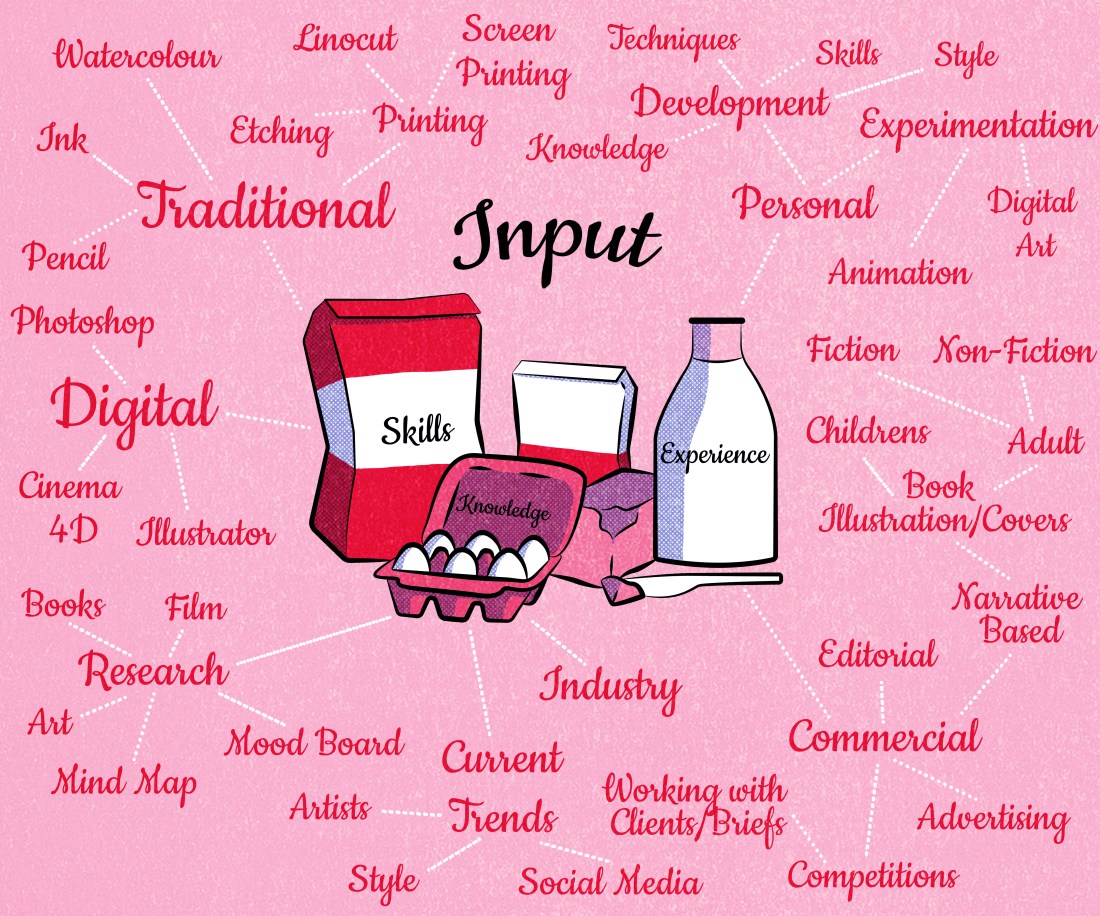
As a task, the class was asked to reflect on themselves and their workflow, thinking in terms of an input and output system. We had to think of what goes into our work, i.e skills, research, experience etc. And then think about what all these elements allow me to create within my work, so this relates to my business, creating a product, selling that product, branding, socialising, promoting myself and so on.

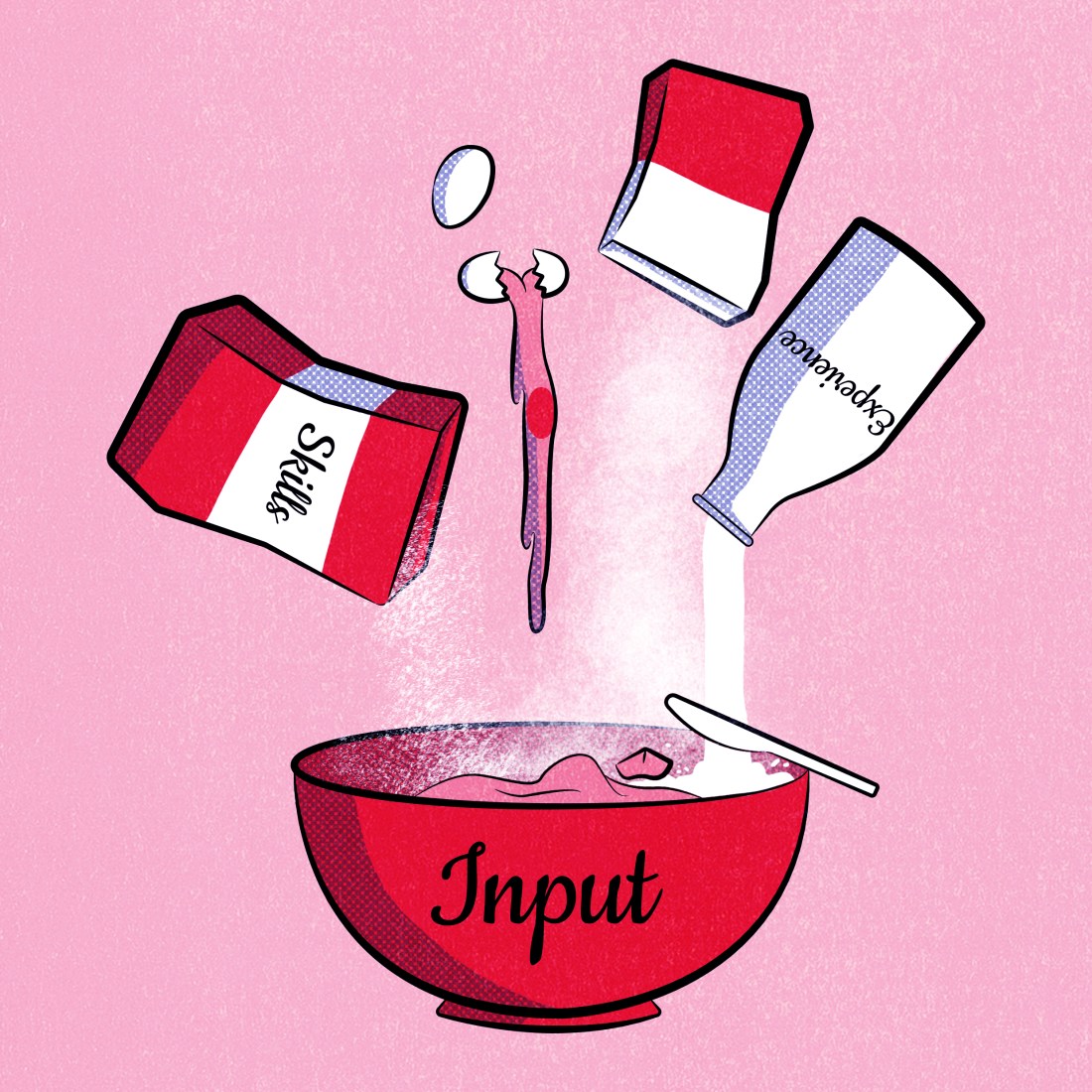
Once we had thought about this, we then had to create a diagram. As of the Illustration we were to think about imagery that worked in a similar way, meaning that it would have an input and output system. When I got told about this theory, my first thought was of Cat in the Hat, how they had the ‘KUPKAKE-INATOR!’ in which you could make cupcakes out of anything!

“Anything?”

“Yes anything!”

“Anyythiing?”

“I’ll get you and it’ll look like a bloody accident!”

(Cat in the Hat, 2003)

So, in my head, I imagined the input going all into a machine, then the output becomes the amazing cupcakes in the process.

This idea had developed through the drawing phase, but the concept was still the same, the ingredients are all the elements in which go into my input, then the final cake is my output, each layer dedicated to a specific area in which my workflow leads to.

inputinge=redoutputsovenoutput

For the input, the main influences within my work process I believe come from my skills, knowledge and experience. Each of these elements can link back to one another, like how my knowledge can grow from the experience, more experience can help improve on skills, etc. From each of these elements, however, I have expanded on them, showing more detail of what factors go into my work.

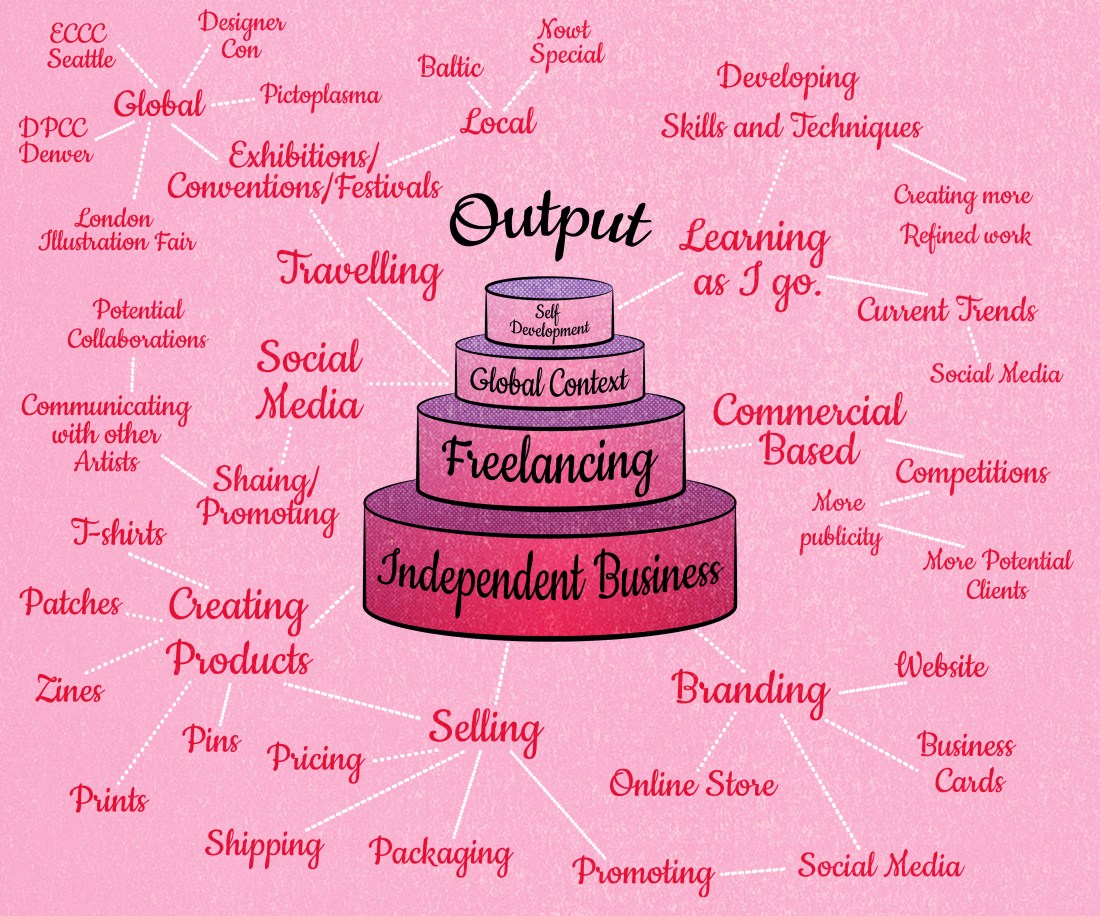
With the output, I have categorised things that are produced from my work, and have separated them into layers of cake, the bottom is my small business that I wish to expand on, which includes all of the elements that would go into that, such as branding, selling, packaging, promoting myself, and actually creating the product I would sell. The next is based on freelancing, which I would associate more as a commercial side of my work, as I would be working more one to one with a client/brief. The third layer is based on a global context, i.e. where I could potentially show/sell my work, but it would also mean connecting more with other artists and businesses on more of a global scale. This could be done either through social media or travelling around the world to events like pictoplasma, or even going to conventions like Designer Con, which a few of the artists I follow attended last year.  The final layer is Self Development, as I do always try to improve on my work with every piece, whether its trying new techniques, playing around with colour pallets, or experimenting with current trends. I have actually tried to do that with this diagram, as I believe the colour halftone effect is quite popular at this moment in time due to the release of ‘Spider-man: Into the Spider-Verse’, so have tried to incorporate the pattern within the shading.


Bibliography

Cat in the Hat. (2003). [film] Directed by B. Welch. Universal Pictures.


Learning Plan: Semester Two

Overall Objective:

Since the last learning plan I created back at the beginning of semester 1, I believe I did achieve some of my goals within that time and have made improvements within my work. My main goal with this year is still to keep on improving, but within semester one I was able to gain more confidence with traditional mediums and printing techniques, I did this through my inktober challenge and the Lion, the Witch and the Wardrobe project. I was also able to achieve my goal of creating more narrative based illustrations, as again, I had created chapter illustrations for the story of the Lion, the Witch and the Wardrobe, I made two book covers for the Penguin Student Design Awards, these were based on Wonder (the children’s book category) and Norwegian Wood (for the adults fiction category) and finally, I did make a set of 3 illustrations for House of Illustrations Book Illustration Competition, which were based on the book Howls Moving Castle, which I had also made a cover for.

In my previous learning plan, click here to read, I had mentioned that I would like to potentially create more editorial pieces, so as I could not do this during the first semester, I would like to try create something along those lines this time. I wouldn’t necessarily be illustrating an article, but I would like to create a piece with a deeper meaning, possibly more thought-provoking as this is not an area that I have really ventured in as of yet, but by doing so I may be able to show themes or communicate current topics that I feel strongly about through my work, potentially allowing the audience to get to know me better.

As I had worked on the Lion, the Witch and the Wardrobe project during semester one instead of the Wizard of Oz one as I had initially planned (I swapped the two around as I felt the LWW project would be better suited to the module as it was going to be more experimental testing out the multiple printing techniques) this semester I will be working on the Wizard of Oz series, and I still wish to work somewhat in the style of Tina Nass, who I had mentioned in a previous blog post which you can read here.  This means again I will be working with more traditional mediums, this time pencil, which hopefully I will gain more confidence with.

In my original proposal for the year, I had planned to work on branding throughout the year, and although I did redesign my business cards, created a depop and did sell two inktober zines along with a couple of prints, there is still a lot more that I want to create before finishing college later this year. This includes: creating a website, (including my portfolio and possibly a shop) creating more products, i.e. prints, t-shirts, pins, bags, stickers and so on. Then working on a promo pack which I can send to possible clients/agencies, I believe this will include a creative cv, business card, a print, stickers, a pin and then I want to create a sort of box that will contain all of these elements.

I did have a better experience with screenprinting so I believe this will be the main method used to create my products especially for the fabric based items like the t-shirts and tote bags, for the prints, however, I may use the risograph. In the past when I have created riso prints, I have really enjoyed how the textures and colours turned out, especially since I used a bright pink combined with a deep blue, so when making my prints I may stick with this form of output as when imagining all of my prints together (old and new) there will be a sense of uniform, right now I’m not sure if that is a good or bad thing though but I will give it more thought closer to the time.

Strengths and Weaknesses:

From the last module, my biggest issue was that my projects ended up overlapping one another, which ended up making me more confused and more stressed towards the end of semester two. I believe this was because I was reading the books one straight after the other, so when I should have been focusing on just one project I would be reading a book for another and feeling like I should be taking notes and creating work for that specific story. So this may not be as much of a problem within semester two if I am not working with as many books, but I will still try my best to remain organised and on top of things, and just focus on one project at a time.

I believe my strengths last semester were my book covers for the Penguin competition, I was able to create them within a short space of time and do feel they are of an industry standard. What I underestimated when starting and initially planning this year was the time frame of the projects. I had thought that since the personal projects were of my own doing that they could be done quicker, however, I had found that they were actually the lengthier projects. Since the commercial ones did have set deadlines I believe I had more incentive to finish them, but with the personal ones, as I did not have a set deadline for myself, I believe there was more time and room for doubt and I always felt I could add more or make changes and so on, but that took time and time which I did not have. Saying this, however, I believe the most improvements came from the personal projects as I did become more confident working traditional, specifically with ink, lining my designs with fine liners then bleeding the ink out with water as to create tone within my work. I also gained more experience and knowledge with certain printing methods, I learnt what worked well and what did not, i.e laser cutting plates as one had not worked as well as the other, as the ink had bled into the sections that were supposed to be left white. This project also renewed my faith in screenprinting, you can read about it here, so it does encourage me to use it more as an output method in the future.


Professional Development Plan:

Within the next few months, I do want to create more commercial work, exploring more areas of illustration such as editorial, so that I can expand my portfolio and potentially gain experience from doing so. I will attempt to do this through competitions and live briefs, the only one I am currently aware of and interested in is the Cheltenham Illustration Awards, which I have created work for in the past, but I hope to find more competitions as the module goes on, as some may not have been announced yet and may come out later in the year. If this is the case then I may have to make quick turnarounds so that the potential addition of another project won’t clash with the ones I already have set in place.

As of my personal projects, my goal is to create a series of illustrations based on the story of The Wonderful Wizard of Oz, so with this project I will gain more experience showing narrative within my work, (in a different sense to how I worked in the previous module, for instance, I want to show the characters continuously from one piece to another, whereas in the previous projects I just drew backgrounds, items or a created a slight suggestion of a character) but in this project I also want to try working more traditionally, using pencil to create the linework and textures within the piece, then I would scan each of the illustrations to colour them digitally, adding the vibrant colour palette that the story already suggests, for instance, the yellow brick road, the emerald city and so on. (I would have also mentioned the ruby red slippers, however, in the book the shoes are actually silver).

When focusing on my branding, I’m sure I will gain a lot of knowledge from that experience as well, as I have never made a website before, I’ve never created pins, screen-printed designs onto clothing and so on. I feel I will also learn more about myself, as to create your own branding I feel you do have to do a lot of self-reflection, thinking about your style of work, what imagery you feel would best suit you, how best to sell yourself and your work through elements such as business cards, websites or creative cv’s. Then there is more thought about promo pack’s, who would you be sending them off to? Agencies, potential clients? You have to consider who you feel your work is best suited to and who would most likely give you a job. All of this I believe will help more once I’ve left college, as I feel it will create a strong base in which I can establish myself as a freelance illustrator, applying to agencies, gaining work, but also selling work like prints, pins or t-shirts etc, on the side as I will hopefully have more knowledge of how to make/where I am able to get these products after this project, for instance, if I am to order pins or any product for that matter, from online, if I have a bad experience I will know not to use a company again, but if it is a good experience I will have a reliable source to create more products with.

Research:

In terms of research, I don’t believe there will be as much as I had in the previous module. With my Wizard of Oz project, I do intend to read the book and take quotes directly from it, so that I can illustrate the specific scenes as accurate as possible. I also intend to research artists, looking more into their process, how they may create their work, and I will try to take in that knowledge and apply it to my own work in my own style.

For the more unknown projects, I believe I will mostly be forming research from social media, for instance, Pinterest or Instagram, finding artists, illustration styles, colour palettes, or images to inspire my own work. When doing this, I do try to go in more depth, researching the artists and their processes, inspiration or thought process behind the piece more. If I do work with stronger themes (as I intend to) I will be doing more research into that theme as well, because although I may feel strongly about it, I would want to know all the facts and information first before creating the piece, so that I could best communicate the issue and strongly stand behind it if someone were to question it or if they wanted to know more information.  This information could potentially be sourced from websites, articles, blogs, interviews and so on.

Anticipated Challenges:

Time again may be a big challenge, but I believe with this module I am going to work more loosely with my timetable. In the last module, my projects did overlap too much which did get me confused and did cause more stress as I ended up trying to work on multiple projects at once. Although this was a bad experience, I do believe I learnt from it, as I feel I now have a better idea of how long my commercial projects may last in comparison to my personal projects, as I was able to produce commercial work a lot quicker as I felt I was more critical of my personal work and since I didn’t have as short of a deadline, I was allowed to be more critical, but that allowed me to take more time on the project, time which I did not necessarily have. SO, with this next module, my projects will not overlap with one another and I will only be focusing on one at a time. When I say that I am going to be working more loosely with the timetable, however, I mean that  I’m going to try making a loose plan of what I believe the dates will be, for instance, what time competitions will be released, how long I will be giving myself on certain projects, but as this module is more unknown, these deadlines will not be set in stone, and if the competitions are announced earlier or later than expected, it will be alright as I can swap around some of my personal projects times. This may seem like a recipe for disaster but it does make sense in my head. My main goal for the next couple of months is to just solely work on one project at a time, without any overlapping, and if I can do that I will be happy.

Another possible challenge will be with access to resources, especially when it comes to the last couple of months as a lot of the courses within the college will be trying to print or produce products for their own deadlines. This may make it harder to use the print room, the workshop, or the printers within CAAD. So as an attempt to battle this, I will try to produce everything earlier, at least within time for my own deadline. This means printing for my portfolio, producing merch: if I use screenprinting for t-shirts or tote bags, if I create another laser cut plate for prints, if I need to use the risograph. The closer it gets to the deadline I feel it will be harder to use these resources so I will try to plan in advance.


All images used are my own unless stated otherwise.


Learning Plan: Semester One

Overall Objective:

This year, it being my last in college, I want to make the most of it to improve my work. I will do this by trying new mediums and techniques, more so in the realm of traditional work as in the previous years I have mostly worked digitally. I also want to explore more areas of illustration, especially in the areas which my portfolio may be lacking, so I want to create more narrative based work, i.e book illustrations or covers, and I would like to create more editorial-based pieces, illustrations based on articles, current topics I feel strongly about, etc. Although I do enjoy creating pretty pieces with next to no context behind them, I do want to start creating more work that does contain stronger messages or can depict a story through them. I don’t feel I have done this a lot in my previous work, so would like to try to do so in my final year.

Strengths and Weaknesses:

I feel my current strengths are in digital work, but I have started trying to incorporate more traditional mediums, mostly within the linework. At the end of last year, I was using a Tombow calligraphy pen for my linework then colouring the pieces digitally, and during summer I wanted to be more experimental and had digitally coloured more sketch-based characters, either created with a pencil or a ball-point pen.

hanuka_style_flowers_FM_cv_wShadow_WHITE_strap_030217.jpg
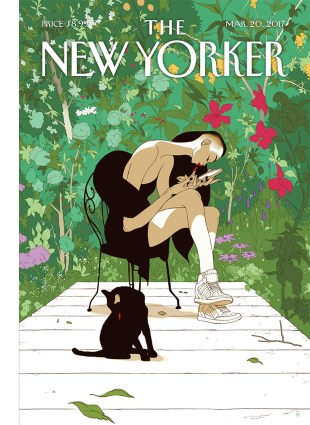
T. Hanuka, Spring Awakening (2017)

Another strength I believe is my colour palettes. I feel I have a good idea of colour theory, so I don’t tend to struggle when choosing a colour palette, but if I do, when working digitally I just have a play around with hue and saturation option in photoshop, until I reach a tone that I feel fits well with the others and allow the piece to be visually appealing to the eye.  My palettes are usually inspired by the themes and/or content of the pieces I create, but I do also find inspiration from other artists, for instance, Tomer Hanuka has influenced a lot of my previous work as I love his work with colour. In his work, he uses quite a monochromatic palette, but then uses a complementary colour which helps offset the piece, and is very attractive to the eye. I have found a lot of inspiration from his work in the past and I feel I have learnt while doing so, so I have been able to form my own palettes from the knowledge of his, knowing which colours work well, what themes they may suggest, what other colours can I add to make the piece more intriguing or which I can add to make my work more easy on the eyes.

I believe my most common weakness is with traditional mediums. Before starting the course I did work more traditionally, using fine liners, markers, paints, pencils etc, but I feel as I have learnt more digital skills and my work has become more refined and of a higher standard over the years, I have lost more confidence with these mediums as the marks they make are a lot more set in stone than working digitally is, for instance, if you make a mistake digitally, you can just edit and undo it, but if you make a mistake with a traditional medium it is a lot harder to erase (unless you’re working with pencil).

I also had less confidence with traditional mediums when it came to linework as I felt my hand/line control would be a lot more wobbly than I intended, not creating as smooth of a line as I could in a program like Illustrator. I have however been trying to improve on my confidence with these issues, for instance in my last few projects last year, I had created the linework by hand, and although some of my lines were more wobbly than I would have liked, I would enjoy the overall piece as I felt they would be less static than my linework from illustrator was. Since not every line was smooth and perfect, I feel it added a more personal touch to my work and I would like to carry on creating my linework by hand, possibly using more mediums than fine liners or my Tombow pen in the future.

Like I had mentioned, I did try experimenting with sketch-based work in the holidays, so ideally I would like to try find a way to use these mediums and techniques but in a more refined way, so that my work would be of an industry standard and quality and would not look as ‘sketchy’.


Professional Development Plan:

As this first module is based around development, I would like to use it as a way to experiment and expand my knowledge. Ideally, I would like to take part in inktober, creating an inked illustration per day every day for the month of October, I believe it would help in improving my confidence with a traditional medium, specifically with my line control, but as I rarely work with ink, it would allow me to experiment with it, learning what marks I can make, if I can create gradients, etc, I’d be gaining more knowledge of the medium from my experience with it and potentially taking that information further into my future work.

Staying along the lines of traditional methods, I would also like to experiment more with printing methods, for instance, screenprinting, etching, linocut printing, printing with a laser cut plate, etc. With this, I would be gaining more knowledge in the form of output, how I could potentially create prints in the future, rather than just using a normal printer. I could potentially still work digitally with some of these methods, but if I were to output my illustrations through an alternative method to a normal printer, for instance using screenprint, it would add more of a personal touch to a possible product, being that I would have created it myself by hand and would have put more thought into how the design would work when printed, i.e with colours, specific layers, how they would be arranged and so on. In the past, I have not had great experiences with screenprinting, however, I know it is a common method used by other artists to create their own products i.e. prints, t-shirts, tote bags etc. so I do want to give it another try, to see if I just had a bad experience the first time, whether it was the design I was using, the method, if I was doing something wrong or whether screenprinting is just not for me?

As I mentioned before, I do want to create more narrative-based work, whether this is book illustrations, covers, or pieces with more backstory. Over the holidays we were asked to think about personal projects we’d like to do and I thought of making illustrations for the Wonderful Wizard of Oz and the Lion, the Witch and the Wardrobe. Both of these stories already have well-known imagery behind them, but I feel the imagery has mostly come from the movies as opposed to the books, so I want to read both of these books, see for myself if there are any differences from book to film, as is very common with movie adaptations, but I want to illustrate as true to the book’s descriptions as possible so that I may potentially give a fresh perspective to the stories, renewing them in my own style.

Looking into competitions for the more commercial side of this module, the ones coming soonest and the ones I feel most interested in are the more narrative-based ones. I have been looking into the Penguin Student Design Awards and House of Illustration – Book Illustration Competition. In both, I would be designing book covers, but for the House of Illustration one, I would also be creating a set of illustrations of the book they choose. In the Penguin Competition, you do get a choice in categories of stories, either adult’s fiction, adults non-fiction and children’s books.

So if I were to participate in both of these competitions, as well as my ideas for personal projects, I would be creating a lot of narrative-based work, but I would have to consider which routes to take, as I would not want my projects to clash or potentially come across as too similar, I do want to create a range of work for a range of different clients and audiences throughout this year.

As I assume my work is going to be based around existing stories, I believe my research will mostly be coming directly from the books, using quotes, finding characters, backgrounds and element descriptions straight from the sources so that I can create illustrations as accurate to the original stories as possible. I feel by not working from the imagery I already know that it will set me apart from other illustrations that may exist, especially if it is in context of a competition as other artists may rely too much on the imagery that is already known as opposed to reading the book themselves, especially if there is a time constraint.

As of other research, I mostly find style, artists or concept inspiration from social media, scrolling through the many artists I follow on Instagram or finding work/images on Pinterest, normally suggested to me by images I may have already pinned, or from a direct search of a theme.  It may be due to being a Gen-Z…

(TANGENT – I like term post-millennial better for myself as although I missed the millennial status by 2 years, I do feel closer to those than the extremes of Gen-Z. I did probably grow up with more access to technology than the previous generation, but I believe I still had a ‘normal’ childhood without needing to have a phone in my hand, actually playing outside with my friends on a day to day basis. I hate when I see toddler nowadays with a tablet in their hands. I’m hoping that when my generation becomes parents, they will recognise this as a problem and will try to raise their children as they were. This in no way was supposed to be read as a hate to Gen-Z, I actually watched a video comparing millennials against Gen-Z’s and they did come out the more positive minded generation,  I just don’t like the thought of being judged for having resources available to me now that older generations have not, but having that supposedly affect me in a negative way. All generations will have had factors that could have affected them, whether it has been war, politics, economy, but no one would want it to be held against them and told: “your generation is like … because of …” but the news especially loves to blame millennials and probably Gen-Z next for any changes going on, but they say it in such a negative light. I could make a whole seprate blog post about my views on this topic, but would you want to read that? Feel free to leave a comment if so! BACK TO THE TOPIC)

…but I love finding inspiration online, when I find new artwork on Pinterest, I love seeing the suggested images afterwards then falling down a rabbit hole of going from one piece to the next and to the next, by doing this I have formed a lot of ‘boards’ two of which I add to and use for inspiration the most you can go check them out here, one is of people, of all different ages, genders, nationalities and so on, and the other is of illustrations, these are pieces that I will have found over the past few years, which I enjoy for some reason or another, but I feel I can come back to at some point to use as inspiration. It’s actually funny when I don’t know what to create and I haven’t looked at the board for a while, as I do forget what is in there and I always refind something that I saved once upon a time which inspires a new concept, colour palette or style I want to use, and it does encourage me to create new work.


Anticipated Challenges:

Time management will always be a hidden challenge, especially with this year if I am estimating the dates of the competitions (when they start and their deadlines). As a module, I do need to plan out my semesters setting out my projects over the given timeframe so I will do my best to stick to the timetables I give myself. As to hopefully not have any issues with time, I do want to keep a planner with me at all times, keeping track of what I’m doing, what I still need to do, when does that task need to be achieved by and so on. I feel this will keep me more organised, keeping me on track of what needs to be done and when, and hopefully the organisation will encourage more workflow. In the past when I have not kept myself organised, I have battled with motivation, lost myself to procrastination and so on, but this year, my final one, I do want the best results for myself and I know I need to put in all the time, effort and motivation get myself those results. So I am determined to keep myself on track, and if I can achieve my goals with the least amount of stress, then that will be perfect.

If I am to work with multiple printing methods, another challenge could possibly be trying to book space within the printing room or the workshop. Since I am within a college with lots of other course and lots of other students, there may be times in which the print room or workshop will be full or the queue for the laser cutter will be too long, so to combat these potential problems, I will try to book a time in the print room if needed earlier on rather than later, as well as creating a plate on the laser cutter sooner rather than later. This will just ensure that I do not run out of time, I do not clash with any other classes and will have my prints created in time for the deadline.


List of Illustrations

Hanuka, T. (2017) Spring Awakening, The New Yorker. [Online] Available from: http://thanuka.com/#/spring/ [Accessed on 17 Sep. 2018]

All other pieces are my own unless stated otherwise.

Reading List

Dimock, M. (2019). Defining generations: Where Millennials end and Generation Z begins. [online] Pew Research Center. Available at: https://www.pewresearch.org/fact-tank/2019/01/17/where-millennials-end-and-generation-z-begins/ [Accessed 27 Apr. 2019].

The Infographics Show. (2019). Millennials vs Generation Z – How Do They Compare & What’s the Difference?. YouTube. [online] Available at: https://www.youtube.com/watch?v=aqdm6aBUZII [Accessed 27 Apr. 2019].